

Tension builds in Gaza after Israeli airstrikes kill commander

1 / 2
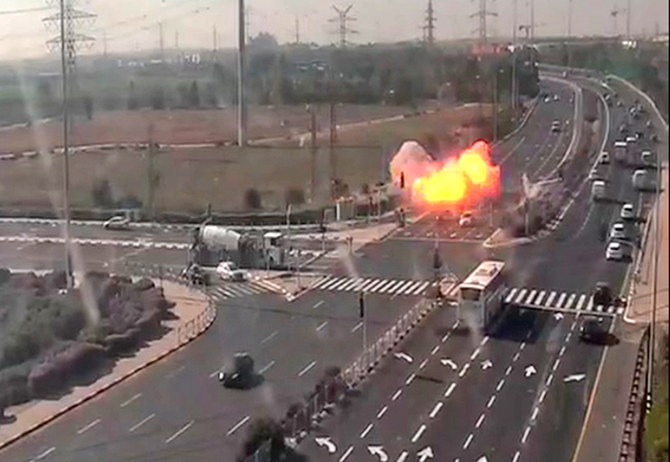
An image grab from footage taken from a CCTV camera shows the moment when a rocket fired from the Gaza Strip hit a highway narrowly missing several speeding vehicles near Israel's Gan Yavne. (AFP)
2 / 2
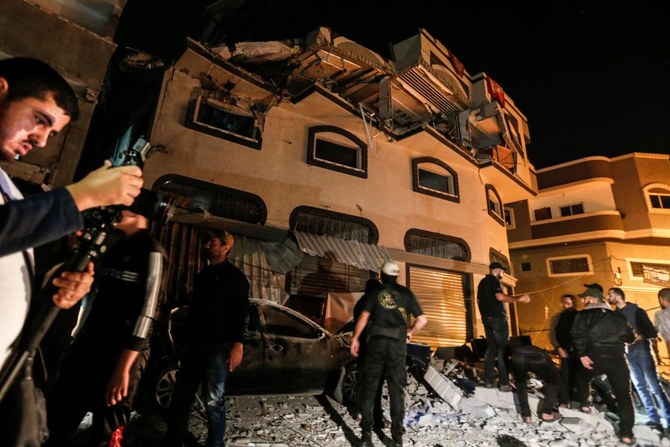
Residents inspect the damaged house of Islamic Jihad leader Baha Abu Al-Ata after an Israeli attack in Gaza city on Tuesday, November 12, 2019. (AFP)
Updated 12 November 2019
Follow

Tension builds in Gaza after Israeli airstrikes kill commander

  • Israeli airstrike kills Bahaa Abu Al-Atta, his wife and wounds two of his sons
  • Al-Quds brigades responded by firing rockets towards Israeli towns, some threatening the city of Tel Aviv

GAZA CITY: Israel killed a senior commander of Islamic Jihad’s armed wing, Bahaa Abu Al-Atta, in an airstrike on his home on Tuesday, also killing his wife and wounding two of his sons.

Al-Quds brigades responded by firing rockets towards Israeli towns, some threatening the city of Tel Aviv.

Israeli warplanes also bombed a number of Islamic Jihad military sites, killing at least two and wounding 16 others.

Islamic Jihad, in a press statement, threatened revenge for the assassination, saying that Israel would not go unpunished.

“We affirm that the response to this crime will have no limits and will be the size of the crime committed by the enemy and that the occupation will bear the consequences of this aggression.”

Islamic Jihad said Al-Atta was the commander of the northern Al-Quds brigade and a member of its military council, which Israel accuses of being behind rocket fire from the Gaza Strip into Israel in recent months.

Hamas issued a press statement condemning the Israeli attack and threatening it would not allow Israel to “change the rules.”

The statement said: “This aggression will backfire in the face of Israeli occupation and its criminal leaders. Israel started this attack and thus will pay a price for it.”

Hamas accused the Israeli prime minister, Benjamin Netanyahu, of trying to escape an internal political crisis by escalating the situation in Gaza.

“Palestinian blood is a red line, so we will not let the Israeli occupation shed it or turn Gaza into an arena to export its internal crises,” the statement continued.

Israel closed the Erez crossing in northern Gaza, as well as the commercial crossing of Karam Abu Salem in the southern Gaza Strip until further notice, and reduced the area of fishing in the sea to 6 miles after previously expanding it to 15 miles.

A military escalation between Israel and Gaza could evolve into a fourth war, but assuming it may happen would be premature, and would depend on Hamas’s response to the assassination of Al-Atta.

Hamas has more political clout than Islamic Jihad as it is responsible for governing the Gaza Strip and providing services. At the same time, it does not want to help Netanyahu.

Mokhaimer Abu Seada, a professor of political science at Al-Azhar University, said: “Hamas does not seem to be interested in reaching an open confrontation with Israel at this stage due to the difficult humanitarian situation in the Gaza Strip and the political crisis in Israel.”

Although the assassination of Al-Atta is the first of a military leader since the 2014 war, Hamas does not see conditions could lead to further attempts on senior Palestinian figures.

Ibrahim Al-Madhoun, a columnist for the Hamas-affiliated Al-Risala newspaper, said: “I believe Hamas will try to avoid war and only respond to Islamic Jihad to rein in the occupation.

“Hamas realizes that Netanyahu wants to escape his internal predicament and … drag the region to a violent military confrontation.”

But the question remains whether Hamas will be able to control Islamic Jihad. That will depend on “the ability of Egyptian mediators to put pressure on the leadership of Islamic Jihad in Gaza and help Hamas,” said Abu Saeda.

Trump warns Iran of ‘very traumatic’ outcome if no nuclear deal

Updated 12 February 2026
Follow

Trump warns Iran of ‘very traumatic’ outcome if no nuclear deal

  • Speaking a day after he hosted Netanyahu at the White House, Trump said he hoped for a result “over the next month”

WASHINGTON: US President Donald Trump threatened Iran Thursday with “very traumatic” consequences if it fails to make a nuclear deal — but Israeli Prime Minister Benjamin Netanyahu said he was skeptical about the quality of any such agreement.
Speaking a day after he hosted Netanyahu at the White House, Trump said he hoped for a result “over the next month” from Washington’s negotiations with Tehran over its nuclear program.
“We have to make a deal, otherwise it’s going to be very traumatic, very traumatic. I don’t want that to happen, but we have to make a deal,” Trump told reporters.
“This will be very traumatic for Iran if they don’t make a deal.”
Trump — who is considering sending a second aircraft carrier to the Middle East to pressure Iran — recalled the US military strikes he ordered on Tehran’s nuclear facilities during Israel’s 12-day war with Iran in July last year.
“We’ll see if we can get a deal with them, and if we can’t, we’ll have to go to phase two. Phase two will be very tough for them,” Trump said.
Netanyahu had traveled to Washington to push Trump to take a harder line in the Iran nuclear talks, particularly on including the Islamic Republic’s arsenal of ballistic missiles.
But the Israeli and US leaders apparently remained at odds, with Trump saying after their meeting at the White House on Wednesday that he had insisted the negotiations should continue.

- ‘General skepticism’ -

Netanyahu said in Washington on Thursday before departing for Israel that Trump believed he was laying the ground for a deal.
“He believes that the conditions he is creating, combined with the fact that they surely understand they made a mistake last time when they didn’t reach an agreement, may create the conditions for achieving a good deal,” Netanyahu said, according to a video statement from his office.
But the Israeli premier added: “I will not hide from you that I expressed general skepticism regarding the quality of any agreement with Iran.”
Any deal “must include the elements that are very important from our perspective,” Netanyahu continued, listing Iran’s ballistic missile program and its support for armed groups such as the Palestinian movement Hamas, Yemen’s Houthi rebels and Hezbollah in Lebanon.
“It’s not just the nuclear issue,” he said.
Despite their differences on Iran, Trump signaled his strong personal support for Netanyahu as he criticized Israeli President Isaac Herzog for rejecting his request to pardon the prime minister on corruption charges.
“You have a president that refuses to give him a pardon. I think that man should be ashamed of himself,” Trump said on Thursday.
Trump has repeatedly hinted at potential US military action against Iran following its deadly crackdown on protests last month, even as Washington and Tehran restarted talks last week with a meeting in Oman.
The last round of talks between the two foes was cut short by Israel’s war with Iran and the US strikes.
So far, Iran has rejected expanding the new talks beyond the issue of its nuclear program. Tehran denies seeking a nuclear weapon, and has said it will not give in to “excessive demands” on the subject.