TOKYO: Emperor Naruhito and Empress Masako waved and smiled from an open car in a motorcade marking his enthronement Sunday before hundreds of thousands of delighted well-wishers who cheered, waved small flags and took photos from both sides of packed sidewalks.
Security was extremely tight with police setting up 40 checkpoints leading to the area. Selfie sticks, bottles and banners — and even shouting — were not allowed inside the restricted zone. Residents in high-rise apartments along the road were advised not to look down from their windows or balconies.
Naruhito succeeded his father Akihito on May 1 following his abdication, and formally ascended the Chrysanthemum Throne in a palace ceremony last month.
The parade started from the Imperial Palace with the Kimigayo national anthem played by the marching band.
Naruhito, wearing a tail coat decorated with medals and carrying a brimmed hat, and Masako, in an off-white long dress and a tiara, kept waving from a Toyota Century convertible. The car was decorated with the chrysanthemum emblems and the emperor’s flag during the half-hour motorcade on the 4.6-kilometer route from the palace to the Akasaka imperial residence in the soft afternoon sun.
Naruhito, sitting on the right side on the slightly raised backseat, constantly turned his head to the right and left, responding to the people cheering from the opposite side of the street as the motorcade slowly moved at a jogger’s speed, led by a fleet of police motorbikes.
The parade was postponed from the original October date due to the recent typhoon that left more than 90 dead and tens of thousands of homes flooded or damaged.
Thousands of people had lined up at checkpoints hours before the parade, trying to secure their place to get the best possible view of the royal couple.
The parade was the first since Naruhito and Masako’s marriage in June 1993, just three years after their parents celebrated their enthronement in a Rolls Royce.
Naruhito and Masako have been warmly welcomed by the public. Many Japanese were especially impressed by the couple freely conversing with President Donald Trump and first lady Melania Trump during their visit weeks after Naruhito’s succession in May, according to palace watchers.
There are expectations that Naruhito, the first emperor with a college degree who also studied abroad, and his Harvard-educated wife Masako, will internationalize the imperial household.
Naruhito, who studied at Oxford, is a historian, a viola player and an expert on water transport. Masako, a former diplomat, has struggled for more than a decade and had largely withdrawn from public appearances until recently. She developed “adjustment disorder” after giving birth to the couple’s only child, Princess Aiko, and facing pressure to produce a boy in Japan’s monarchy, which allows only male heirs.
Despite concerns about her health and skepticism over her ability to fulfil even part of hugely popular former Empress Michiko’s work, Masako has been seen in good health and in smiles as she attended most of her duties recently.
Opinion polls show public support and a sense of friendliness to the royal family have increased over the past three decades, owing largely to Naruhito’s parents’ effort to bring what used to be the aloof palace closer to the people.


![]()

Emperor Naruhito greets public in Japan parade marking enthronement
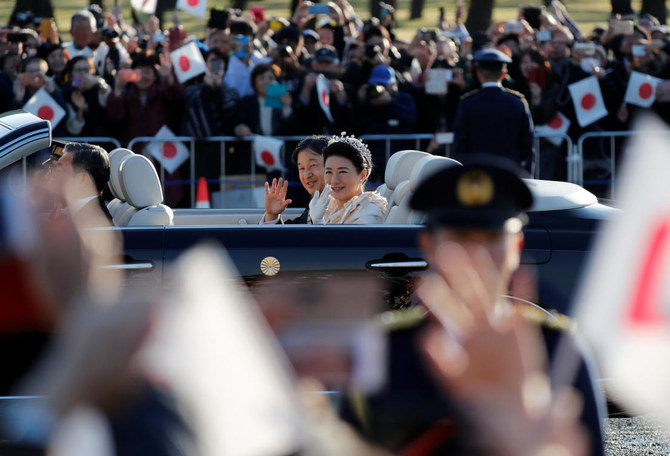
Emperor Naruhito greets public in Japan parade marking enthronement
- Security was extremely tight with police setting up 40 checkpoints leading to the area
- The parade was the first since Naruhito and Masako’s marriage in June 1993
Latest updates


Recommended


© 2026 SAUDI RESEARCH & PUBLISHING COMPANY, All Rights Reserved And subject to Terms of Use Agreement.