

Row between Turkey and Europe escalates over fate of European Daesh fighters

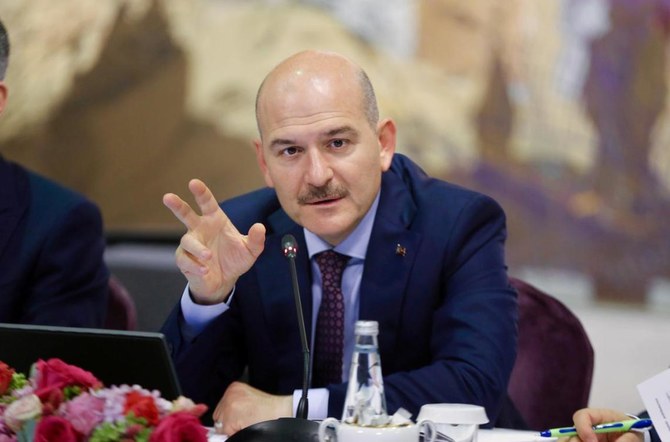
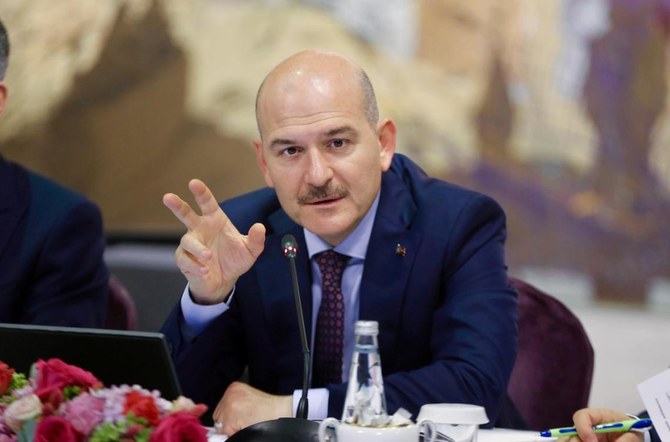
Turkish Interior Minister Suleyman Soylu said that Turkey would send captured Daesh members back to their home countries. (Reuters)
Updated 06 November 2019
Follow

Row between Turkey and Europe escalates over fate of European Daesh fighters

  • Turkey’s Interior Minister Suleyman Soylu: ‘Turkey is not a hotel for any Daesh terrorist’
  • After a series of terror attacks in Europe by Daesh members who returned home after being radicalized, European countries consider them ‘persona non grata’

ANKARA: Turkey has urged Europe to take back battle-hardened Daesh militants before it is too late.

Turkey’s Interior Minister Suleyman Soylu said on Saturday that Turkey would send captured Daesh members back to their home countries, and he complained about European inaction on the matter.

“Turkey is not a hotel for any Daesh terrorist,” he said.

Lorne L. Dawson, professor of religious studies at the University of Waterloo in Canada, said responsibility for the repatriation of foreign fighters lay with these nations, and it was the most humane way to address the plight of children of foreign fighters who should not suffer because of their parents’ actions.

“The hesitation to do so would appear to be primarily political, since the repatriation of foreign fighters will be criticized aggressively by more conservative elements in these countries,” Dawson told Arab News. He said that many domestic terrorists have been successfully reintegrated into their societies, but only after receiving sustained and appropriate counseling.

“In principle, then, the same should be true for many returning foreign fighters, and in fact there are many such returnees already present in most of the countries from which fighters left, and so far they have been linked to only a very few further terrorists acts,” he said.

Last Friday, Turkey detained two female Daesh terrorists and their children at the request of the Dutch Embassy in Ankara. One of the women was stripped of her Dutch citizenship over her membership of Daesh. Turkey will decide on the legislative steps to be taken against them, but the Netherlands wants them to stand trial in Syria or Turkey.

On Sunday, a senior Daesh official responsible for training camps was arrested in Turkey’s southern Osmaniye province.

The Brussels-based think-tank Egmont recently released a report showing that there are at least 430 Daesh prisoners in Syria with European nationality, along with some 700 children. France, Germany and Belgium have the highest numbers of foreign fighters who traveled to Syria to join Daesh.

However, after a series of terror attacks in Europe by Daesh members who returned home after being radicalized, European countries consider them “persona non grata” and insist on establishing an international court in Iraq for laying criminal charges.

About 800 Daesh members are claimed to have fled from the prisons they were kept in Syria in recent weeks. In late October, the deportation process to Turkey began of dozens of Daesh terror suspects with their family members, all Turkish nationals.

Nihat Ali Ozcan, a retired major now serving as a security analyst at Ankara-based think-tank TEPAV, said that international law requires that Turkey deports Daesh fighters who are captured within Turkish territories, but the problem begins when they are captured within Syria in zones that are outside of the Assad regime’s control.

“Some countries want them to stay there, and for instance the Netherlands began the process of stripping Daesh members with dual citizenship of their Dutch nationality to render them stateless,” he told Arab News.

But Ankara criticizes Western countries for resisting repatriation by revoking their citizenship: “It is not acceptable for us (to hear) ‘I stripped them of the citizenship, you take care of it.’ This is also irresponsibility,” Soylu said on Saturday.

Turkey sends foreign fighters caught in Syria to prisons located in the area of Turkey’s Operation Euphrates Shield and they are then sent back to their countries of origin.

“However, it is usually difficult to prove in a trial that they committed any crimes because convictions are usually based solely on a confession and no other supporting evidence,” Ozcan said.

The average sentence for returned fighters, in Turkey or in Western countries, has been five years’ imprisonment, resulting in security threats from those who cannot be efficiently rehabilitated.

Imprisonment has its own complications. Prison can become “an incubator of radicalization” in the words of the EU’s counterterrorism coordinator, Gilles de Kerchove, and imprisoned foreign fighters can also inspire their inmates.

For Dawson, the kind of programming required to rehabilitate many of the fighters is in place in many nations, especially in the West, and it merely needs to be repurposed from preventing violent radicalization to promoting the disengagement of foreign fighters.

Meanwhile, Turkey on Monday evening captured the 65-year-old sister of slain Daesh leader Abu Bakr Al-Baghdadi in northwestern Syria, where she was living with her family near the town of Azaz in Aleppo province. The area is part of the region administered by Turkey.


Pakistani fighter jet crashes in Jalalabad, pilot captured: Afghan military, police

Updated 42 min 34 sec ago
Follow

Pakistani fighter jet crashes in Jalalabad, pilot captured: Afghan military, police

  • Fighting between Pakistan and Afghanistan’s Taliban military entered its third day on Saturday
  • Pakistan’s strikes on Friday hit Taliban military installations and posts, including in Kabul and Kandahar

JALALABAD: A Pakistani jet has crashed in Jalalabad city and the pilot captured alive, the Afghan military and police said Saturday, with residents telling AFP the man parachuted from the plane before being detained.
"A Pakistani fighter jet was shot down in the sixth district of Jalalabad city, and its pilot was captured alive," police spokesman Tayeb Hammad said.
Wahidullah Mohammadi, spokesman for the military in eastern Afghanistan, confirmed the Pakistani jet was downed by Afghan forces "and the pilot was captured alive".

The AFP journalist heard a jet overhead before blasts from the direction of the airport in Jalalabad, the capital of Nangarhar province, which sits on the road between Kabul and the Pakistani border.

Fighting between Pakistan and Afghanistan’s Taliban military entered its third day on Saturday, following overnight clashes as the international community expressed increasing concern about the conflict and called for urgent talks.

Pakistan’s strikes on Friday hit Taliban military installations and posts, including in Kabul and Kandahar, in one of the deepest Pakistani incursions into its western neighbor in years, officials said.

Islamabad accuses the Taliban of harboring Tehreek-e-Taliban Pakistan (TTP) militants, who it claims are waging an insurgency inside Pakistan, a charge the Taliban denies.

Pakistan described its actions as a response to cross-border assaults, while Kabul denounced them as a breach of its sovereignty, saying it remained open to dialogue but warned any wider conflict would result in serious consequences.

The fighting has raised ‌the risk ‌of a protracted conflict along the rugged 2,600-kilometer frontier.

Diplomatic efforts gathered ‌pace ⁠late on Friday ⁠as Afghanistan said its foreign minister, Amir Khan Muttaqi, spoke by telephone with Saudi Arabia’s Prince Faisal bin Farhan about reducing tensions and keeping diplomatic channels open.

The European Union called for both sides to de-escalate and engage in dialogue, while the United Nations urged an immediate end to hostilities.

Russia urged both sides to halt the clashes and return to talks, while China said it was deeply concerned and ready to help ease tensions.

The United States supports Pakistan’s right to defend itself against attacks by ⁠the Taliban, a State Department spokesperson said.

Border fighting continues

Exchanges of fire continued along ‌the border overnight.

Pakistani security sources said an operation dubbed “Ghazab Lil Haq” was ongoing and that Pakistani forces had destroyed multiple Taliban posts and camps in several sectors. Reuters could not independently verify the claims.

Both sides have reported heavy losses with conflicting tolls that Reuters could not verify. Pakistan said 12 of its ‌soldiers and 274 Taliban were killed while the Taliban said 13 of its fighters and 55 Pakistani soldiers died.

Taliban deputy spokesman Hamdullah Fitrat ⁠said 19 civilians were ⁠killed and 26 wounded in Khost and Paktika. Reuters could not verify the claim.

Pakistan’s Defense Minister Khawaja Muhammad Asif said “our cup of patience has overflowed” and described the fighting as “open war,” warning that Pakistan would respond to further attacks.

Taliban Interior Minister Sirajuddin Haqqani said in a speech in Khost province that the conflict “will be very costly,” and that Afghan forces had not deployed broadly beyond those already engaged.

He said the Taliban had defeated “the world, not through technology, but through unity and solidarity,” and through “great patience and perseverance,” rather than superior military power.

Pakistan’s military capabilities far exceed those of Afghanistan, with a standing army of hundreds of thousands and a modern air force.

In stark contrast, the Taliban lacks a conventional air force and relies largely on light weaponry and ground forces.

However, the Islamist group is battle-hardened after two decades of insurgency against US-led forces before returning to power in 2021.