Turkey detains 43 suspected Daesh members, foils plot: police

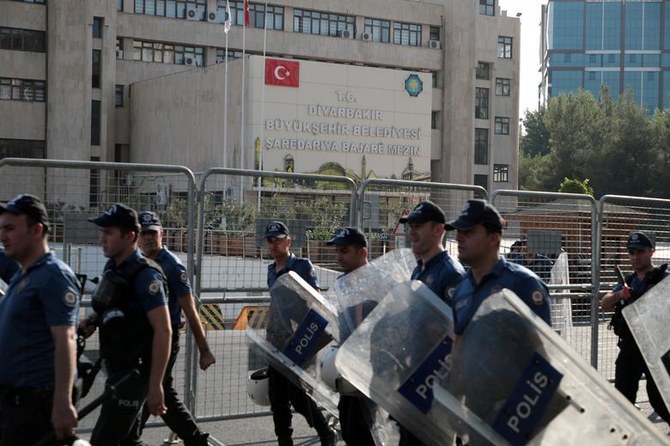
Turkish police walk in front of the Metropolitan Municipality headquarters in Diyarbakir, Turkey, August 19, 2019. (Reuters)
Updated 29 October 2019
Follow

Turkey detains 43 suspected Daesh members, foils plot: police

  • The suspects were detained in Istanbul and the northwestern province of Bursa in three separate operations

ISTANBUL: Turkish authorities have detained 43 people suspected of belonging to Daesh and of plotting attacks targeting celebrations of Turkey’s national day on Tuesday, police and state media said.
The detentions came two days after US President Donald Trump announced that Daesh leader Abu Bakr Al-Baghdadi had been killed in a raid by US special forces in northwest Syria, near the Turkish border.
The suspects were detained in Istanbul and the northwestern province of Bursa in three separate operations, according to a police statement and the state-run Anadolu news agency.
Three of the suspects who were believed to have been preparing an attack to disrupt Republic Day celebrations in Istanbul, were detained on Tuesday, Anadolu said.
It said anti-terror and intelligence units established that the suspects had been in contact with people who would provide logistic support for the attack.
Anadolu said another 26 suspected Daesh members were detained in Bursa on Tuesday. It said 12 of them were Syrian nationals and that proceedings were underway to deport them. The other 14 suspects were sent to the police, it added.
Turkish police later said a further 14 suspected extremists, three of them Turkish nationals, were detained in Istanbul. It said the suspects were planning to attack the celebrations in Istanbul following Al-Baghdadi’s death, but did not elaborate.
Turkey has said it shared information with the United States, its NATO ally, ahead of Sunday’s raid in northern Syria and that it is proud to have helped bring “a notorious terrorist to justice.”
On Tuesday Turks were marking the 96th anniversary of the founding of the secular Turkish republic on the ashes of the Ottoman Empire.
Trump said on Tuesday the US military had also killed the person who would likely have succeeded Al-Baghdadi as the leader of Daesh, without identifying him.
Daesh has carried out atrocities against religious minorities and attacks on five continents in the name of an ultra-fanatic version of Islam that has horrified mainstream Muslims.
The death of Baghdadi is a severe blow to the group, which has been in disarray and has no declared successor as leader yet. But it has in the past proved resilient, continuing to mount or inspire attacks in the region and beyond despite losing most of its territory in recent years.


Bangladesh to fund Rohingya education for first time as foreign donors pull back

Updated 5 sec ago
Follow

Bangladesh to fund Rohingya education for first time as foreign donors pull back

  • Funding shortfalls forced UNICEF to close thousands of schools in Rohingya refugee camps
  • Rohingya are excluded from public schools in Bangladesh to prevent long-term integration

DHAKA: The Bangladeshi government will fund the primary education of Rohingya children living in refugee camps following the closure of thousands of UN-supported facilities due to budget shortages, authorities said on Wednesday.

Hundreds of thousands of Rohingya were forced to flee a military crackdown in Myanmar and take shelter in neighboring Bangladesh in 2017. Today, more than 1 million of them are cramped inside 33 camps in Cox’s Bazar district on the country’s southeast coast. About half are children.

The Bangladeshi government does not allow Rohingya children to enroll in regular public schools outside the camps under its longstanding policy to prevent long‑term integration. Since the beginning of the crisis, Bangladesh, which is not a signatory to the UN refugee convention, has made it clear that the Rohingya settlement is temporary.

Education has largely been organized by NGOs and UN agencies, providing basic literacy without recognized certificates. But many of these schools were forced to close last year, as foreign aid plunged — especially after the US, which contributed 55 percent of it, suspended most of its humanitarian operations.

To prevent the collapse of educational facilities, the Bangladeshi government on Tuesday for the first time approved state funding to keep them operational, with more than $16 million designated for primary education for Rohingya children under a World Bank grant.

“This World Bank funding will be used by UNICEF to operate learning centers in the Rohingya camps. As UNICEF is currently facing a severe funding shortage, the Bangladesh government has stepped in to provide support, with assistance from World Bank loans,” Mizanur Rahman, refugee relief and repatriation commissioner in Cox’s Bazar, told Arab News.

“Due to the funding crisis, most learning centers in the camps have suspended operations. With this new funding, many of these centers will be able to resume activities. There are around 8,000 learning centers in the camps, of which only about 4,000 are currently operating, while the other half remain closed.”

There are more than 400,000 school-age Rohingya children in the Bangladesh refugee camps. The Bangladeshi government’s support will reach 200,000 of them, with the teaching program based on the national curriculum of their home country, Myanmar.

About 1,100 teachers will be employed and trained to work with the children, Rahman said.

“The government has approved the funding primarily for one year, but the program will continue until 2027. Revised negotiations may take place later to consider a further extension.”