

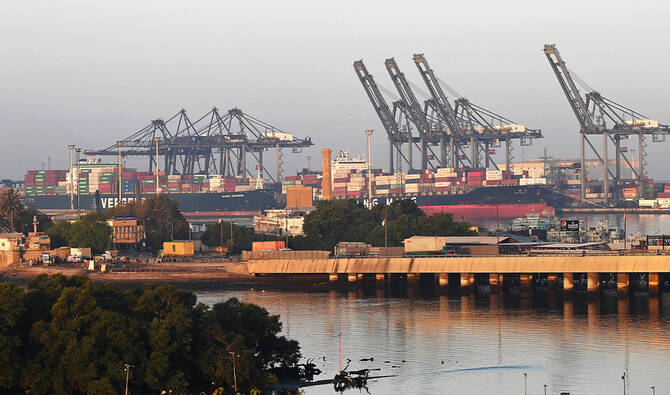

KARACHI: Pakistan’s Maritime Affairs Minister Junaid Anwar Chaudhry on Sunday announced storage charge waivers ranging from 25 to 50 percent at the Karachi Port Trust (KPT) terminals to facilitate exporters hit by recent disruptions in Gulf-bound shipments due to the Iran war.
The Iran war has disrupted global shipping lines, causing shipping delays and in turn, logistical and cost-related problems for exporters worldwide, including those in Pakistan.
In a statement released by Pakistan’s Maritime Affairs Ministry, Chaudhry said these waivers cover export containers stranded at terminal yards that could not be loaded due to operational issues.
“The waivers aim to reduce financial pressure on importers and exporters, clear pending consignments, and boost cargo clearance efficiency,” the minister was quoted as saying.
The ministry said that following discussions with terminal operators, KPT Chairman Rear Admiral (retd.) Shahid Ahmed secured waivers of 50 percent at the Karachi Gateway Terminal Limited (KGTL) from March 1 to 20, 2026; 50 percent at the Karachi International Container Terminal (KICT) from March 1 to 10, 2026; and 25 percent at South Asia Pakistan Terminals (SAPT) from March 11 to 31, 2026.
Chaudhry noted that the move would support the export sector, ensure trade continuity and ease logistical bottlenecks.
“Maritime institutions are being encouraged to adopt a more facilitative and trade-friendly approach so that operational delays do not translate into avoidable costs for stakeholders,” he said.
The minister stressed improved coordination among ports and terminals for smoother logistics and better service delivery.
He said the relief measures were part of a broader strategy to make the maritime sector more responsive, competitive, and aligned with national trade priorities.
Pakistan has sought to leverage the Iran war and its related marine disruptions to its advantage by aiming to position itself as a transshipment hub.
The country has witnessed increased port activity and operations since the war in Iran began in February, hoping to enhance its exports and build investor confidence in its maritime abilities.


