Moody’s moves South Africa one step closer to ‘junk’ status

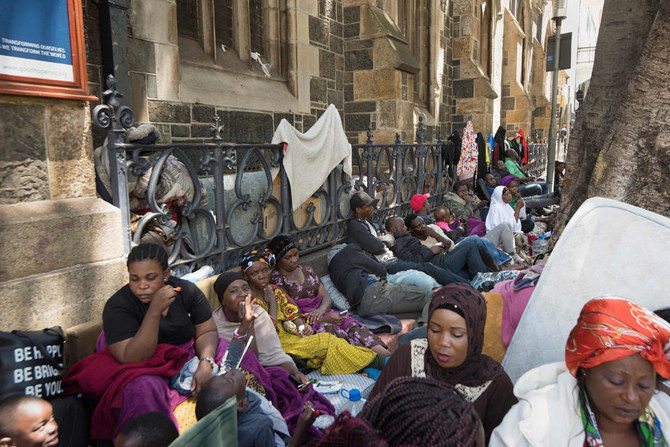
Hundreds of people originally from various countries are seen outside the Methodist Church where they have taken refuge after being chased away from a corridor close to the offices of the United Nations High Commission for Refugees(UNHCR) in Cape Town, on October 31, 2019. They are asking the UNHCR to intervene on their behalf. They say they don't feel safe in South Africa anymore due to high levels of crime as well as xenophobia. (AFP / RODGER BOSCH)
Updated 02 November 2019
Follow

Moody’s moves South Africa one step closer to ‘junk’ status

JOHANNESBURG: Ratings agency Moody’s moved South Africa one step closer to “junk” status on Friday by revising the outlook on the country’s last investment-grade credit rating to “negative” because of a slowdown in economic growth and rising debt burden.
Analysts had expected the outlook revision on the ‘Baa3’ rating, the lowest rung of investment grade, after a bleak mid-term budget statement this week that slashed this year’s growth forecast to 0.5% and showed government debt racing to more than 70% of gross domestic product by 2023.
S&P Global and Fitch already have South Africa’s debt in sub-investment grade.
“The negative outlook signals in part Moody’s rising concern that the government will not find the political capital to implement the range of measures it intends, and that its plans will be largely ineffective in lifting growth,” Moody’s said in a statement after South African financial markets had closed.
“The development of a credible fiscal strategy to contain the rise in debt, including in the 2020 budget process and statement, will be crucial to sustain the rating at its current level,” the agency added.
The negative outlook means there is a window of 12-18 months in which a downgrade could be delivered.
A move to “junk status” typically increases a government’s cost of borrowing by raising the premium that investors demand to hold its debt.
A downgrade to sub-investment grade could also see South Africa evicted from the benchmark World Government Bond Index of local currency debt, which could trigger billions of dollars of passive outflows.
Phoenix Kalen, director of emerging markets strategy at Societe Generale, said South Africa was now in the “last-chance saloon” and that it had to stabilize its debt trajectory.
“This will be a Herculean task,” Kalen said, citing financial pressures at state-owned companies among causes for concern.
The South African government has been forced into repeated bailouts of state companies such as struggling power firm Eskom, which is due to receive more than 100 billion rand ($6.65 billion) of state money over the next two fiscal years.


Growing pressure on Arab banks amid complex cross-border contracts, legal risks 

Updated 7 sec ago
Follow

Growing pressure on Arab banks amid complex cross-border contracts, legal risks 

DAMMAM: Arab banks — numbering around 520 this year — are facing mounting challenges, led by the growing complexity of cross-border banking contracts and rising legal risks tied to modern financial products, Wissam Fattouh, secretary-general of the Union of Arab Banks, told Al-Eqtisadiah. 

Fattouh said addressing these challenges, driven by global economic and financial shifts, requires Arab banks — whose combined assets exceed $5.5 trillion — to strengthen risk management, continue structural reforms, and expand cooperation with foreign banks and financial institutions in line with the nature of global financial markets. 

He noted that the “Certified International Arbitrator” credential offered by the UAB to Arab banks is one of the professional tools supporting governance in banking transactions and providing effective, specialized alternatives to traditional litigation, particularly in cross-border disputes. 

Growing complexity of financial products and services 

Fattouh said the certification represents a specialized professional program aimed at preparing qualified banking and legal professionals to handle international commercial and banking disputes, particularly those linked to the financial sector, as financial products and services become more complex, regulations tighten, and global compliance requirements increase. 

In November, the UAB told Al-Eqtisadiah that the assets of 11 Saudi banks included among the 100 largest Arab banks last year, accounted for 24 percent of the total, reaching $1.1 trillion out of $4.5 trillion. 

The top 10 Arab banks were led by Qatar National Bank, followed by First Abu Dhabi Bank, Saudi National Bank, Emirates NBD, Al-Rajhi Bank, Abu Dhabi Commercial Bank, National Bank of Egypt, National Bank of Kuwait, Riyad Bank, and Kuwait Finance House. 

Fattouh said Arab banks have demonstrated a clear ability in recent years to withstand global economic shocks, supported by solid capitalization and liquidity levels, as well as a relative improvement in asset quality, strengthening the sector compared with several other emerging markets. 

Betting on continued development of regulatory frameworks 

Fattouh expects the Arab banking sector to continue playing a pivotal role in financing productive sectors, supporting small and medium-sized enterprises, and contributing to funding the transition toward a green economy, as well as advancing digital transformation across Arab economies. 

He stressed that this role depends on the continued development of regulatory frameworks and stronger risk management, particularly amid rising cyber risks, compliance challenges, and global market volatility. 

He added that digitalization has become essential for improving operational efficiency, noting that the UAB will focus in 2026 on enhancing dialogue between Arab banks and regulators, supporting the development of banking and financial policies, and contributing to regional financial stability. 

He further said that the Union also plans to organize specialized training programs in risk management, compliance, digitalization, and finance.