

‘Get gaming,’ Saudi Arabia’s eSport federation boss says

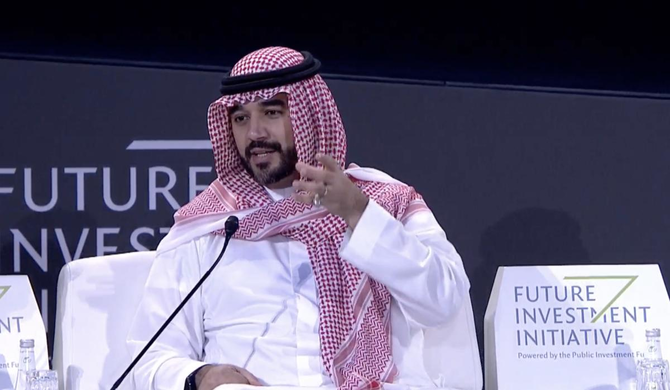
Prince Faisal bin Bandar bin Sultan, SAFEIS president, talking about eSports at the Future Investment Initiative 2019 in Riyadh. (Screenshot/FII)
Updated 01 November 2019
Follow

‘Get gaming,’ Saudi Arabia’s eSport federation boss says

  • Says industry behind electronic and intellectual sports is vast
  • Strong community of gamers in Saudi Arabia and support from government

RIYADH: The world of eSports is evolving in Saudi Arabia, and its youthful audience means it could become an industry leader, according to the president of the Saudi Arabian Federation for Electronics and Intellectual Sports (SAFEIS).

“We are a population of youth; 70 percent of the population is under the age of 30. Everybody hears these numbers, but that means 70 percent of our population is my target audience,” Prince Faisal bin Bandar bin Sultan, SAFEIS president, told Arab News on the sidelines of the Future Investment Initiative (FII).

SAFEIS was founded in 2017, and in what is considered a young industry no one has yet taken a leadership role, he said. “We have the opportunity, we have the community and we have the skills. Both our young men and women, who are some of the best competitors, have the ability to take the bull by the horns.”

The industry behind electronic and intellectual sports is vast, covering not only competitions and video gaming, but coders and inventors, he said. “We can become the leader, not just in competitions and events, but in the actual technology and in the integration between male and female athletes, which we are well ahead in.”

How ahead? In most countries the world of eSports is male-dominated, with 70 percent of males participating, but the Kingdom is different. “In Saudi Arabia, when we’ve done our surveys and talked to our community, it’s about 52 percent male and 48 percent female.”

The first eSports cup, which was a government-sanctioned event, had both male and female participants, he said. “Which rarely happens internationally, let alone in Saudi. That was one of the first movers.”


Visitors at the GSA eSports Cup in Riyadh in 2018. (AFP)

However, it was not done with the idea that “we have to have women involved.” Every participant qualified on their own merits and in the lens of competition and that was what was “great” about it, he said. 

“There wasn’t any awkwardness, it was very natural, and everyone was there to have fun,” he said of the first mixed-gender competition.

There is a strong community of gamers in Saudi Arabia and support from the government, but the difficulties SAFEIS faces lie in convincing the private sector to invest in the sector.

“The only way this is sustainable is if the private sector gets involved. If we as a federation are growing and paying and doing everything for 10 years to come, nothing is going to happen. It’s not going to grow.”  

However, things are slowly changing with the private sector taking more of a lead in events and licensing.

“As people start to see that it makes money, they are going to do it at a business level.” This will bring in revenues and build a stronger community of eSports enthusiasts, he said.

With all the new technologies, including cloud gaming and 5G networks, being introduced into Saudi Arabia, Prince Faisal added: “This is the time for people to start moving and get gaming.”


First EU–Saudi roundtable on critical raw materials reflects shared policy commitment

Updated 16 January 2026
Follow

First EU–Saudi roundtable on critical raw materials reflects shared policy commitment

RIYADH: The EU–Saudi Arabia Business and Investment Dialogue on Advancing Critical Raw Materials Value Chains, held in Riyadh as part of the Future Minerals Forum, brought together senior policymakers, industry leaders, and investors to advance strategic cooperation across critical raw materials value chains.

Organized under a Team Europe approach by the EU–GCC Cooperation on Green Transition Project, in coordination with the EU Delegation to Saudi Arabia, the European Chamber of Commerce in the Kingdom and in close cooperation with FMF, the dialogue provided a high-level platform to explore European actions under the EU Critical Raw Materials Act and ResourceEU alongside the Kingdom’s aspirations for minerals, industrial, and investment priorities.

This is in line with Saudi Vision 2030 and broader regional ambitions across the GCC, MENA, and Africa.

ResourceEU is the EU’s new strategic action plan, launched in late 2025, to secure a reliable supply of critical raw materials like lithium, rare earths, and cobalt, reducing dependency on single suppliers, such as China, by boosting domestic extraction, processing, recycling, stockpiling, and strategic partnerships with resource-rich nations.

The first ever EU–Saudi roundtable on critical raw materials was opened by the bloc’s Ambassador to the Kingdom, Christophe Farnaud, together with Saudi Deputy Minister for Mining Development Turki Al-Babtain, turning policy alignment into concrete cooperation.

Farnaud underlined the central role of international cooperation in the implementation of the EU’s critical raw materials policy framework.

“As the European Union advances the implementation of its Critical Raw Materials policy, international cooperation is indispensable to building secure, diversified, and sustainable value chains. Saudi Arabia is a key partner in this effort. This dialogue reflects our shared commitment to translate policy alignment into concrete business and investment cooperation that supports the green and digital transitions,” said the ambassador.

Discussions focused on strengthening resilient, diversified, and responsible CRM supply chains that are essential to the green and digital transitions.

Participants explored concrete opportunities for EU–Saudi cooperation across the full value chain, including exploration, mining, and processing and refining, as well as recycling, downstream manufacturing, and the mobilization of private investment and sustainable finance, underpinned by high environmental, social, and governance standards.

From the Saudi side, the dialogue was framed as a key contribution to the Kingdom’s industrial transformation and long-term economic diversification agenda under Vision 2030, with a strong focus on responsible resource development and global market integration.

“Developing globally competitive mineral hubs and sustainable value chains is a central pillar of Saudi Vision 2030 and the Kingdom’s industrial transformation. Our engagement with the European Union through this dialogue to strengthen upstream and downstream integration, attract high-quality investment, and advance responsible mining and processing. Enhanced cooperation with the EU, capitalizing on the demand dynamics of the EU Critical Raw Materials Act, will be key to delivering long-term value for both sides,” said Al-Babtain.

Valere Moutarlier, deputy director-general for European industry decarbonization, and directorate-general for the internal market, industry, entrepreneurship and SMEs at European Commission, said the EU Critical Raw Materials Act and ResourceEU provided a clear framework to strengthen Europe’s resilience while deepening its cooperation with international partners.

“Cooperation with Saudi Arabia is essential to advancing secure, sustainable, and diversified critical raw materials value chains. Dialogues such as this play a key role in translating policy ambitions into concrete industrial and investment cooperation,” she added.