

Saudi Arabia chairs meeting to evaluate Arab Media Action Plan

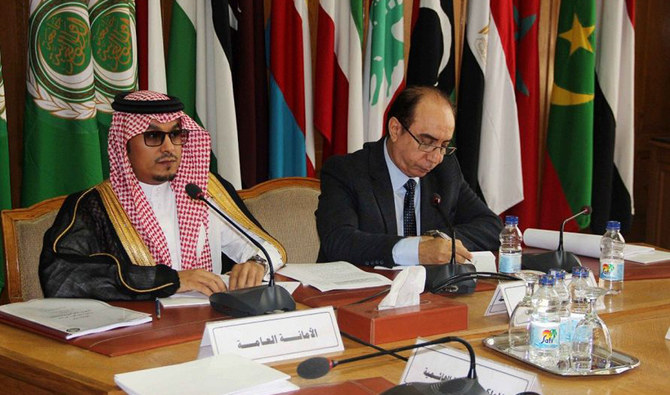
The meeting was chaired by Turki bin Marzooq Al-Omari, the director of media operations in charge of the Arab League file at the Saudi Ministry of Media. (SPA)
Updated 31 October 2019
Follow

Saudi Arabia chairs meeting to evaluate Arab Media Action Plan

  • The Arab Media Action Plan was formulated during the extraordinary session of the Arab Information Ministers Council (AIMC) held on Aug.15, 2001.

CAIRO: The first meeting of the expert group assessing the Arab Media Action Plan started at the headquarters of the General Secretariat of the Arab League in Cairo on Wednesday.

The meeting was chaired by Turki bin Marzooq Al-Omari, the director of media operations in charge of the Arab League file at the Saudi Ministry of Media, with the participation of media experts and representatives of member states of the Arab League and of media organizations, unions and other bodies.

The Arab Media Action Plan was formulated during the extraordinary session of the Arab Information Ministers Council (AIMC) held on Aug.15, 2001. 

It focused on the Palestinian cause, presenting to the whole world the crimes committed by the Israeli occupation against the Palestinian people, land, sanctities and properties. It also fights terrorism and seeks to corrects the negative stereotype of Arabs and Islam abroad.

To cope with the developments the Arab region has witnessed in recent years and the resulting distortion of the image of Arabs and Islam in the West, the plan has been updated several times.

Al-Omari conveyed the greetings of the Minister of Media Turki Al-Shabanah, who is chairman of the 50th session of the Council of Arab Information Ministers, to the group.

Al-Omari said during the opening session that they would discuss the Arab Media Action Plan to establish a positive image of Arab political positions and of Arabs and Islam more generally.

Dr. Fawzi Al-Ghuwail, director of the AIMC’s technical secretariat, reviewed a report on the projects that have been accomplished, stressing the importance of the main axis of the team’s work in evaluating the media action plan.

“The plan faced many challenges during the past year during the implementation of its projects due to the conflicts in some of the region’s countries. This led to a lack of focus on the Palestinian cause and disrupted the plan’s relevant projects.”

He added: “This meeting seeks to conduct a comprehensive evaluation of the plan’s activities, including the introduction of some amendments and new ideas. New activities might also be introduced in accordance with the priorities of Arab Media Action Plan at this stage.”

He called on Arab countries to “present feasible proposals and provide the necessary funding for the activities and programs.”


Meta to charge Arab advertisers extra fee for reaching European audiences

Updated 22 sec ago
Follow

Meta to charge Arab advertisers extra fee for reaching European audiences

  • US tech giant told advertisers it will add fees ranging from 2 to 5 percent on image and video ads delivered on its platforms to offset digital service taxes
  • Charges are determined by where the audience is located, not where the advertiser is based

LONDON: Meta will from July 1 impose location-based surcharges on advertisers targeting audiences in six European countries, a move that will directly affect Arab businesses that run campaigns across the continent.

The US tech giant announced it will add fees ranging from 2 to 5 percent on image and video ads delivered on its platforms, including Facebook, Instagram and WhatsApp, to offset digital service taxes imposed by individual governments.

Crucially, the charges are determined by where the audience is located, not where the advertiser is based.

That means Saudi, Emirati, Egyptian or other Arab companies paying to reach consumers in the UK, France or Italy will face the additional costs regardless of their own country’s tax arrangements with Meta.

Fees will apply at 2 percent for ads reaching UK audiences, 3 percent for France, Italy and Spain, and 5 percent for Austria and Turkiye.

“If you deliver $100 in ads to Italy, where there is a 3% location fee, you will be charged $100 (ad delivery), plus $3 (location fee), for $103 total,” the company wrote in an email to an advertiser initially reported by Bloomberg. “Note that any applicable VAT will be calculated on top of the total amount.”

The taxes have been introduced at different points, starting with France in 2019, though not the EU as a bloc.

Many tech companies report substantial sales in Europe and millions of users but pay minimal tax on profits. The goal is to claw back locally derived economic value, Bloomberg reported.

The move follows similar decisions by Google and Amazon, which have also begun passing European digital tax costs on to advertisers.

For Arab brands with growing European footprints, particularly in fashion, travel, hospitality and media, the new fees add another layer of cost to campaigns already subject to currency and targeting complexities.

Digital services taxes, levied as a percentage of revenues earned by major tech platforms in individual countries, have drawn criticism from Washington, which argues they unfairly target US companies.

Meta has been reached for comments.