

US and Gulf countries sanction individuals and businesses linked to Iran and Hezbollah

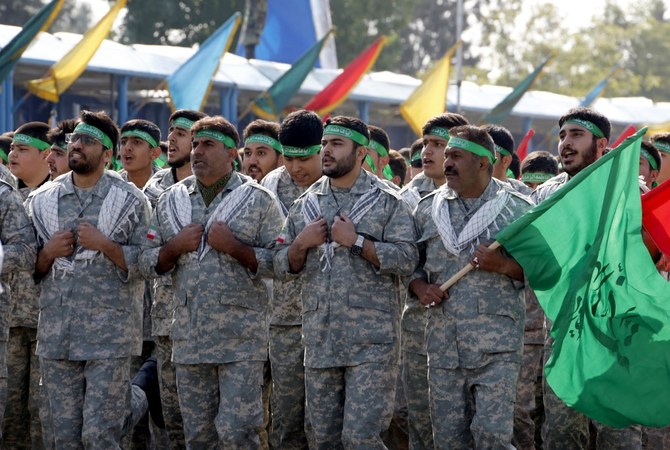
The terror financing designation targets businesses providing financial support to the Basij Resistance Force. (AFP/FIle photo)
Updated 31 October 2019
Follow

US and Gulf countries sanction individuals and businesses linked to Iran and Hezbollah

  • Several of the businesses targeted provide financial support to the Basij Resistance Force
  • The action was taken by the Terrorist Financing Targeting Center, set up in Riyadh by Trump and the six GCC countries

JEDDAH: A Saudi-based coalition that combats terrorist financing imposed new sanctions on Wednesday targeting 25 companies, banks and individuals linked to Iran’s support for extremist groups throughout the Middle East.

The new measures are aimed in particular at militant networks associated with the Islamic Revolutionary Guard Corps in Iran and Hezbollah in Lebanon, and will tighten controls on both groups’ finances.

The sanctions were imposed by the Terrorist Financing Targeting Center (TFTC) in Riyadh, which was set up by Saudi Arabia and the US in May 2017 and includes the other Gulf states.

US Treasury Secretary Steve Mnuchin, who is attending the Future Investment Initiative forum in Riyadh this week, said the sanctions “coincide with my trip to the Middle East, where I am meeting with my counterparts across the region to bolster the fight against terrorist financing.”

Mnuchin added: “The TFTC’s coordinated disruption of the financial networks used by the Iranian regime to fund terrorism is a powerful demonstration of Gulf unity.

“This action demonstrates the unified position of the Gulf nations and the United States that Iran will not be allowed to escalate its malign activity in the region.”

Twenty-one of the companies targeted by the new sanctions form a vast network of businesses providing financial support to the Basij Resistance Force, a subordinate group of the Revolutionary Guard, the US Treasury said. The companies were used “to oppress domestic opposition with brutal displays of violence” and supply fighters to regional conflicts in Yemen, Syria and elsewhere.

The Treasury said shell companies and other surreptitious measures were used to mask Basij ownership and control over multibillion-dollar business interests in Iran’s automotive, mining, metals, and banking industries, many of which operate across the Middle East and Europe.

The four individuals targeted with sanctions were affiliated to Hezbollah in Lebanon, and coordinated the group’s operations in Iraq, it said. 

Among the banks targeted was Bank Mellat, a privately owned Iranian financial institution with links to Iran’s nuclear and ballistic missile programs.

Mnuchin said this week that the US would increase economic pressure on Iran over its nuclear program. Sanctions reimposed on Tehran by President Donald Trump after he withdrew the US from the 2015 deal to curb Iran’s nuclear program have dried up Iranian oil revenues and cut Iranian banks’ ties to the financial world.


More than 100 Palestinians detained in West Bank since start of Ramadan, including women, children

Updated 5 sec ago
Follow

More than 100 Palestinians detained in West Bank since start of Ramadan, including women, children

  • Arrests by Israelis accompanied by extensive field interrogation

RAMALLAH: Israeli forces have detained more than 100 Palestinians from the West Bank since the beginning of the holy month of Ramadan, including women, children, and former prisoners, the Palestinian Prisoner’s Society reported on Sunday.

The organization said the detentions coincided with Israel’s announcement of the intensification of such actions during Ramadan, with recent settler attacks providing cover for widespread detentions across most West Bank governorates, including Jerusalem. Many detainees from Jerusalem have been barred from entering Al-Aqsa Mosque.

A statement pointed out that arrests by Israelis are accompanied by extensive field interrogation which often targets all sections of Palestinian society.

Documented violations accompanying detentions include severe beatings, organized terror campaigns against detainees and their families, destruction and looting of homes, confiscation of vehicles, money and gold, demolition of family homes, use of family members as hostages, employment of prisoners as human shields, and extrajudicial executions.

The society stressed that Israel exploits detention campaigns to expand settlement activity in the West Bank, with settlers serving as a key tool to impose a new reality.

The Palestinian Detainees Affairs Commission has revealed harrowing details of the abuses faced by Palestinian prisoner Mohammed Wajih Mahamid from Jenin during his incarceration in Israeli prisons.

The commission said that on Nov. 15, 2023, Mahamid was severely beaten on his right knee with a baton used by prison guards, causing a serious injury that left him unable to walk without crutches.

He was beaten again on the same knee on March 29, 2025, resulting in severe swelling which was later confirmed to be a fracture. Despite his condition, the prison authorities only provided painkillers and refused to transfer him to hospital, maintaining a policy of deliberate medical neglect.

The commission stressed that these abuses reflected the harsh reality faced by Palestinian detainees, who are deprived of basic human rights, medical treatment and care.