

Pakistan central bank warns of inflationary pressures due to India tensions

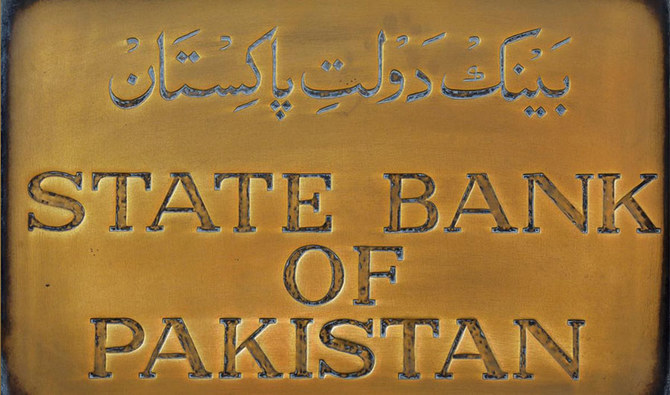
A brass plaque of the State Bank of Pakistan is seen outside of its wall in Karachi, Pakistan December 5, 2018. (REUTERS//File Photo)
Updated 29 October 2019
Follow

Pakistan central bank warns of inflationary pressures due to India tensions

  • Annual inflation expected to exceed 11-12 percent from annual projection of 8.5 percent for fiscal year 2020
  • State bank says achieving ambitious tax collection target amidst a broader economic slowdown “may present a challenge”

KARACHI: Pakistan’s central bank on Sunday warned against increased inflationary pressures due to ongoing tensions with the neighbor and arch-rival India, saying in an annual report that cross-border flare-ups represented a risk.

Tensions have been running high between the two countries since Indian Prime Minister Narendra Modi’s government withdrew Kashmir’s autonomy in August, seeking to tighten its grip on the Muslim-majority territory also claimed by Pakistan. The move was accompanied by a security crackdown on dissent, to head off protests.

In its annual report released on Sunday, the central bank warned that lower inflation prospects in the fiscal year 2021 represented an upside risk due to ongoing tensions with neighboring India.

“Cross-border tensions (which have flared up intermittently since Q3-FY19 [quarter 3 financial year 2019] and worsened during Q1-FY20) represent an upside risk to this outlook, given their tendency to drive up food inflation,” the central bank said.

The bank said annual inflation was expected to exceed 11-12 percent from an annual projection of 8.5 percent by the Planning Commission of Pakistan for the fiscal year 2020.

Demand pressures had generally subsided, the state bank said, though the cost-related impact may be more pronounced in the first half of the fiscal year due to a one-off adjustment in the prices of utilities and other FY20 budget-related measures.

By the second half, supported by the end of deficit monetization by the government, price pressures may begin to recede, the bank said, setting the tone for considerably lower inflation in FY21.

“At the same time, the global slowdown may pose a downside risk to the outlook, especially if international oil prices fall more sharply than anticipated,” the report said. “Real GDP growth is likely to remain subdued,” it added, saying “the early signs of recovery are already visible.”

Recovery could be driven by development spending, the bank said, given the observed tendency that Pakistan’s GDP growth and public sector development spending (PSDP) moved in the same direction.

Other triggers could include improvement in market sentiments vis-à-vis an IMF bailout program, a better showing by the agriculture sector compared to last year, and a further improvement in the current account balance.

The central bank painted a positive outlook of external sector outlook on the whole while citing both upside and downside risks. The bank projected $25.4 – 25.9 billion exports during FY 20 against a target of $26.2 billion and expects an export boost to China and Malaysia.

“The FTA-II (Free Trade Agreement) with China and preferential trade agreement with Indonesia may also give a boost to exports. A decline in imports would be instrumental in improving the current account as the policy-induced import compression would continue on top of subdued prices, barring any adverse shock from international oil prices,” the bank’s report said.

“The outlook for the financial sector, by contrast, is not straightforward,” it added. “The FY20 budget looks to fix the deficiencies of the tax system and represents an earnest effort to increase documentation. It envisages a sizeable reduction in the deficit, by enhancing revenues and squeezing expenditures.”

The bank said though Pakistan had set an Rs5.5 trillion tax collection target for the current fiscal year FY20, “achieving the ambitious tax collection target in the middle of a broader economic slowdown may present a challenge”.

Moreover, even if things panned out more or less according to plan, the fiscal deficit may be in the neighborhood of 7 percent nevertheless, implying that there would still be some way to go before fiscal consolidation is achieved, the bank noted.

The central bank also highlighted reasons for low foreign investment in the country, saying dispute settlement mechanisms were found lacking in terms of contract enforcement and expropriation: “This makes both the existing and potential investors wary of venturing into any capital formation activity.”

Pakistan has 48 bilateral investment treaties (BITs) with other countries but “investors often complain of not getting all the facilitations identified in the respected BITs’.

“Here, it is also worth mentioning that the recent BITs to which Pakistan is a signatory include clauses on which the country’s investment laws and policies are either less accommodating or even silent,” the central bank said. 

Existing investors also complain about the long duration of court proceedings for resolving standardized commercial disputes in Pakistan, the state bank said.


Pakistan, Iraq agree on tighter coordination over pilgrims under new regulated travel system

Updated 4 sec ago
Follow

Pakistan, Iraq agree on tighter coordination over pilgrims under new regulated travel system

  • New system requires all Iraq-Iran pilgrimages to be organized by licensed groups under state oversight
  • Long-running “Salar” model relied on informal caravan leaders, leading to overstays and missing pilgrims

ISLAMABAD: Pakistan and Iraq this week agreed to closely coordinate on the management and security of Pakistani pilgrims, as Islamabad rolls out a new, tightly regulated travel system aimed at preventing overstays, undocumented migration and security breaches during religious visits to Iraq and Iran.

The understanding was reached during a meeting between Pakistan’s Interior and Narcotics Control Minister Mohsin Naqvi and Iraq’s Interior Minister General Abdul Amir Al-Shammari on Thursday evening, where both sides discussed measures to facilitate pilgrims while strengthening oversight, Pakistan’s interior ministry said.

The agreement comes as Pakistan dismantles its decades-old pilgrim travel model and replaces it with a centralized, licensed system after authorities confirmed that tens of thousands of Pakistani pilgrims had overstayed or gone missing abroad over the past decade, triggering concerns from host governments.

“You have, for the first time during your tenure, taken effective measures to organize pilgrim groups, which are commendable,” Al-Shammari told Naqvi, according to Pakistan’s interior ministry.

“All pilgrims included in the list provided by Pakistan’s Ministry of Interior will be allowed to enter Iraq,” he added, making clear that only travelers cleared under the new system would be permitted.

Naqvi said Pakistan would strictly enforce return timelines under the revised framework.

“Pilgrims traveling to Iraq will not be allowed to stay beyond the designated period,” he said, adding that relevant authorities in both countries would remain in close coordination.

Both interior ministers also agreed to strengthen information-sharing and joint mechanisms on security cooperation, counterterrorism and the prevention of human smuggling, officials said.

“The safety, dignity, and facilitation of Pakistani pilgrims is the top priority of the Government of Pakistan,” Naqvi said.

Al-Shammari said he would visit Pakistan soon to finalize a joint roadmap to further improve pilgrim facilitation, security coordination and broader bilateral cooperation, according to the interior ministry.

Pakistan’s government has overhauled its pilgrim travel regime this year, abolishing the long-running “Salar” system under which informal caravan leaders managed pilgrimages. The move followed official confirmation that around 40,000 Pakistani pilgrims had overstayed or disappeared in Iran, Iraq and Syria over the past ten years.

Under the new Ziyarat Management Policy, only licensed Ziyarat Group Organizers (ZGOs) are allowed to arrange pilgrimages, with companies held directly responsible for ensuring pilgrims return on time. Authorities have completed security clearance for 585 companies seeking registration, while scrutiny of applications remains ongoing.

Islamabad has also barred overland travel for major pilgrimages, including Arbaeen, citing security risks in Pakistan’s southwestern Balochistan province, meaning all travel to Iraq and Iran is now restricted to regulated air routes.

Tens of thousands of Pakistani pilgrims travel each year to Iraq and Iran to visit some of the most revered shrines in Shia Islam, including the mausoleums of Imam Ali in Najaf and Imam Hussain in Karbala in Iraq, and major religious sites in Mashhad and Qom in Iran. Pilgrimages peak during religious occasions such as Arbaeen, when millions of worshippers converge on Karbala from across the region. The scale of travel, often involving long stays and cross-border movements, has long posed logistical, security and migration-management challenges for Pakistani authorities and host governments alike.