Early Renaissance painting found in French kitchen fetches 24 mn euros

1 / 2
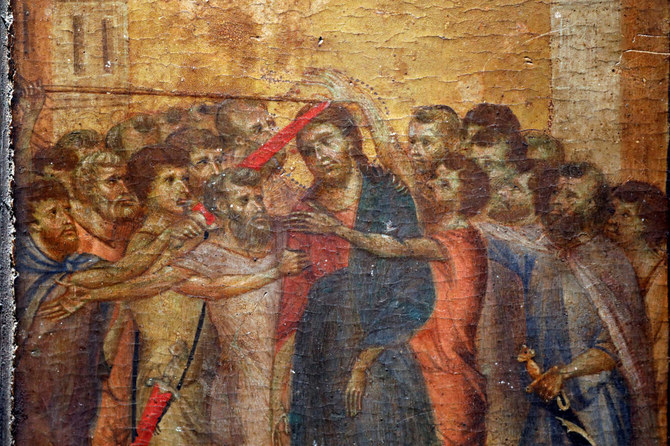
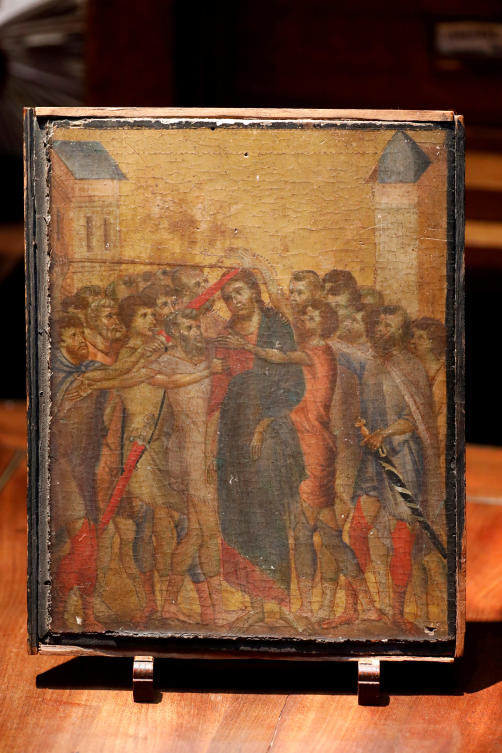
A part of the painting "Christ Mocked", a long-lost masterpiece by Florentine Renaissance artist Cimabue in the late 13th century, which was found months ago hanging in an elderly woman's kitchen in the town of Compiegne, is seen in Paris, France, September 24, 2019. (Reuters)
2 / 2
The painting "Christ Mocked", a long-lost masterpiece by Florentine Renaissance artist Cimabue in the late 13th century, which was found months ago hanging in an elderly woman's kitchen in the town of Compiegne, is displayed in Paris, France, September 24, 2019. (Reuters)
Updated 27 October 2019
Follow

Early Renaissance painting found in French kitchen fetches 24 mn euros

SENLIS: A rare masterpiece by Italian early Renaissance master Cimabue that was discovered in a French kitchen was sold on Sunday for 24 million euros ($26.6 million), about five times the initial estimate.
The Acteon auction house did not identify the winning bidder for the painting, “Christ Mocked,” at the sale in Senlis, outside Paris.
The selling price, which included costs, smashed the initial estimate of between four million and six million euros.
Bidding began at three million euros, with only three of the eight bidders present at the auction.
It is the first time in decades that a painting by Cimabue, a pioneering primitive painter who lived from 1272-1302 and is also known as Cenni di Pepo, has gone under the hammer.
Acteon said the figure was the highest ever reached for a mediaeval painting and the eighth-highest ever reached for a mediaeval or old master painting.
The highest figure ever reached for a painting was the $450 million paid for the Salvator Mundi attributed to Leonardo da Vinci and sold at auction in 2017.
Experts in September announced the sensational discovery of the painting by Cimabue which was owned by a woman in the northern French town of Compiegne, who had it hanging between her kitchen and her sitting room.
She believed it was merely an old religious icon when she took it to the auctioneers to be valued.
The tiny unsigned work, measuring just 26 by 20 centimeters (10 by eight inches), was found to be in excellent condition, though covered in grime from having been displayed right above a cooking hotplate.
Art experts at Turquin in Paris used infrared reflectology to confirm that the piece is part of a larger diptych from 1280, when Cimabue painted eight scenes of the passion and crucifixion of Christ. Each of the two panels in the diptych had four scenes.
Only two other elements of the diptych are known to exist: “The Flagellation of Christ” displayed at the Frick in New York, and “The Virgin and Child with Two Angels” at the National Gallery in London.
Cimabue is renowned for his mosaics, frescoes and altarpieces.
Historians say only about a dozen works on wood — all unsigned — are thought to have been made by the Italian artist.
His more natural and nuanced depictions marked a turning point for Italian painters still influenced by highly stylized Byzantine art.
Art historians consider him a trailblazer for the creative Renaissance that would flourish under greats like Giotto, one of Cimabue’s pupils.


Japan’s beloved last pandas leave for China as ties fray

Updated 27 January 2026
Follow

Japan’s beloved last pandas leave for China as ties fray

TOKYO: Two popular pandas are set to leave Tokyo for China Tuesday, leaving Japan without any of the beloved bears for the first time in 50 years as ties between the Asian neighbors fray.
Panda twins Lei Lei and Xiao Xiao are due to be transported by truck out of Ueno Zoological Gardens, their birthplace, disappointing many Japanese fans who have grown attached to the furry four-year-olds.
“Although I can’t see them, I came to share the same air with them and to say, ‘Hope you’ll be OK,’” one woman visiting the zoo told public broadcaster NHK.
The pandas’ abrupt return was announced last month during a diplomatic spat that began when Japanese Prime Minister Sanae Takaichi hinted that Tokyo could intervene militarily in the event of an attack on Taiwan.
Her comment provoked the ire of Beijing, which regards the island as its own territory.
The distinctive black-and-white animals, loaned out as part of China’s “panda diplomacy,” have symbolized friendship between Beijing and Tokyo since they normalized diplomatic ties in 1972.
Their repatriation comes a month before their loan period expires in February, according to the Tokyo Metropolitan Government, which operates Ueno Zoo.
Japan has reportedly been seeking the loan of a new pair of pandas.
However, a weekend poll by the liberal Asahi Shimbun newspaper showed that 70 percent of those surveyed do not think the government should negotiate with China on the lease of new pandas, while 26 percent would like them to.
On Sunday, Ueno Zoo invited some 4,400 lucky winners of an online lottery to see the pandas for the last time.
Passionate fans without tickets still turned out at the park, sporting panda-themed shirts, bags and dolls to demonstrate their love of the animals.
China has discouraged its nationals from traveling to Japan, citing deteriorating public security and criminal acts against Chinese nationals in the country.
Beijing is reportedly also choking off exports to Japan of rare-earth products crucial for making everything from electric cars to missiles.
However, China routinely removes pandas from foreign countries and the latest move may not be politically motivated, said Masaki Ienaga, a professor at Tokyo Woman’s Christian University and an expert in East Asian international relations.
“If you talk about (Chinese) politics, the timing of sending pandas is what counts,” and pandas could return to Japan if bilateral ties warm, he said.
Other countries use animals as tools of diplomacy, including Thailand with its elephants and Australia with its koalas, he added.
“But pandas are special,” he said. “They have strong customer-drawing power, and... they can earn money.”
kh/aph/mjw