CANBERRA, Australia: Ivan Milat, whose grisly serial killings of young backpackers horrified Australians in the early ‘90s, died in a Sydney prison on Sunday, prison authorities said. He was 74.
He had been in custody since 1994 and was diagnosed in early 2019 with esophageal and stomach cancer. Milat died in the medical wing of Long Bay Prison, New South Wales state Corrective Services said in a statement.
Milat murdered three German, two British, and two Australian backpackers after giving them rides while they were hitchhiking. The serial killings came to light when the mutilated corpses were found in a forest near Sydney over 14 months in 1992 and 1993.
The case set off a frenzy of attention that consumed Australians like few others. Police put a team of investigators on the case, a reward was offered and media intensely covered the hunt for the killer and the possibility of more victims.
In September 1992, two runners orienteering in the Belanglo State Forest southwest of Sydney discovered a concealed corpse. Police unearthed a second body nearby, and dental records confirmed the victims were Britons Caroline Clarke, 21, and Joanne Walters, 22, who’d been last seen in Sydney five months earlier.
Two more bodies were found in October 1993 by a man searching for firewood. Police identified them as Australian couple Deborah Everist and James Gibson, both 19, who’d gone missing in late 1989.
Police searches of the forest revealed the body of German Simone Schmidl, 21, and later in November the corpses of German couple Anja Habschied, 20, and Gabor Neugebauer, 21, who’d been missing since 1991.
Police in New South Wales established a 20-person team of detectives and analysts, posting a reward of AU$500,000 for information that would lead to the perpetrator.
Milat was arrested on May 22, 1994, following two months of surveillance. Police were aided by an identification of Milat by a British man, Paul Onions, who had accepted a ride from him while hitchhiking out of Sydney in 1990 and managed to escape the car, running down the road while Milat shot at him.
Clive Small, a former detective who led the murder investigation, said Onions’ identification enabled police to execute search warrants targeting Milat.
A search of Milat’s house found several weapons including parts of a rifle that matched one used in the murders, and the cameras of some of his victims.
“Ivan’s home was like an Aladdin’s cave in terms of the items that were found there,” Small told Nine Network television on Sunday, referring to a range of incriminating evidence including victim’s property as well as ropes and plastic ties that were used to bind victims.
When his trial ended in 1996, Milat was found guilty of seven murders and sentenced to serve seven consecutive life sentences.
Small said of Milat’s death: “A lot of people are going to be very satisfied with the current outcome and will be pleased that it’s over.”
“I had absolutely no respect for him at all. I thought that if he had one ounce of decency in him, he could have shown it before he died by admitting and clarifying a number of issues that are outstanding,” Small added.
Police still believe Milat may have been responsible for other murders, carried out with similar characteristics, including three people whose bodies were found in three other forests from as early as 1971 to 1991.
Ian Clarke, the Northumberland-based father of British victim Caroline Clarke, told Nine: “No matter how Christian one might be, you can’t help but be glad that this has happened.”
Milat was born on Dec. 27, 1944, one of 12 children of a Croatian immigrant father and an Australian-born mother and was a Sydney road worker.
In a television interview in 2019, an older brother summed up Milat’s infamy.
“He was going to kill somebody from the age of 10,” Boris Milat told Australia’s Channel 7 television network. “It was built into him. He had a different psyche. He’s a psychopath, and it just manifested itself with, ‘I can do anything, I can do anything.’“


![]()

Australian serial killer Ivan Milat dies in prison at 74
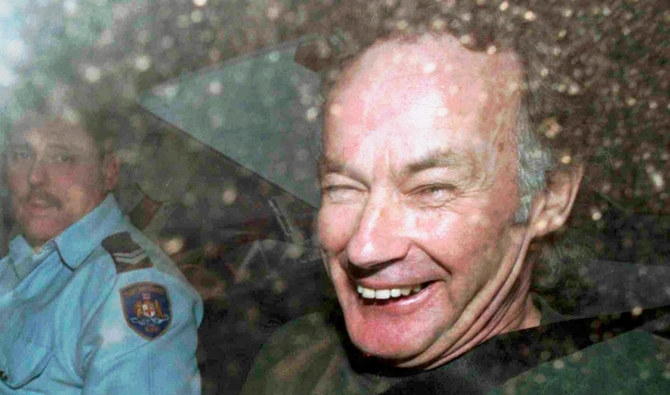
Australian serial killer Ivan Milat dies in prison at 74
- Milat murdered three German, two British, and two Australian backpackers after giving them rides while they were hitchhiking


Latest updates



Recommended


© 2026 SAUDI RESEARCH & PUBLISHING COMPANY, All Rights Reserved And subject to Terms of Use Agreement.