

FBI ask public to help identify victims as US serial killer confesses to 93 murders

1 / 3
This combination of undated sketches provided by the FBI shows drawings made by admitted serial killer Samuel Little, based on his memories of some of his victims. Little, who claims to have killed more than 90 women across the country, is now considered to be the deadliest serial killer in U.S. history, the Federal Bureau of Investigation said. (AP)
2 / 3
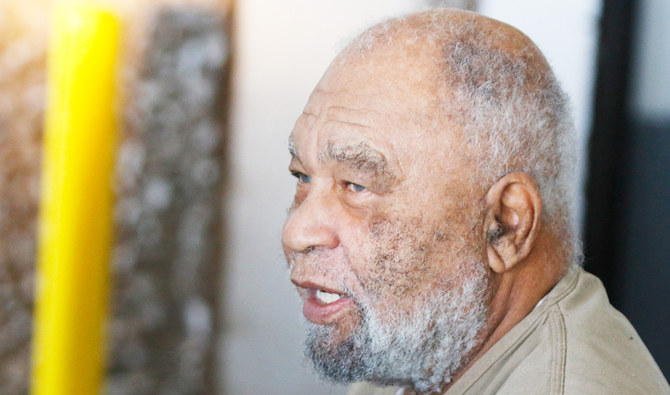
In this Monday, Nov. 26, 2018 file photo, Samuel Little, who often went by the name Samuel McDowell, leaves the Ector County Courthouse after attending a pre-trial hearing in Odessa, Texas. (AP)
3 / 3
This combination of undated sketches provided by the FBI shows drawings made by admitted serial killer Samuel Little, based on his memories of some of his victims. Little, who claims to have killed more than 90 women across the country, is now considered to be the deadliest serial killer in U.S. history, the Federal Bureau of Investigation said. (AP)
Updated 09 October 2019
Follow

FBI ask public to help identify victims as US serial killer confesses to 93 murders

  • One unidentified victim was described by investigators as a black man aged 18 or 19 who presented himself to Little as a woman named Marianne or Mary Ann. He was slain in 1971 or 1972

LOS ANGELES: The FBI is asking for the public’s help in identifying dozens of victims of a convicted murderer who has confessed to strangling 93 people, claims the agency says are credible and make him the most prolific serial killer in US history.
Investigators who have interviewed Samuel Little at a Los Angeles-area prison say they have confirmed 50 of the homicides he admitted to carrying out between 1970 and 2005 and have released videotapes of his jailhouse confessions as they investigate the remaining slayings.
“Even though he is already in prison, the FBI believes it is important to seek justice for each victim — to close every case possible,” the FBI said in a statement posted to its website, which also includes drawings made by Little, 79, of many of the women he strangled.
Little, who is serving life behind bars for his conviction on three murders committed in the 1980s, began confessing additional killings some 18 months ago to a Texas Ranger who interviewed him in his cell at the state prison in Lancaster, California, according to the FBI.
He appears to have targeted mostly vulnerable young black women, many of them prostitutes or drug addicts, whose deaths were not well-publicized at the time and in some cases not recorded as homicides.
The FBI videotapes show Little, sitting in front of a cinder block wall in blue jail scrubs and a gray knit cap, sometimes appearing bemused or smiling as he recalls the circumstances surrounding the murders.

The FBI has also released sketches made by Little of victims who remain unidentified in hopes that members of the public might recognize them. The agency cautioned that not all Little’s descriptions may be accurate as his memory is faulty.
A map posted on the FBI website shows that most of the still uncorroborated murders were committed across the US South, although one young woman was killed in northern Ohio and two others in Southern California.
One unidentified victim was described by investigators as a black man aged 18 or 19 who presented himself to Little as a woman named Marianne or Mary Ann. He was slain in 1971 or 1972.
Another was a 25-year-old white woman with blonde hair, blue eyes and a “hippie appearance” whom Little met in Ohio and strangled to death in northern Kentucky in approximately 1984.
It was not yet clear if Little, who is in failing health, will face additional prosecutions in the newly uncovered murders. 

To see more videos, check the FBI website.


Afghan hunger crisis deepens as aid funding falls short, UN says

Updated 8 sec ago
Follow

Afghan hunger crisis deepens as aid funding falls short, UN says

  • International aid to war-torn Afghanistan has dwindled significantly since 2021
  • “For the first time in decades, WFP cannot launch a significant winter response,” the UN agency said

KABUL: The UN World Food Programme is unable for the first time in decades to provide effective aid to millions of Afghans suffering from malnutrition, with deaths especially among children likely to rise this winter, the WFP said on Tuesday.
International aid to war-torn Afghanistan has dwindled significantly since 2021, when US-led forces exited the country and the Taliban regained power. The crisis has been compounded by multiple natural calamities such as earthquakes.
“For the first time in decades, WFP cannot launch a significant winter response, while also scaling up emergency and nutrition support nationwide,” the UN agency said in a statement, adding that it needed over $460 million to deliver food assistance to six million most vulnerable Afghans.
“With child malnutrition already at its highest level in decades, and unprecedented reductions in (international) funding for agencies providing essential services, access to treatment is increasingly scarce,” it said.
Child deaths are likely to rise during Afghanistan’s freezing winter months when food is scarcest, it said.
The WFP estimates that 17 million people face hunger, up about 3 million from last year, a rise driven in part by millions of Afghans deported from neighboring Iran and Pakistan under programs to send back migrants and refugees.
Humanitarian agencies have warned that Afghanistan lacks the infrastructure to absorb a sudden influx of returnees.
“We are only 12 percent funded. This is an obstacle,” Jean-Martin Bauer, WFP Director of Food Security and Nutrition Analysis, told a press briefing in Geneva. He added that 3.7 million Afghan children were acutely malnourished, 1 million of whom were severe cases. “So yes, children are dying,” he said.