

Tradition, modernity mingle at Japanese Emperor Naruhito’s enthronement

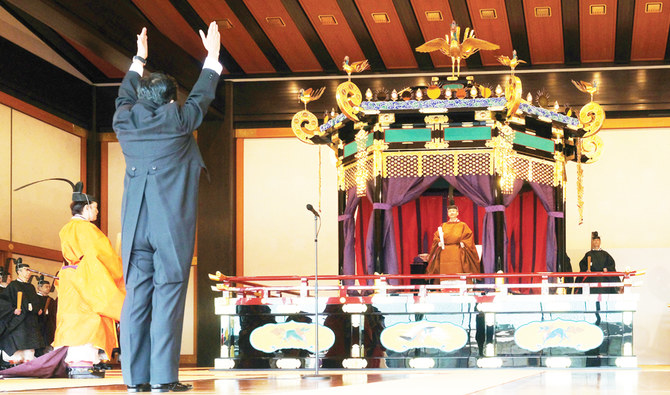
Japanese Prime Minister Shinzo Abe shouts “banzai,” meaning “long live the emperor,” during the enthronement ceremony for Emperor Naruhito at the Imperial Palace in Tokyo. (AFP)
Updated 23 October 2019
Follow

Tradition, modernity mingle at Japanese Emperor Naruhito’s enthronement

  • Ritual-bound, centuries-old ceremony takes places at Imperial Palace in Tokyo
  • Heads of state and officials from Japan and 180 countries among the attendees

TOKYO: It was a ceremony similar to coronations used by monarchs worldwide, but combining the historical and the spiritual with modernity. Japan’s Emperor Naruhito formally completed his ascension to the Chrysanthemum Throne at the Imperial Palace in Tokyo on Oct. 22.
Purple curtains were drawn back to reveal Naruhito, 59, and Empress Masako, 55, standing before their imperial thrones as the enthronement ceremony began.
Wearing a dark orange robe, similar to that worn by his father Akihito at his own enthronement in 1990, Naruhito proclaimed his ascension from a 6.5 meter-high, canopied “Takamikura” throne.
Through the centuries-old ceremony, Naruhito declared himself Japan’s 126th emperor and vowed to “stand with the people” before roughly 2,000 guests, including heads of state and officials from Japan and more than 180 countries. Among the attendees were Japanese royal family members also wearing traditional robes.
In his congratulatory message to the emperor, Prime Minister Shinzo Abe promised that the people of Japan would “respect (his) highness the emperor as the symbol of the state and of the unity of the Japanese people.” He then stood before Naruhito’s throne, bowed and raised his hands three times, shouting “banzai,” meaning “long live the emperor.”
Saudi Arabia was represented by Minister of State Prince Turki bin Mohammed bin Fahd bin Abdul Aziz, who conveyed greetings from King Salman and Crown Prince Mohammed bin Salman to the Japanese people.Saudi Ambassador to Japan Naif bin Marzouq Al-Fahadi, and other Saudi officials, were also present.


Japan’s Princess Mako attended the enthronement ceremony. (AFP)


The enthronement ceremony is a part of a succession of rituals that began in May when Naruhito inherited the throne, after Akihito became the first emperor to abdicate in 200 years.
As Naruhito ascended the throne, boxes containing items of imperial regalia, including an imperial sword and jewel, were presented to him.
“Having previously succeeded to the Imperial Throne in accordance with the constitution of Japan and the Special Measures Law on the Imperial House Law, I now … proclaim my enthronement to those at home and abroad,” the Japan Times newspaper quoted Naruhito as declaring.
“I pledge hereby that I shall act according to the constitution and fulfill my responsibility as the symbol of the state, and of the unity of the people of Japan, while always wishing for the happiness of the people and the peace of the world, turning my thoughts to the people and standing by them.”

An imperial procession that was to take place after the ceremony was postponed after Typhoon Hagibis hit Tokyo earlier this month. On Nov. 10, the emperor and empress will take part in a procession through central Tokyo to the Akasaka Imperial Residence.
To mark the enthronement, the government has granted pardons to more than half a million people found guilty of petty crimes such as traffic violations.
In an article for Arab News, Shihoko Goto, deputy director for geoeconomics at the Asia Program of the US think tank the Wilson Center, asked a question she believes will be echoed by many in Japan: “Can the country carry on its historical legacy while embracing the opportunities of the 21st century?

“The new imperial couple is likely to want to further Emperor Akihito’s legacy as a conduit for reconciliation.”


India, Arab League target $500bn in trade by 2030

Updated 54 min ago
Follow

India, Arab League target $500bn in trade by 2030

  • It was the first such gathering of India–Arab FMs since the forum’s inauguration in 2016
  • India and Arab states agree to link their startup ecosystems, cooperate in the space sector

NEW DELHI: India and the Arab League have committed to doubling bilateral trade to $500 billion by 2030, as their top diplomats met in New Delhi for the India–Arab Foreign Ministers’ Meeting. 

The foreign ministers’ forum is the highest mechanism guiding India’s partnership with the Arab world. It was established in March 2002, with an agreement to institutionalize dialogue between India and the League of Arab States, a regional bloc of 22 Arab countries from the Middle East and North Africa.

The New Delhi meeting on Saturday was the first gathering in a decade, following the inaugural forum in Bahrain in 2016.

India’s Foreign Minister S. Jaishankar said in his opening remarks that the forum was taking place amid a transformation in the global order.

“Nowhere is this more apparent than in West Asia or the Middle East, where the landscape itself has undergone a dramatic change in the last year,” he said. “This obviously impacts all of us, and India as a proximate region. To a considerable degree, its implications are relevant for India’s relationship with Arab nations as well.”

Jaishankar and his UAE counterpart co-chaired the talks, which aimed at producing a cooperation agenda for 2026-28.

“It currently covers energy, environment, agriculture, tourism, human resource development, culture and education, amongst others,” Jaishankar said.

“India looks forward to more contemporary dimensions of cooperation being included, such as digital, space, start-ups, innovation, etc.”

According to the “executive program” released by India’s Ministry of External Affairs, the roadmap agreed by India and the League outlined their planned collaboration, which included the target “to double trade between India and LAS to US$500 billion by 2030, from the current trade of US$240 billion.”

Under the roadmap, they also agreed to link their startup ecosystems by facilitating market access, joint projects, and investment opportunities — especially health tech, fintech, agritech, and green technologies — and strengthen cooperation in space with the establishment of an India–Arab Space Cooperation Working Group, of which the first meeting is scheduled for next year.

Over the past few years, there has been a growing momentum in Indo-Arab relations focused on economic, business, trade and investment ties between the regions that have some of the world’s youngest demographics, resulting in a “commonality of circumstances, visions and goals,” according to Muddassir Quamar, associate professor at the School of International Studies, Jawaharlal Nehru University.

“The focus of the summit meeting was on capitalizing on the economic opportunities … including in the field of energy security, sustainability, renewables, food and water security, environmental security, trade, investments, entrepreneurship, start-ups, technological innovations, educational cooperation, cultural cooperation, youth engagement, etc.,” Quamar told Arab News.

“A number of critical decisions have been taken for furthering future cooperation in this regard. In terms of opportunities, there is immense potential.”