

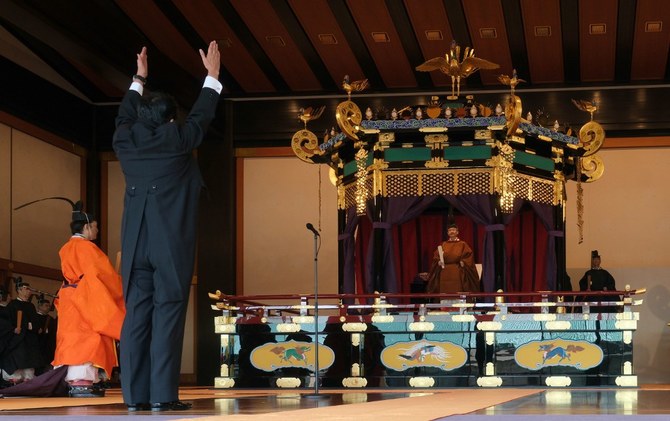

TOKYO: With his formal enthronement as Japan’s 126th emperor, in a line said to stretch back more than 2,600 years, Naruhito takes on a role that has changed almost beyond recognition from its mythological origins.
Recent decades have seen the Japanese emperor’s role recast in new ways. Naruhito, who ascended the Chrysanthemum Throne on May 1 this year, has already signaled that he will continue reshaping the emperor’s role.
He has called for “new royal duties” to fit modern times, and said he hopes — like his father, current Emperor Emeritus Akihito — to be “close to the people.”
Tradition holds that Japanese emperors are descended from legendary sun goddess Amaterasu, who imparted the “three treasures” of a mirror, sword and jewels that are a key part of the imperial regalia.
In keeping with their mythological status, the “treasures” are kept from public sight, and were expected to remain hidden even when handed to Naruhito during the enthronement ceremony on Oct. 22.
In the early years of Japan’s imperial history, emperors were military commanders from powerful families who controlled wealthy settlements.
The role of the emperor in governing, however, has varied. Some, like Emperor Tenmu in the seventh century, wielded enormous power.
Dubbed “king of kings” by imperial enthusiasts, Tenmu shaped the political system based on ancient law and cemented imperial power.
But many other emperors served as little more than rubber stamps for samurai warriors or ambitious officials from leading families.
Down the ages, emperors have played a key role in performing the rites of Japan’s native Shinto religion, which venerates deities found in nature.
In the late 1860s, reformists brought in an era of rapid change that turned Japan from a rural backwater into a world power.
Compared to the titular heads of state that had come before, the new Emperor Meiji — great-grandfather of Akihito — wielded significant power.
Defined as “sacred and inviolable,” the emperor was now a father figure to be served and obeyed by his family: The state.
That ideological framework was used by nationalists in the military and government to lead the country into conflict during World War II.
When Akihito was born in 1933, the role he was expected to inherit came with full sovereign powers, including dissolving Parliament, issuing decrees and commanding the armed forces.
All that ended with Japan’s defeat in World War II. Akihito, then the crown prince, listened in tears on Aug. 15, 1945, as his father, wartime Emperor Hirohito, made an unprecedented radio address to announce the shock loss.
The fate of the imperial household hung in the balance, with some in favor of dissolving the monarchy because of its symbolic war role.
But US Gen. Douglas MacArthur, who led the post-war occupation of Japan, opted to preserve the dynasty while greatly curbing its power, effectively turning the emperor into a figurehead.
After World War II, an imperial rescript clarified that the emperor should not be regarded as divine, but performing prayers for a successful harvest and national peace is still considered one of his key responsibilities.
Akihito embraced the revised role when he took the throne in 1989, and focused on remolding the monarchy for a democratic age.
On top of religious and formal duties such as attending ceremonies and receiving foreign guests, he advocated for peace.
Akihito also rejected nationalism, expressed “deep remorse” over Japan’s past, and called for history to be remembered rather than revised.
As emperor, he stepped beyond his religious remit to offer not just prayers, but also comfort to survivors of Japan’s natural disasters.
He stunned the nation in 1991 when he rolled up his sleeves and took off his shoes in a shelter to kneel before survivors of a volcanic eruption.
His more modern approach was once seen as risky, said Yuji Otabe, history professor at Shizuoka University of Welfare.
“It was a sort of gamble,” Otabe said. “Such an act would have been impossible in the past because the emperor was regarded as god.”
But the changes helped cement Akihito’s popularity, with the vast majority of Japanese saying they have “positive feelings” or “respect” for him.
“In one era emperors were like popes, and in another they were like czars. Now the emperor’s role can be said to be similar to kings,” said Asao Kure, associate professor at Kyoto Sangyo University. “The roles of the emperor have mirrored each era of the country.”
Akihito said defining his position as emperor had been an “endless” process. On April 30 this year, he bequeathed that process to Naruhito when he abdicated, becoming the first Japanese emperor to do so since 1817.


