Bangladesh to move Rohingya to flood-prone island next month

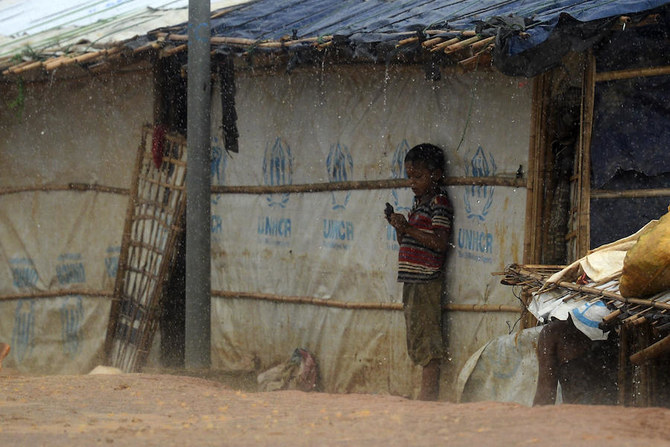
A Rohingya refugee boy takes shelter during a rainfall at the Kutupalong Rohingya refugee camp in Bangladesh's Ukhia district on August 24, 2019. (AFP)
Updated 20 October 2019
Follow

Bangladesh to move Rohingya to flood-prone island next month

  • Dhaka wants to move 100,000 refugees to Bhasan Char to ease overcrowding in its camps at Cox’s Bazar
  • The number of refugees in Cox’s Bazar has swelled since August 2017

DHAKA: Bangladesh will start relocating Rohingya Muslims to a flood-prone island off its coast next month as several thousand refugees have agreed to move, a government official said on Sunday.
Dhaka wants to move 100,000 refugees to Bhasan Char – a Bay of Bengal island hours by boat from the mainland – to ease overcrowding in its camps at Cox’s Bazar, home to more than 1 million Rohingya Muslims who have fled neighboring Myanmar.
“We want to start relocation by early next month,” Mahbub Alam Talukder, the Relief and Repatriation Commission chief based in Cox’s Bazar, told Reuters, adding that “the refugees will be shifted in phases.”
“Our officials are compiling the lists of the refugees who are willing to move there,” he said, adding that as many as 7,000 refugees had by Saturday agreed to shift.
Some human rights groups have expressed concern over that plan because the island is remote and prone to devastation from cyclones. Many refugees oppose the move, which some human rights experts fear could spark a new crisis.
Densely populated Bangladesh has been grappling with large refugee numbers, with local communities turning hostile toward Rohingya after a second failed bid to send thousands back to Myanmar in August.
The number of refugees in Cox’s Bazar has swelled since August 2017, when a Myanmar military-led crackdown that UN investigators have said was conducted with “genocidal intent” prompted some 730,000 Rohingya to flee.
A UN human rights investigator who visited in January said she feared a new crisis if Rohingya were taken to the island.
“There are a number of things that remain unknown to me even following my visit, chief among them being whether the island is truly habitable,” said Yanghee Lee, the UN special rapporteur on human rights in Myanmar.
Shah Kamal, secretary of Bangladesh’s Disaster Management Ministry, said the government was in talks with UN agencies to move the refugees to Bhasan Char, which it has been developing for the past three years.
“There is no reason to be concerned about floods because we have built storm surge embankment, with all other facilities,” he said.
“No one will be moved there against their will.”


US military boards sanctioned oil tanker in Indian Ocean

Updated 3 sec ago
Follow

US military boards sanctioned oil tanker in Indian Ocean

  • Tanker tracking website says Aquila II departed the Venezuelan coast after US forces captured then-President Nicolás Maduro
  • Pentagon says it 'hunted' the vessel all the way from the Caribbean to the Indian Ocean
WASHINGTON: US military forces boarded a sanctioned oil tanker in the Indian Ocean after tracking the ship from the Caribbean Sea, the Pentagon said Monday.
The Pentagon’s statement on social media did not say whether the ship was connected to Venezuela, which faces US sanctions on its oil and relies on a shadow fleet of falsely flagged tankers to smuggle crude into global supply chains.
However, the Aquila II was one of at least 16 tankers that departed the Venezuelan coast last month after US forces captured then-President Nicolás Maduro, said Samir Madani, co-founder of TankerTrackers.com. He said his organization used satellite imagery and surface-level photos to document the ship’s movements.
According to data transmitted from the ship on Monday, it is not currently laden with a cargo of crude oil.
The Aquila II is a Panamanian-flagged tanker under US sanctions related to the shipment of illicit Russian oil. Owned by a company with a listed address in Hong Kong, ship tracking data shows it has spent much of the last year with its radio transponder turned off, a practice known as “running dark” commonly employed by smugglers to hide their location.
US Southern Command, which oversees Latin America, said in an email that it had nothing to add to the Pentagon’s post on X. The post said the military “conducted a right-of-visit, maritime interdiction” on the ship.
“The Aquila II was operating in defiance of President Trump’s established quarantine of sanctioned vessels in the Caribbean,” the Pentagon said. “It ran, and we followed.”
The US did not say it had seized the ship, which the US has done previously with at least seven other sanctioned oil tankers linked to Venezuela.
A Navy official, who spoke on condition of anonymity to discuss military operations, would not say what forces were used in the operation but confirmed the destroyers USS Pinckney and USS John Finn as well as the mobile base ship USS Miguel Keith were operating in the Indian Ocean.
In videos the Pentagon posted to social media, uniformed forces can be seen boarding a Navy helicopter that takes off from a ship that matches the profile of the Miguel Keith. Video and photos of the tanker shot from inside a helicopter also show a Navy destroyer sailing alongside the ship.
Since the US ouster of Maduro in a surprise nighttime raid on Jan. 3, the Trump administration has set out to control the production, refining and global distribution of Venezuela’s petroleum products. Officials in President Donald Trump’s Republican administration have made it clear they see seizing the tankers as a way to generate cash as they seek to rebuild Venezuela’s battered oil industry and restore its economy.
Trump also has been trying to restrict the flow of oil to Cuba, which faces strict economic sanctions by the US and relies heavily on oil shipments from allies like Mexico, Russia and Venezuela.
Since the Venezuela operation, Trump has said no more Venezuelan oil will go to Cuba and that the Cuban government is ready to fall. Trump also recently signed an executive order that would impose a tariff on any goods from countries that sell or provide oil to Cuba, primarily pressuring Mexico because it has acted as an oil lifeline for Cuba.