

Turkey accused of using illegal phosphorus munitions in Syria

1 / 2
A young Kurdish man is treated at an emergency clinic for burns suffered from a suspected phosphorus bomb dropped by Turkish jets in northern Syria. (Photo credit: The Times of London)
2 / 2
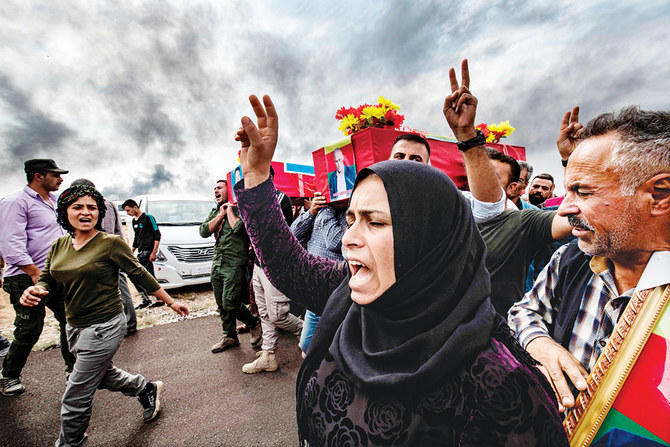
Mourners near the Syrian Kurdish border town of Ras Al-Ain attend the funeral of civilians and fighters, who died in attacks by Turkish-led forces. (AFP)
Updated 20 October 2019
Follow

Turkey accused of using illegal phosphorus munitions in Syria

  • Reports are credible, expert tells Arab News
  • Hospitals report spike in burns victims

ANKARA: Accusations that Turkey has used banned incendiary weapons against civilians in its invasion of northern Syria are credible, a leading security analyst told Arab News on Saturday.

Kurdish leaders said Turkish President Recep Tayyip Erdogan’s fighter jets had dropped munitions containing napalm and white phosphorus on civilian targets in the border town of Ras Al-Ain, a key objective for Turkish troops.

“The Turkish aggression is using all available weapons against Ras Al-Ain,” the Kurdish administration said. “Faced with the obvious failure of his plan, Erdogan is resorting to weapons that are globally banned, such as phosphorus and napalm.”

Nicholas Heras, an analyst at the Center for New American Security, told Arab News: “There are now multiple credible reports that Turkey has used white phosphorus munitions in its campaign in northeast Syria, and especially against the stubborn defenders of the city of Ras Al-Ain.”

The attacks on Ras Al-Ain are being investigated by UN chemical weapons inspectors, the Organization for the Prohibition of Chemical Weapons (OPCW), and Human Rights Watch. 

OPCW said it had “not yet determined the credibility of these allegations,” and its inspectors were monitoring the situation.

If the use of banned incendiary weapons were proved, it would be a grave violation of Turkey’s pledge to wage war with concern for civilian lives, Heras said.

HIGHLIGHTS

  • Erdogan’s jets ‘dropped munitions containing napalm and white phosphorus in Ras Al-Ain.’
  • The attacks are being probed by UN chemical weapons inspectors and Human Rights Watch.
  • A video posted on social media shows children with burns that a doctor says were consistent with the use of banned weapons.


Rami Abdel Rahman, head of UK-based monitoring group the Syrian Observatory for Human Rights, said there had been a spike in burn wounds treated at the Syrian-Kurdish hospital at Tal Tamir, mostly casualties brought in from the Ras Al-Ain area. 

The Kurdish Red Crescent said at least six people were being treated in hospital for burns. 

Kurdish officials posted a video on social media showing children with burns that one doctor in Hasakeh province said were consistent with the use of banned weapons.

Hamish de Bretton-Gordon, a British chemical weapons expert, told the UK newspaper The Times that the burns appeared to have been caused by white phosphorus.
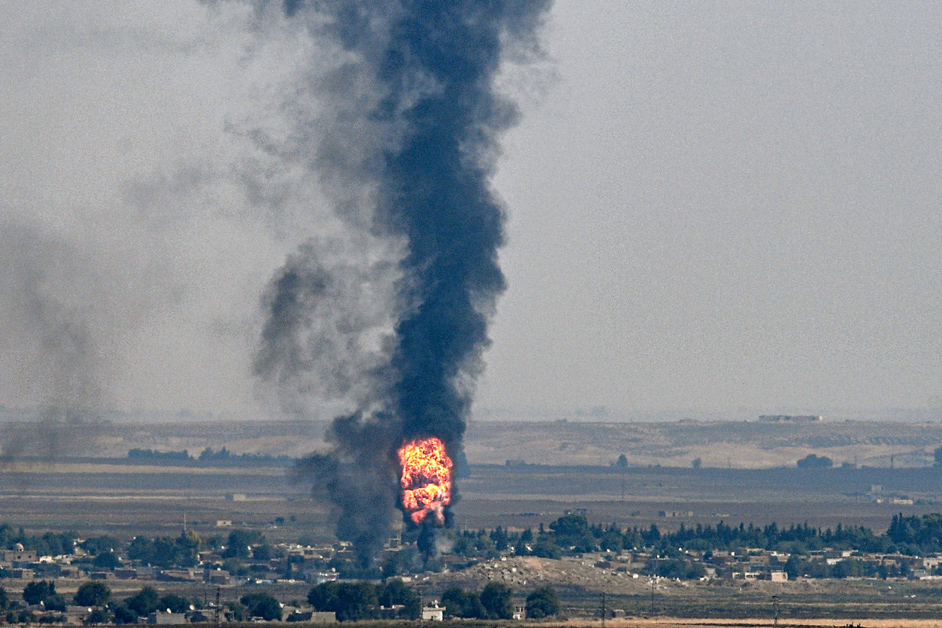


This picture taken on October 17, 2019 shows smoke and fire rising from the Syrian town of Ras al-Ain during the Turkish offensive against Kurdish groups in northeastern Syria. Kurdish authorities in northeastern Syria accused Turkey of resorting to banned weapons such as napalm and white phosphorus munitions. (AFP / Ozan Kose)

The substance may be used to create a smoke screen, or as a battlefield marker, especially at night, but its use as an incendiary weapon is prohibited under international law.

Since 1997, Turkey has been a signatory to the Convention on the Prohibition of the Development, Production, Stockpiling and Use of Chemical Weapons and on their Destruction.

Dr. Willem Theo Oosterveld, a senior fellow at the Hague Centre for Strategic Studies, said the deployment of white phosphorus was not explicitly prohibited by the Geneva Conventions. 

However, he said, under humanitarian law “the use of means and methods of warfare which are of a nature to cause superfluous injury or unnecessary suffering is prohibited.”


Lebanese finance minister denies any plans for a Kushner-run economic zone in the south

Updated 45 min 44 sec ago
Follow

Lebanese finance minister denies any plans for a Kushner-run economic zone in the south

  • Proposal was made by US Envoy Morgan Ortagus but was ‘killed on the spot’
  • Priority is to regain control of state in all aspects, Yassine Jaber tells Arab News

DAVOS: Lebanon’s finance minister dismissed any plans of turning Lebanon’s battered southern region into an economic zone, telling Arab News on the sidelines of the World Economic Forum’s meeting in Davos that the proposal had died “on the spot.”

Yassine Jaber explained that US Envoy to Lebanon Morgan Ortagus had proposed the idea last december for the region, which has faced daily airstrikes by Israel, and it was immediately dismissed.

Jaber’s comments, made to Arab News on the sidelines of the World Economic Forum in Davos, were in response to reports which appeared in Lebanese media in December which suggested that parts of southern Lebanon would be turned into an economic zone, managed by a plan proposed by Jared Kushner, US President Donald Trump’s son in law.

Meanwhile, Jaber also dismissed information which had surfaced in Davos over the past two days of a bilateral meeting between Lebanese ministers, US Middle East Envoy Steve Witkoff and Kushner.

Jaber said that the meeting on Tuesday was a gathering of “all Arab ministers of finance and foreign affairs, where they (Witkoff and Kushner) came in for a small while, and explained to the audience the idea about deciding the board of peace for Gaza.”

He stressed that it did not develop beyond that.

When asked about attracting investment and boosting the economy, Jaber said: “The reality now is that we need to reach the situation where there is stability that will allow the Lebanese army, so the (Israeli) aggression has to stop.”

Over the past few years, Lebanon has witnessed one catastrophe after another: one of the world’s worst economic meltdowns, the largest non-nuclear explosion in its capital’s port, a paralyzed parliament and a war with Israel.

A formal mechanism was put in place between Lebanon and Israel to maintain a ceasefire and the plan to disarm Hezbollah in areas below the Litani river.

But, the minister said, Israel’s next step is not always so predictable.

“They’re actually putting pressure on the whole region. So, a lot of effort is being put on that issue,” he added.

“There are still attacks in the south of the country also, so stability is a top necessity that will really succeed in pushing the economy forward and making the reforms beneficial,” he said.

Lawmakers had also enacted reforms to overhaul the banking sector, curb the cash economy and abolish bank secrecy, alongside a bank resolution framework.

Jaber also stressed that the government had recently passed a “gap law” intended to help depositors recover funds and restore the banking system’s functionality.

“One of the priorities we have is really to deal with all the losses of the war, basically reconstruction … and we have started to get loans for reconstructing the destroyed infrastructure in the attacked areas.”

As Hezbollah was battered during the war, Lebanon had a political breakthrough as the army’s general, Joseph Aoun, was inaugurated as president. His chosen prime minister was the former president of the International Court of Justice, Nawaf Salam.

This year marks the first time a solid delegation from the country makes its way to Davos, with Salam being joined by Jaber, Economy and Trade Minister Amr Bisat, and Telecoms Minister Charles Al-Hage.

“Our priority is to really regain the role of the state in all aspects, and specifically in rebuilding the institutions,” Jaber said.