

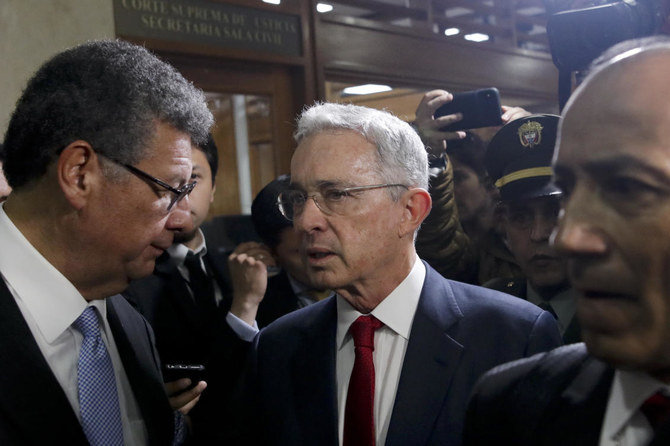

BOGOTA, Colombia: Powerful former President Alvaro Uribe appeared before Colombia’s Supreme Court on Tuesday for questioning in a case involving alleged witness tampering that could potentially cast a dark shadow over is legacy.
A magistrate queried Uribe behind closed doors for over seven hours about accusations that, through a lawyer, he tried to influence and even bribe members of a paramilitary group who had damaging information against him.
After the questioning, the court released a brief statement announcing that officials had concluded there were sufficient grounds to continue investigating Uribe, though no charges have been filed.
“I defended my loyalty to the truth,” Uribe said in a lengthy address to supporters that stretched late into the evening. The case stems from allegations raised by Sen.
Ivan Cepeda, who claims he has firsthand witness accounts that Uribe was a founding leader of a paramilitary group in his home province during the decades-long civil conflict involving government forces, leftist rebels and right-wing bands.
The ex-chief of state has denied all accusations of ties to the paramilitaries, who are accused of drug trafficking, killing innocents and driving thousands from their homes or lands while fighting rebels.
The case has divided the South American nation and set off demonstrations both in favor of and against the ex-president.
Political analysts are also watching it as an important test for Colombia’s justice system, which throughout its history has struggled to hold prominent political and military leaders accountable.
“It’s crucial that Colombia’s justice system handles this with professional, dispassionate rigor so that it doesn’t devolve into a circus,” said Adam Isacson, a Colombia expert with the Washington Office on Latin American think tank.
Perhaps no political leader in Colombia’s recent history has wielded as much influence as Uribe, who still has legions of followers.
He led the “no” campaign that preceded Colombian voters rejecting a peace accord with leftist rebels in 2016, though the government later adopted a slightly revised version. Last year, Uribe’s support lifted a little-known senator, Ivan Duque, to the presidency.
But allegations of ties to drug cartels and paramilitaries have dogged him since the early 1980s, when the civil aviation agency he led was accused of giving air licenses to drug traffickers. Declassified State Department cables from a decade later show US officials were told the up-and-coming politician had ties to cartels.
Uribe has persistently denied those charges and was an unwavering US ally in the war on drugs during his 2002-2010 presidency.
He extradited a record number of suspected drug traffickers to the US and aggressively expanded a US program to aerially spray wide swaths of illegal coca crops with chemical herbicide.
“I never thought my defense of honor and love for Colombia, with respect for citizens and in accordance with the Constitution, would create legal problems for me,” Uribe said Monday.
His court appearance stems from allegations that Cepeda made in 2014 during a debate in Congress over Uribe’s alleged paramilitary ties. Cepeda claimed he had accounts from two ex-combatants confirming the association.
Uribe in turn accused Cepeda of slander, but the Supreme Court later dismissed the case, instead opening an investigation into the ex-president.
The case hinges largely on statements by former paramilitary fighter Juan Guillermo Monsalve, who claims Uribe helped form a branch of the United Self-Defense Forces of Colombia, an umbrella paramilitary group.
Monsalve alleges a lawyer for Uribe, Diego Cadena, pressured him to retract his statement. A second ex-paramilitary has also alleged that Cadena paid him to testify in favor of the former president.
Many Colombians are either devout Uribe loyalists who praise his iron-fisted approach to defeating leftist rebels while president or skeptics who have long wanted to see the former leader in court.
“Whether they convict him or absolve him, half of all Colombians will be angry,” the newsweekly Semana recently wrote.
Uribe’s legal woes are also mingled with frustrations over the peace deal with leftist guerrillas. Most ex-rebels will serve no jail time if they fully confess any crimes, an offer that irks many Colombians. Several former rebel commanders are serving in Congress, another stipulation of the fragile accord.
Uribe acolytes like Sen. Paloma Valencia complain the judicial system is letting ex-combatants accused of multiple, grave human rights violations off easy while interrogating a popular former president.
“It’s surprising that who is being called to court is a leader who has represented the majority of Colombians in recent years,” she told the newspaper El Tiempo.
As Uribe arrived at the Palace of Justice, surrounded by six bodyguards, several hundred people gathered outside chanting phrases against him, including, “The people are angry!“
“Let the court deliver justice,” said Marta Delgado, a housewife holding up a white poster with the words, “I support the Supreme Court.”
About 50 police officers stood guard in front of the historic building, where a 1985 attack by leftist M19 guerrillas — and a heavy-handed police and military response — left over 100 people dead.
A smaller group yelled out in favor of Uribe, crying, “We are with you!” “He’s always looked after the wellbeing of Colombians,” said Luis Munera, who runs a cattle and fruit tree farm. “I can’t accept him being branded a paramilitary.”
In his evening address, Uribe delivered a detailed account stretching more than an hour explaining why he is innocent and reminding Colombians of his accomplishments in defeating guerrillas and reducing crime.
He included seemingly unrelated details, like the charcuterie he brought to a political event, while also touching on the current president’s environmental policy and the neurological impacts of drug use.
Regarding the questioning by the court, he said he has “tranquility” in knowing that he defended the truth and expressed reverence for the magistrate who interrogated him.
“I have no complaints,” Uribe said. “He should have observed my respect for justice.”


