

Face masks banned as Hong Kong leader invokes emergency powers

1 / 2
Hong Kong’s ban on face masks would take effect on Saturday under colonial-era emergency powers invoked for the first time in more than 50 years. (AFP)
2 / 2
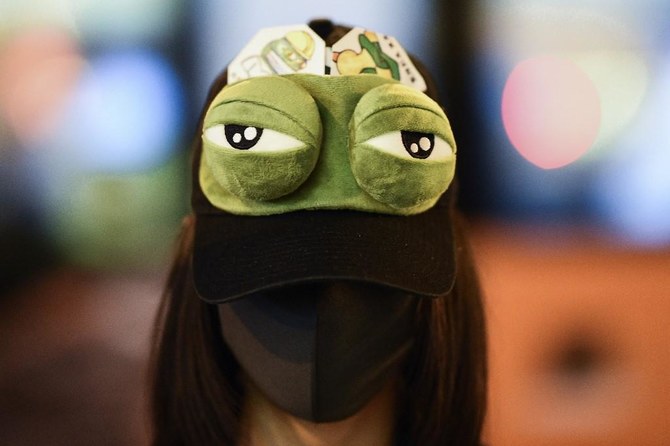
Hong Kong protesters have used face masks to avoid identification. (AFP)
Updated 06 October 2019
Follow

Face masks banned as Hong Kong leader invokes emergency powers

  • The emergency law was last used 52 years ago
  • Protesters used face masks, yellow helmets, goggles and respirators to protect themselves

HONG KONG: Hong Kong’s embattled leader Carrie Lam on Friday invoked colonial-era emergency powers for the first time in more than 50 years in a dramatic move intended to quell escalating violence in the Chinese-ruled city.

Lam, speaking at a news conference, said a ban on face masks would take effect on Saturday under the emergency laws that allow authorities to “make any regulations whatsoever” in whatever they deem to be in the public interest.

Many protesters wear masks to hide their identity due to fears employers could face pressure to take action against them.

It was not clear how the government would implement the mask ban in a city where many of its 7.4 million residents wear them every day to protect against infection following the outbreak of the deadly Severe Acute Respiratory Syndrome (SARS) in 2003.

Four months of anti-government protests have plunged the former British colony into its biggest political crisis since its handover to Beijing in 1997 and have created a serious challenge to Chinese leader Xi Jinping.

Violence escalated on Tuesday, the 70th anniversary of the founding of the People’s Republic of China, when police fired about 1,800 volleys of tear gas, 900 rubber bullets and six live bullets — one of which hit an 18-year-old.

The student, Tony Tsang, was shot at close range as he fought an officer with what appeared to be a white pole. He has been charged with rioting, which carries a maximum 10-year sentence, and assaulting an officer. Tsang is in stable condition in hospital.

The shooting enraged protesters who rampaged across the city, throwing petrol bombs, blocking roads and starting fires as police responded with tear gas.

Even before the new rules were confirmed, protests against them began across the Asian financial hub, with hundreds of office workers wearing masks gathering to march. “Police brutality is becoming more serious and the set-up of an anti-mask law is to threaten us from protesting,” said one protester, who asked to be identified as just Chan, a 27-year-old financial industry worker.

Pro-Beijing groups had been pushing for legislation to ban face masks at demonstrations.

The protesters are angry about what they see as creeping interference by Beijing in their city’s affairs despite a promise of autonomy in the “one country, two systems” formula under which Hong Kong returned to China in 1997.

China dismisses accusations it is meddling and has accused foreign governments, including the United States and Britain, of stirring up anti-China sentiment.

What began as opposition to a proposed extradition law, that could have seen people sent for trial in mainland courts, has grown into a call for five demands, including universal suffrage and an inquiry into alleged police brutality.

The protests have been inflamed by the police shooting of a teenaged secondary school student on Tuesday during a clash, and more rallies are expected later in the evening and over the weekend.

Authorities have already loosened guidelines on the use of force by police, according to documents seen by Reuters.


Iran war unsettles India’s packaged water makers as bottles, caps get pricey

Updated 12 March 2026
Follow

Iran war unsettles India’s packaged water makers as bottles, caps get pricey

  • Higher polymer ‌prices hurt bottled water industry
  • Industry worth $5 billion has big multinational players like Pepsi, Coca-Cola

NEW ​DELHI: The Iran war is rattling India’s $5 billion packaged water market just ahead of the sweltering summer season.
One of the world’s fastest growing bottled water markets is seeing some manufacturers hike prices for distributors, as supply disruptions linked to the war fuel higher costs in everything from plastic bottles to caps, labels and cardboard boxes.
Though retail prices are yet to feel the heat and bigger companies are absorbing the pain, about 2,000 smaller bottled water makers have increased rates for their resellers by around 1 rupee per ‌bottle, a ‌5 percent hike, which will rise by a further 10 percent in ​coming ‌days, ⁠according ​to the ⁠Federation of All India Packaged Drinking Water Manufacturers’ Association.
Consumers usually pay less than 20 rupees, or around 20 US cents, for a one-liter bottle.
“There is chaos and within the next 4-5 days, this will start impacting customer prices,” said Apurva Doshi, the federation’s secretary general.
Rising oil prices have increased the cost of polymer, which is made from crude oil and is a key material for the industry’s plastic bottles. The cost of material used in making ⁠plastic bottles has risen by 50 percent to 170 rupees per kilogram, ‌while the price of the caps has more than ‌doubled to 0.45 rupees apiece. Even corrugated boxes, labels and ​adhesive tape are costing much more, ‌industry letters showed.
Clean water is a privilege in the country of 1.4 billion people where ‌researchers say 70 percent of the groundwater is contaminated, leaving people reliant on bottled water. Companies including Bisleri, Coca-Cola’s Kinley, Pepsi’s Aquafina, billionaire Mukesh Ambani’s Reliance and Tata all compete for a share of the $5 billion market. The companies did not respond to Reuters request for comment.
PREMIUM WATER FACES HEAT ‌TOO
Within the broad bottled water market, natural mineral water is a $400 million business in India and a new, fast-growing wellness product for ⁠India’s wealthy.
The premium ⁠water segment accounted for 8 percent of the bottled water market last year in India, compared to just 1 percent in 2021, Euromonitor says.
Aava, which sells mineral water sourced from the foothills of the Aravalli mountains, has increased prices of its water bottles by 18 percent for resellers, Shiroy Mehta, CEO of the company, told Reuters.
“Most manufacturers are absorbing 40-50 percent of the cost to ensure that they don’t lose clients. It’s a poor situation for the beverage industry ahead of the summer season,” he said.
The mass market, however, is dominated by companies that produce “drinking water” to be sold in 1-liter bottles to customers. Clear Premium Water, a brand of India’s Energy Beverages, said in a notice to its distributors there ​had been an “unprecedented and continuous surge” in ​prices of key raw materials used in packaging and production.
“It is no longer possible for us to absorb the escalating costs while maintaining existing product prices,” the notice said.