

Pakistan central bank expected to hold rates on Monday ahead of IMF deal

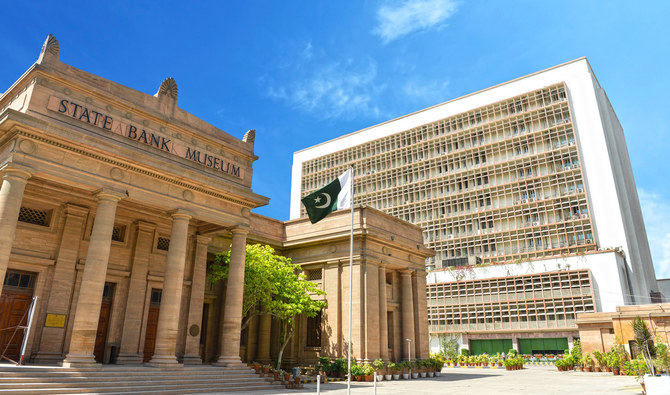
This file photo, posted on August 7, 2023, shows Pakistan’s central bank and State Bank Museum in Karachi. (Photo courtesy: Facebook/SBP)
Short Url
Updated 26 April 2024
Follow

Pakistan central bank expected to hold rates on Monday ahead of IMF deal

  • Median estimate in Reuters poll predicts State Bank will hold rates steady
  • South Asian nation is seeking new long-term, larger IMF bailout program

KARACHI: Pakistan’s central bank is widely expected to hold its key interest rate at a record 22 percent for the seventh straight policy meeting on Monday as Pakistan gears up for an International Monetary Fund board approval and talks on a longer term program.
Monday’s policy decision will be followed by the fund’s executive board meeting to discuss the approval of $1.1 billion in funding for Pakistan, which is the last tranche of a $3 billion standby arrangement with the IMF secured last summer to avert a sovereign default.
The median estimate in a Reuters poll of 14 analysts predicts the State Bank of Pakistan (SBP) will hold rates steady.
Four analysts are forecasting a 100-basis-point (bps) cut, while two expect a 50-bps cut on Monday.
Eight respondents expect a rate cut before Pakistan signs a new program with the IMF. There is another MPC meeting on 10 June 2024, which is possibly before Pakistan gets another IMF Programme.
The South Asian nation is seeking a new long-term, larger IMF loan. Pakistan’s Finance Minister, Muhammad Aurangzeb, has said Islamabad will begin talks with the fund next month, and could secure a staff-level agreement on the new program by early July.
Pakistan’s key rate was last raised in June to fight persistent inflationary pressures and to meet one of the conditions set by the IMF for securing the bailout.
Pakistan’s Consumer Price Index (CPI) for March rose 20.7 percent from the year before, slowing down partly due to the “base effect,” touching a record high of 38 percent in May 2023.
Tahir Abbas, head of research at Arif Habib Limited said that the central bank is unlikely to cut rates before getting a new IMF program. “The monetary policy will also consider the inflationary outcome of tensions in the middle east and its impact of fuel prices, along with the Fed’s delay in monetary easing,” he added.
“Expect a symbolic reduction in the current quarter (till June), with aggressive cuts to follow in the September quarter as the government has to roll over approximately 6.7 trillion rupees of maturing domestic treasury bills in the last quarter of the calendar year,” said Mustafa Pasha, CIO of Lakson Investments.
He added that by then there will be greater clarity on inflation and FX inflows. “Historically the SBP has cut rates in the 1st year of an IMF program and we expect the policy rate to settle around 17 percent by December.”

Imran Khan’s party shutdown draws mixed response; government calls it ‘ineffective’

Updated 08 February 2026
Follow

Imran Khan’s party shutdown draws mixed response; government calls it ‘ineffective’

  • Ex-PM Khan’s PTI party had called for a ‘shutter-down strike’ to protest Feb. 8, 2024 general election results
  • While businesses reportedly remained closed in Khyber Pakhtunkhwa, they continued as normal elsewhere

ISLAMABAD: A nationwide “shutter-down strike” called by former prime minister Imran Khan’s party drew a mixed response in Pakistan on Sunday, underscoring political polarization in the country two years after a controversial general election.

Khan’s Pakistan Tehreek-e-Insaf (PIT) opposition party had urged the masses to shut businesses across the country to protest alleged rigging on the second anniversary of the Feb. 8, 2024 general election.

Local media reported a majority of businesses remained closed in the Khyber Pakhtunkhwa (KP) province, governed by the PTI, while business continued as normal in other provinces as several trade associations distanced themselves from the strike call.

Arab News visited major markets in Islamabad’s G-6, G-9, I-8 and F-6 sectors, as well as commercial hubs in Rawalpindi, which largely remained operational on Sunday, a public holiday when shops, restaurants and malls typically remain open in Pakistan.

“Pakistan’s constitution says people will elect their representatives. But on 8th February 2024, people were barred from exercising their voting right freely,” Allama Raja Nasir Abbas Jafri, the PTI opposition leader in the Senate, said at a protest march near Islamabad’s iconic Faisal Mosque.

Millions of Pakistanis voted for national and provincial candidates during the Feb. 8, 2024 election, which was marred by a nationwide shutdown of cellphone networks and delayed results, leading to widespread allegations of election manipulation by the PTI and other opposition parties. The caretaker government at the time and the Election Commission of Pakistan (ECP) both rejected the allegations.

Khan’s PTI candidates contested the Feb. 8 elections as independents after the party was barred from the polls. They won the most seats but fell short of the majority needed to form a government, which was made by a smattering of rival political parties led by Prime Minister Shehbaz Sharif. The government insists the polling was conducted transparently and that Khan’s party was not denied a fair chance.

Authorities in the Pakistani capital deployed a heavy police contingent on the main road leading to the Faisal Mosque on Sunday. Despite police presence and the reported arrest of some PTI workers, Jafri led local PTI members and dozens of supporters who chanted slogans against the government at the march.

“We promise we will never forget 8th February,” Jafri said.

The PTI said its strike call was “successful” and shared videos on official social media accounts showing closed shops and markets in various parts of the country.

The government, however, dismissed the protest as “ineffective.”

“The public is fed up with protest politics and has strongly rejected PTI’s call,” Pakistan’s Information Minister Attaullah Tarar said on X.

“It’s Sunday, yet there is still hustle and bustle.”

Ajmal Baloch, All Pakistan Traders Association president, said they neither support such protest calls, nor prevent individuals from closing shops based on personal political affiliation.

“It’s a call from a political party and we do not close businesses on calls of any political party,” Baloch told Arab News.

“We only give calls of strike on issues related to traders.”

Khan was ousted from power in April 2022 after what is widely believed to be a falling out with the country’s powerful generals. The army denies it interferes in politics. Khan has been in prison since August 2023 and faces a slew of legal challenges that ruled him out of the Feb. 8 general elections and which he says are politically motivated to keep him and his party away from power.

In Jan. 2025, an accountability court convicted Khan and his wife in the £190 million Al-Qadir Trust land corruption case, sentencing him to 14 years and her to seven years after finding that the trust was used to acquire land and funds in exchange for alleged favors. The couple denies any wrongdoing.