ISLAMABAD: Pakistan’s economic indicators are showing positive signs, with an agenda of painful reforms and privatization on track, Prime Minister Shehbaz Sharif said on Friday, ahead of an IMF board meeting to decide on a $1.1 billion funding for the country.
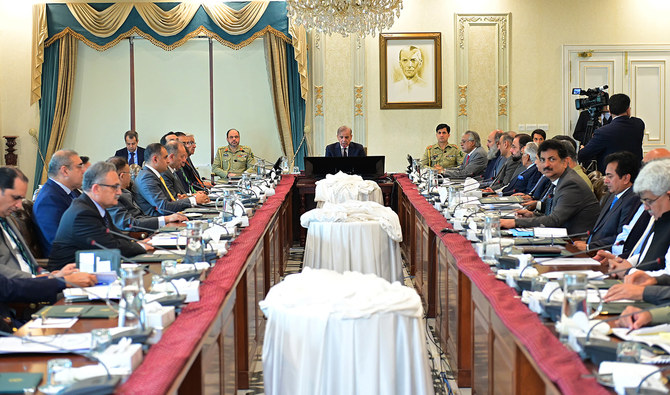
The prime minister said, in an address to his cabinet that was telecast live, that exports and remittances had shown a rise within one-and-a-half month of his government.
The IMF board is meeting on Monday to decide on the disbursement of the second and last tranche of a $3 billion standby arrangement Islamabad secured last summer to avert a sovereign default.
With a chronic balance of payment crisis, Pakistan needs $24 billion in payments for debt and interest servicing in the next fiscal year starting July 1 — three-time more than its central bank’s foreign currency reserves.
The South Asian nation is seeking yet another long-term, larger IMF loan. Pakistan’s Finance Minister, Muhammad Aurangzeb, has said Islamabad could secure a staff-level agreement on the new program by early July.
If successful, it would be the 24th IMF bailout for Pakistan.
The IMF-led structural reforms require Pakistan to raise its tax to GDP ratio from around 9 percent to at least 13 percent-14 percent, stop losses in state-owned enterprise and manage its energy sector losses which run into trillions of rupees.
“It is not just for an antibiotic to work anymore. It needs a surgery,” Sharif said.
Pakistan’s finance ministry expects the economy to grow by 2.6 percent in the current fiscal year ending June, while average inflation is projected to stand at 24 percent, down from 29.2 percent in fiscal year 2023/2024.
Inflation soared to a record high of 38 percent last May.


Pakistan’s economic conditions improving, reforms and privatization on track — PM
https://arab.news/6nuxw
Pakistan’s economic conditions improving, reforms and privatization on track — PM

- Sharif says exports and remittances had shown a rise within one-and-a-half month of his government
- Pakistan’s finance ministry expects the economy to grow by 2.6 percent in the current fiscal year ending June

Pakistan IT exports rise nearly 20 percent to $2.61 billion in first seven months of fiscal year
- January ICT exports climb to $374 million year-on-year
- Sector remains country’s top-earning services export
KARACHI: Pakistan’s information and communication technology (ICT) export earnings rose 19.78 percent year-on-year to $2.61 billion in the first seven months of the fiscal year ending June 2026, the IT ministry said on Tuesday, highlighting the sector’s growing role as a source of foreign exchange.
Pakistan’s IT and IT-enabled services sector has emerged as one of the country’s fastest-growing sources of foreign exchange, generating over $3 billion annually and employing roughly a million freelancers in addition to formal software firms.
Unlike traditional manufacturing exports, the industry relies primarily on remote digital labor, from software development to back-office services, making it resilient during economic crises but constrained by payment barriers, talent migration and infrastructure reliability challenges. However, IT services require minimal imports and benefit from a large pool of young workers and freelancers, making the sector central to government plans to boost dollar inflows and reduce pressure on the balance of payments.
“ICT export remittances surged 19.78 percent, reaching $ 2.61 billion during the first seven months of FY 2025-26 compared to $ 2.18 billion achieved during the corresponding period last year,” the IT ministry said in a statement.
Monthly exports also expanded, with ICT services exports reaching $374 million in January 2026, up 19.5 percent from $313 million a year earlier, according to the ministry’s data.
The ministry said ICT remained the country’s highest-earning services sector, well ahead of “other business services,” which generated $1.21 billion over the same July-January period.
Pakistan has increasingly relied on technology exports, including software development, outsourcing and freelance services, to generate foreign exchange as the economy adjusts under structural reforms and tight import controls following a balance-of-payments crisis.
Officials say continued growth will depend on easing payment bottlenecks, improving digital infrastructure and expanding higher-value technology services beyond traditional outsourcing.


