

European unity is the best response to pressing issues of today’s world

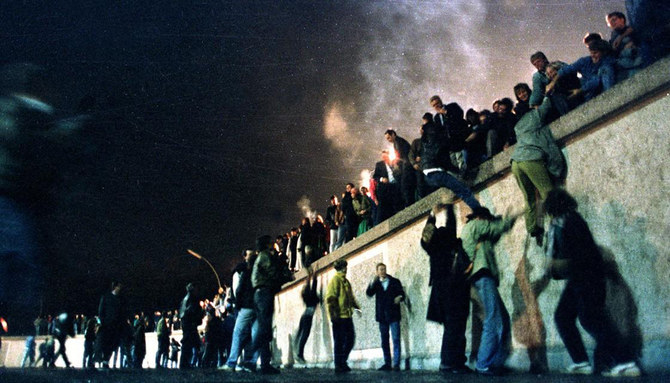
East German citizens climb the Berlin wall in November 1989. (Reuters/ File)
Updated 03 October 2019
Follow

European unity is the best response to pressing issues of today’s world


Heiko Maas

Just a few days ago, I stood on the same balcony on which, precisely 30 years ago, German Vice Chancellor Hans Dietrich Genscher informed many hundreds of East German citizens who had taken refuge in the West German Embassy in Prague that they would be able to leave for the Federal Republic.

Hungary, in what was an exemplary step, had opened its borders with Austria in September 1989 to tens of thousands of people who had fled East Germany, thereby enabling them eventually to travel to West Germany. We also celebrated this with young people from Germany and Hungary in Berlin a few days ago.

Both events were important milestones on the path to German unity. They left significant symbolic cracks in the Berlin Wall and, as a result, its days were numbered. It is therefore to a large extent also thanks to Hungary, and the former Czechoslovakia, that we Germans have been able to celebrate our unity for the past 29 years.

It was clear as I stood on the balcony in Prague, and in my conversations with eyewitnesses — for example during the celebrations marking the 30th anniversary of the opening of the border in Hungary — that the reunification of Germany and Europe was founded on the belief that a united continent offered all people a better future than the clash of systems. In 1989 and 1990, our international partners were confident that a united Germany would, together with its neighbors, give rise to a peaceful and free Europe in a spirit of solidarity.

The reunification of Germany and Europe was founded on the belief that a united continent offered all people a better future than the clash of systems.

Heiko Maas

We are more convinced than ever that a strong and united Europe is the best response to the pressing issues of our times. Such a Europe is also the best guarantor of peace and prosperity for Germany. It is, therefore, all the more important that, despite whatever differences we may have, we continue our close dialogue with our partners in Eastern Europe.

Reinforcing our community is what will take us forward, not emphasizing our differences. We want to underscore this especially during our presidency of the EU Council in 2020 — the 30th anniversary of German unification.

The events in East Germany in the autumn of 1989 also demonstrated the power that people have when they take to the streets in peaceful protest and stand up for their democratic rights. Examples come to mind from all around the world in which we can observe something similar today.

This shows how important it is for us to stand up for democratic values, the protection of human rights and a rules-based international order, not least against the backdrop of our own experience. We are assuming responsibility for this at the global level together with our partners.


Heiko Maas  is the foreign minister of Germany


Afghan man goes on trial over deadly Munich car-ramming

Updated 4 sec ago
Follow

Afghan man goes on trial over deadly Munich car-ramming

  • The suspect, partially identified as Farhad N., 25, remained silent and did not offer a statement at the opening of the trial
  • He faces two charges of murder and 44 of attempted murder

MUNICH: An Afghan man went on trial in Germany on Friday accused of ramming a car into a crowd in Munich last year, killing a two-year-old girl and her mother and injuring dozens.
The suspect, partially identified as Farhad N., 25, remained silent and did not offer a statement at the opening of the trial, sitting in the dock wearing a green fur-lined hooded jacket.
He faces two charges of murder and 44 of attempted murder, with prosecutors saying he acted out of a “religious motivation” and expected to die in the attack.
The vehicle rampage in February 2025 was one of several deadly attacks linked to migrants which inflamed a heated debate on immigration ahead of a general election that month.
Farhad N. is accused of deliberately steering his car into a 1,400-strong trade union street rally in Munich on February 13.
The vehicle came to a halt after 23 meters (75 feet) “because its front wheels lost contact with the ground due to people lying in front of and underneath the car,” according to the charge sheet.
A 37-year-old woman and her young daughter were both hurled through the air for 10 meters and sustained severe head injuries, of which they died several days later.
Prosecutors have said Kabul-born Farhad N. “committed the act out of excessive religious motivation,” and that he had uttered the words “Allahu Akbar,” meaning “God is the greatest,” after the car rampage.
“He believed he was obliged to attack and kill randomly selected people in Germany in response to the suffering of Muslims in Islamic countries,” they said when he was charged in August.
However, he is not believed to have been part of any Islamist militant movement such as the Daesh group.
Farhad N. was examined by a psychiatrist after exhibiting “certain unusual behaviors” during pretrial detention, including a tic in which he sometimes twitches his head, a court spokesman said on Friday.
The preliminary psychiatric report concluded that he is criminally responsible, but the presiding judge has said that the issue could be considered during the proceedings, according to the spokesman.
The trial is scheduled to run for 38 days until the end of June.

- Spate of attacks -

Farhad N. arrived in Germany in 2016 as an unaccompanied teenager, having traveled overland at the height of the mass migrant influx to Europe.
His asylum request was rejected but he was spared deportation, found work with a series of jobs and was able to remain in the country.
Police said Farhad N. worked in security and was heavily engaged in fitness training and bodybuilding.
The Munich attack came a month after another Afghan man had carried out a knife attack on a kindergarten group that killed two people, including a two-year-old boy, in the city of Aschaffenburg.
The perpetrator was later confined to a psychiatric facility after judges found he had acted during an acute psychotic episode.
In December 2024, six people were killed and hundreds wounded when a car plowed into a Christmas market in the eastern city of Magdeburg. A Saudi man was arrested and is currently on trial.
Several Syrian nationals were also arrested over attacks or plots at around the same time, including a stabbing spree that killed three people at a street festival in the city of Solingen.
Germany took in more than a million asylum seekers in 2015-2016 — an influx that has proved deeply divisive and helped fuel the rise of the far-right AfD.
Chancellor Friedrich Merz, who took power last May, has vowed to crack down on criminal migrants and has ramped up deportations of convicts to Afghanistan.
Germany in December also deported a man to Syria for the first time since that country’s civil war broke out in 2011.