

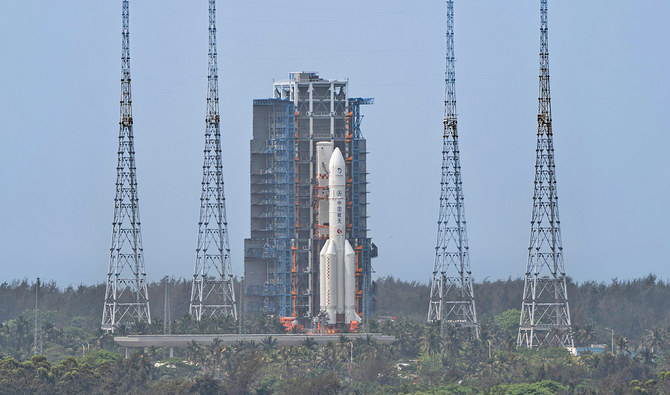

ISLAMABAD: ‘ICUBE-Qamar’ (ICUBE-Q), a cube satellite, is poised to become Pakistan’s first entry into the lunar orbit as part of China’s Chang’e-6 mission today, Friday, with developers describing it as a “historic moment” that would open new avenues for future deep space missions from the South Asian nation.
Chang’e 6 is a planned robotic Chinese and Pakistani lunar exploration mission that will attempt Beijing’s second sample return mission and aims to obtain the first-ever soil and rock samples from the lunar far side and return them to earth. The samples will contain material ejected from the lunar mantle and will be used to provide insight into the history of the moon, earth, and the solar system.
The primary phase of the mission is expected to last about 53 days. Like its predecessors, the spacecraft is named after the Chinese moon goddess Chang’e.
Around 100 students from Pakistan’s Institute of Space Technology (IST) have contributed to developing the satellite, scheduled to launch into lunar orbit at 12:50 PM PST on Friday, May 3, 2024, from the Wenchang space launch site in Hainan, China.
“This is Pakistan’s first deep space mission which is indeed a historic moment and following that maybe in the future other deep space missions can be planned,” Khurram Khurshid, the head of the electrical engineering and computer science department at IST and a co-lead on the satellite project, told Arab News.
Pakistan’s proposal to build the satellite was accepted by the China National Space Agency (CNSA) from plans submitted by eight member states of the Asia-Pacific Space Cooperation Organization (APSCO).
“In the first month of 2022, out of all the proposals from the APSCO member states, the Chinese space agency thoroughly evaluated and selected one, which happened to be ours which was a significant moment for us as our proposal was chosen in deep space mission.”
The design, development, and qualification of the ICUBE-Q satellite were spearheaded by faculty members and students of the IST in collaboration with China’s Shanghai Jiao Tong University (SJTU), with support from Pakistan’s National Space Agency, SUPARCO.
“Along with faculty members, around 100 students contributed to various aspects of the satellite, including electrical engineering for electronics, aerospace engineering for control systems, computer science for software, and mechanical/materials engineering for identifying materials suitable for the moon’s harsh environment,” Khurshid said.
The ICUBE-Q has two cameras as payload for taking images of the lunar surface that will be transmitted back to earth for analysis, the official said.
Khurshid said after selection in 2022, it took two years of round-the-clock work by students and researchers to complete the project within the deadline.
“The design and development of the satellite were finished approximately eight months ago after rigorous qualification tests, some conducted in-house and others by SPARCO,” he said.
The satellite was then sent to China eight months back for further verification to ensure it met all requirements.
“China’s stringent standards meant even minor discrepancies could result in rejection, emphasizing the importance of successful qualification tests,” he added, “and once these tests were successfully completed, it marked a significant milestone as it validated our designs and confirmed the satellite’s readiness for the mission.”
The major cost in such missions was the substantial funding required to launch a satellite, Khurshid said, adding that the cost of manufacturing the satellite was not high and was funded by SUPARCO:
“It is a small satellite, like a 7 kg satellite, so it was not a big cost as major cost required for launching a satellite will be provided free by China.”
After securing the free launch opportunity, all the faculty and students involved “got very excited and devoted their efforts to this project,” Khurshid said.
Four of the Pakistan team members are in China to witness the historic launching.


