LONDON : The National Day of Germany this year coincides with the upcoming 30th anniversary of the fall of the Berlin Wall.
The Oct. 3 event also comes at another key moment in the nation’s post-Cold War history, with Angela Merkel’s long chancellorship now in its twilight phase after around a decade and a half in office.
Merkel has long been the most important political leader in continental Europe, having been head of the German Christian Democratic Union (CDU) from 2000 to 2018, and chancellor since 2005.
Indeed, in the era of Donald Trump, she has had solid claims to being the most influential leader in the Western world too, with the potential exception of Emmanuel Macron.
To put Merkel’s achievements into wider international perspective, three US presidents (George Bush, Barack Obama and Trump), four French presidents (Jacques Chirac, Nicolas Sarkozy, Francois Hollande and Macron), and five UK prime ministers (Tony Blair, Gordon Brown, David Cameron, Theresa May and Boris Johnson) have so far served during her long tenure.
Merkel has already exceeded the previous record of Margaret Thatcher as Europe’s longest serving female leader, which was 11 years.
It remains unclear if she will serve a full fourth term to 2021, by which time she would match Helmut Kohl’s 16 years of office from 1982 to 1998 and surpass Konrad Adenauer’s service from 1949 to 1963 as Germany’s first post-war chancellor.
Indeed, a full fourth term would place Merkel only behind Otto von Bismarck, who served for almost two decades from 1871–90 during a period in which he was a dominant force in European affairs, having helped previously drive the unification of Germany.
Yet, while Merkel is such a pivotal figure on the global stage, with Germany the anchor country in the EU, she is facing challenges on multiple fronts.
This includes defending the integrity of the EU and preserving the broader Western post-war order that she and many compatriots in Germany so value.
Merkel has played a major role in the last decade in efforts to stabilize the Brussels-based club of the EU — from the Greek debt crisis through to the immigration challenges, in which her country took in a million refugees and migrants in 2015 alone.
Another challenge to the EU’s stability are the continuing Brexit negotiations, which will come to a head again this Autumn with the possibility that the United Kingdom could leave with “no-deal.”
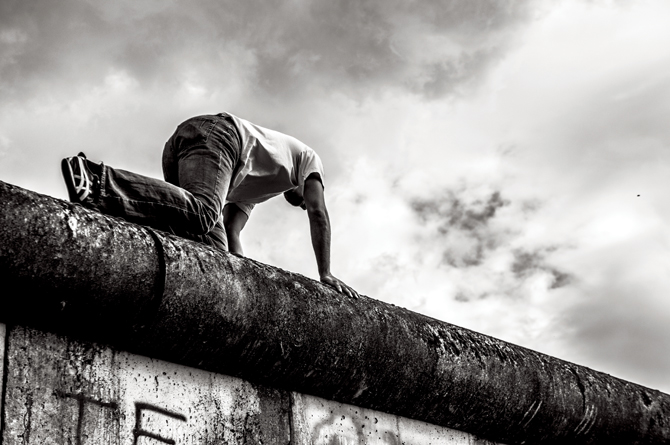
The 30th anniversary of the fall of the Berlin Wall coincides with the German National Day on Oct. 3. (Shutterstock)
Beyond Brexit, the fragility of broader political situation across the continent is shown not only by the weakening of Merkel’s own government, but also by the populist surge in eastern Europe.
Donald Tusk, president of the EU Council, has remarked that the challenges are collectively perhaps the “most dangerous ever.”
According to Tusk, two of the main threats are the rise of anti-EU, nationalist sentiment across the continent, and the “state of mind of pro-European elites,” which Tusk fears are too subservient to “populist arguments, as well as doubting in the fundamental values of liberal democracy.”
While Brexit exemplifies these challenges, the problem is by no means limited to the UK, as countries from Italy to Poland show.
If these issues were not big enough for Merkel, the third threat cited by Tusk is what he calls the new geopolitical reality that has witnessed an increasing assertive Russia and instability in the Middle East and Africa. The latter has driven the migration problems that are afflicting Europe.
Intensifying this is the uncertainty from Washington, with Trump previously calling for more Brexits across the continent.
Merkel’s own style and values have frequently collided with those of Trump, who relishes his role as disruptor of the established Western order that she embodies.
While the White House has asserted that Germany is “a bedrock of the transatlantic relationship and the NATO alliance,” bilateral relations have unquestionably been cooler in recent years.
This was symbolised in March 2017 when Merkel first met Trump. He appeared to refuse shaking her hand at a press conference, and the two did not even speak from last autumn for more than five months before a phone call on March 1.
The personal animosity between Trump and Merkel has brought a chill to bilateral relations with several issues becoming thornier in the bilateral relationship, including trade and defence spending.
On trade, Trump has called Germany “very bad” because of its significant trade surplus — with exports larger than imports; the president has particularly singled out the nation’s car exports, which he has threatened to put tariffs on.
Merkel is acutely aware of this irritant in bilateral relations and has asserted that Germany’s trade surplus is on a pathway to narrowing due to higher domestic demand.
A second sore centres around Germany’s failure to spend 2 percent of GDP on defense spending, a key NATO goal. Indeed, the country spent “only” 1.13 percent of GDP in 2017.
Again, Merkel acknowledges the vulnerability here. She asserts that the nation is committed to the 2% target, with foreign missions from Mali to Afghanistan and humanitarian aid in Syria.
Yet, the tensions between Germany and the US are a microcosm of broader tensions within the Western alliance which Merkel cares so deeply about.
Since she became head of the CDU, there have been a series of intra-Western disagreements over issues from the Middle East, including the Iraq war (opposed in 2003 by Germany) through to the rise of China, with some European countries and the US having disagreements over the best way to engage with the rising Asian power.
Yet, despite occasional discord, until the Trump presidency Germany and key Western nations generally continued to agree around a broad range of issues such as international trade; backing for a Middle Eastern peace process between Israel and the Palestinians along the Oslo principles; plus strong support for the international rules-based system and the supranational organizations that make this work.
Today, many of these key principles are being disrupted if not outright undermined by Trump’s agenda.
The ongoing battle that Merkel is fighting with Trump matters not just to Germany, therefore, but also to Europe and the world at large, given that she — alongside Macron — has emerged as perhaps the most authoritative defender of the liberal international order in her period in office.
Indeed, she and French president, with Trump, currently embody more than any other democratic leaders the present “fight” in international relations between the liberal centre ground, and an apparently rising populist tide, and which will play out into the 2020s.