TOKYO: Japan’s national sales tax was raised to 10 percent from 8 percent on Tuesday, amid concerns that the long-delayed move could derail the fragile growth path of the world’s third largest economy.
Officials said ample measures were taken to minimize the impact of the hike after previous tax increases — a 2-point increase to 5 percent in 1997 and another to 8 percent in 2014 — brought on recessions.
Prime Minister Shinzo Abe postponed this hike twice but said it was unavoidable given rising costs for elder care and a growing national debt as the population ages and shrinks. After decades of fiscal deficits that have taken the debt to more than twice the size of the economy, Abe has promised a return to balance by 2025, but that will require growth to be sustained at a healthy pace.
The sales tax hike coincided with the release of data showing business sentiment among large manufacturers worsening in September to its worst level since 2013.
The result was better than expected, but the outlook is forecast to deteriorate further by December’s quarterly report of the Bank of Japan’s survey, called the “tankan.”
“Particularly affected are producers of basic materials, reflecting recent commodity market movements, as well as producers of general-purpose and production machinery, who are exposed to risks posed by recent re-escalation of US-China trade frictions,” Oxford Economics said in a commentary.
Other data released this week have shown industrial output decreasing in August, while unemployment remained at a 26-year low of 2.2 percent.
The economy expanded at an annual pace of 1.8 percent in April-June, faster than anticipated. But slowing exports and rising prices for oil are expected to drag growth lower in coming months.
The sales tax increase covers most goods and services from clothes, electronics to transportation and medical fees, but the government has sought to soften its impact with tax breaks for home and car purchases. It also kept the tax for groceries unchanged for low-income households and is providing free pre-school education to families.
“We’ll take expeditious and utmost efforts to ward off any risk of a downward swing in the economy,” Chief Cabinet Secretary Yoshihide Suga said on the eve of the tax hike.
Analysts say the tax hike poses a deflationary risk at a time of growing uncertainty over trade tensions between the US and China.
That’s after years of ultra-loose monetary policy aimed at trying to convince businesses and consumers to spend more money. More than six years after Bank of Japan Gov. Haruhiko Kuroda launched his “big bazooka” injections of billions of dollars of cash into the economy, aimed at prying the country out of its deflationary doldrums.
“Considering the current economic conditions, the timing is bad,” said Toshihiro Nagahama, chief economist at Dai-ichi Life Research Institute.
He noted that the economy has slowed since late last year and that demand generated by the construction boom for the Tokyo 2020 Olympics is fading. The fear is that might undo years of efforts to escape a deflationary rut where falling prices due to slack demand depress investment, a main driver of growth.
The tax hike will put an estimated additional burden on households of more than ¥2 trillion ($18 billion).
The exceptions and incentives built into the new sales tax regime are causing confusion. For instance, purchases “to go” at Starbucks Coffee outlets are still taxed at 8 percent, while customers choosing to dine in have to pay 10 percent.
Businesses are adapting with price cuts and rewards for cashless payments to attract customers. So, economists said there was not a huge rush to beat the increase. That may mean the higher tax’s impact will be less severe than the blows of previous hikes.


Japan raises sales tax to 10% amid signs economy weakening
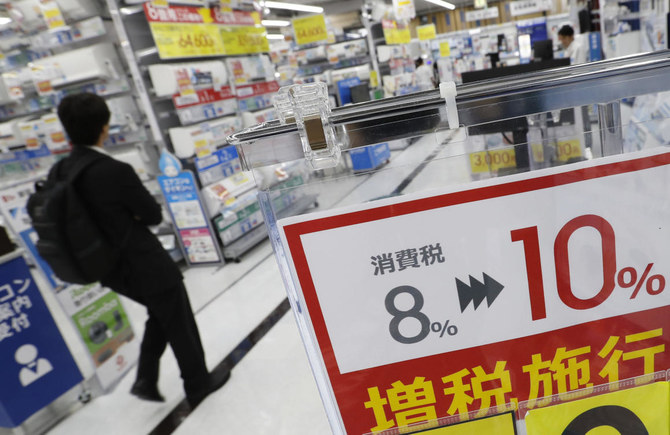
Japan raises sales tax to 10% amid signs economy weakening

- Officials say ample measures taken to minimize the impact of the hike after previous tax increases
- Sales tax increase covers most goods and services


Saudi Arabia’s cultural sector is a new economic engine between Riyadh and Paris, says ambassador
RIYADH: Culture has become a fundamental pillar in bilateral relations between France and Saudi Arabia, according to the French Ambassador to the Kingdom, Patrick Maisonnave.
Maisonnave noted its connection to the entertainment and tourism sectors, which makes it a new engine for economic cooperation between Riyadh and Paris.
He told Al-Eqtisadiah during the opening ceremony of La Fabrique in the Jax district of Diriyah that cultural cooperation with Saudi Arabia is an important element for its attractiveness in the coming decades.
La Fabrique is a space dedicated to artistic creativity and cultural exchange, launched as part of a partnership between the Riyadh Art program and the French Institute in Riyadh.
Running from Jan. 22 until Feb 14, the initiative will provide an open workspace that allows artists to develop and work on their ideas within a collaborative framework.
Launching La Fabrique as a space dedicated to artistic creativity
The ambassador highlighted that the transformation journey in the Kingdom under Vision 2030 has contributed to the emergence of a new generation of young artists and creators, alongside a growing desire in Saudi society to connect with culture and to embrace what is happening globally.
He affirmed that the relationship between the two countries is “profound, even cultural par excellence,” with interest from the Saudi side in French culture, matched by increasing interest from the French public and cultural institutions unfolding in the Kingdom.
Latest estimates indicate that the culture-based economy represents about 2.3 percent of France’s gross domestic product, equivalent to more than 90 billion euros ($106.4 billion) in annual revenues, according to government data. The sector directly employs more than 600,000 people, making it one of the largest job-creating sectors in the fields of creativity, publishing, cinema, and visual arts.
Saudi Arabia benefiting from French experience in the cultural field
Maisonnave explained that France possesses established cultural institutions, while Saudi Arabia is building a strong cultural sector, which opens the door for cooperation opportunities.
This comes as an extension of the signing of 10 major cultural agreements a year ago between French and Saudi institutions, aiming to enhance cooperation and transfer French expertise and knowledge to contribute to the development of the cultural system in the Kingdom.
He added that experiences like La Fabrique provide an opportunity to meet the new generation of Saudi creators, who have expressed interest in connecting with French institutions and artists in Paris and France.
La Fabrique encompasses a space for multiple contemporary artistic practices, including performance arts, digital and interactive arts, photography, music, and cinema, while providing the public with an opportunity to witness the stages of producing artistic works and interact with the creative process.


