

Saudi judiciary preserves human rights, says minister

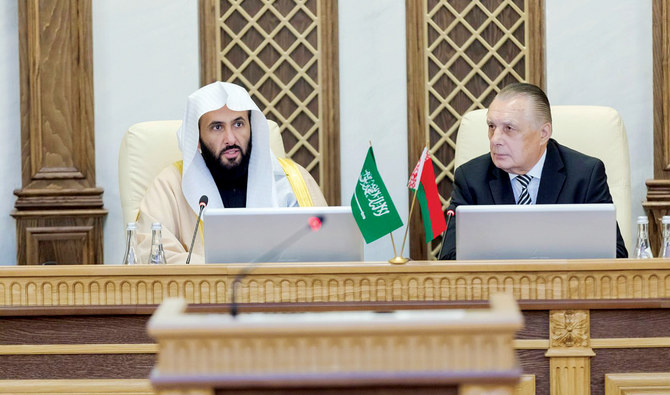
Saudi Justice Minister Dr. Walid Al-Samaani meets the chairman of the Supreme Court of Belarus, Valentin Sukalo, in Minsk. SPA
Updated 28 September 2019
Follow

Saudi judiciary preserves human rights, says minister

  • “The Saudi judiciary applies fair trial standards, preserves the rights and balances between protecting society’s interest and achieving justice,” says minister

MINSK: Saudi Justice Minister Dr. Walid Al-Samaani has said that the Saudi judiciary preserves and protects human rights, during a visit to the Economic Court and the Supreme Court in Minsk, Belarus.

Al-Samaani met the chairman of the Supreme Court, Valentin Sukalo, and judicial officials, during the visit.

“There are numerous Saudi laws that protect human rights, such as the Basic Law of Governance that stresses the state’s responsibility to preserve these rights and the judicial procedures that constantly stipulate the rights of the parties to the case at all stages,” Al-Samaani said.

“Judicial guarantees adopted by the Saudi judiciary focus on the right of everyone to litigation that ensures equality between the parties to the case during hearings, in addition to preserving the dignity of the accused.”

“The Kingdom’s judicial system, due to King Salman’s and the crown prince’s support, witnessed the launching and implementation of many initiatives and projects that contributed to the development of Saudi justice and made qualitative leaps in all judicial areas,” he said.

Al-Samaani said that the Basic Law of Governance established high standards and noble principles governing the Kingdom’s criminal justice system. “These standards and principles protect values, maintain security, preserve the rights of the parish and achieve social serenity,” he said.

“The Saudi judiciary applies fair trial standards, preserves the rights and balances between protecting society’s interest and achieving justice.”

Al-Samaani showcased the Saudi courts’ specializations and degrees, pointing out that “the Saudi Supreme Court adopts the judiciary’s general principles and rules. It also reviews some types of verdicts and decisions issued or endorsed by the courts of appeal. Saudis may also appeal to the Supreme Court in cases specified by the regulations.”

This visit comes within the framework of the memorandum of understanding signed between the two countries’ ministries of justice last year. It aims to promote international partnerships, benefit from international judicial experiences, exchange expertise and cooperate in the provision of judicial and legal assistance and train human resources to implement the best judicial and legal practices.

Klija Festival in Buraidah empowers small businesses

Updated 24 January 2026
Follow

Klija Festival in Buraidah empowers small businesses

  • Half a million attend 15-day celebration of heritage; event creates 1,500 seasonal jobs

RIYADH: The 17th Klija Festival in Buraidah drew more than half a million visitors during its 15-day run, celebrating the region’s heritage and entrepreneurial spirit.

Organized by the Qassim Chamber of Commerce, the event highlighted small businesses, providing a platform for entrepreneurs to showcase local products.

More than 340 sales outlets, marketing corners and points of sale welcomed attendees, while the festival provided 1,500 seasonal job opportunities, the Saudi Press Agency reported.

The small business pavilions featured families in the cottage industry, artisans and startups presenting traditional foods, and handicrafts and heritage items that reflect the region’s identity.

Participants said that the festival was a key marketing platform, boosting sales, increasing brand awareness, facilitating knowledge exchange and fostering connections with organizations supporting SMEs.

Mohammed Al-Hanaya, Qassim Chamber secretary-general and festival supervisor, said that the event brought together families, artisans, SMEs, companies and institutions, stimulating commercial activity, opening direct marketing channels and enhancing economic returns.

He added that the festival provided seasonal jobs for more than 1,500 young men and women across operations, marketing and services, supporting the labor market, empowering national talent, and connecting youth to the events and creative economy.

Klija, a traditional cookie made from wheat flour, dates or sugar, date syrup and natural ingredients such as cardamom and lemon, is a rich source of energy, carbohydrates, dietary fiber and natural proteins.

A cultural icon rooted in Qassim’s traditions, the cookie has gained international exposure through the festival, expanding the availability of packaged products.

Starting next year, the festival will be renamed the International Klija Festival, a rebranding approved by Qassim Gov. Prince Faisal bin Mishaal, who described it as a “successful model for turning local initiatives into global economic engines.”

This year’s festival, held at the King Khalid Cultural Center, included international participants from Egypt, Turkiye and Morocco, marking its evolution into a cross-cultural platform.