

Pompeo has no comment on possibility of US-Iran prisoner swap

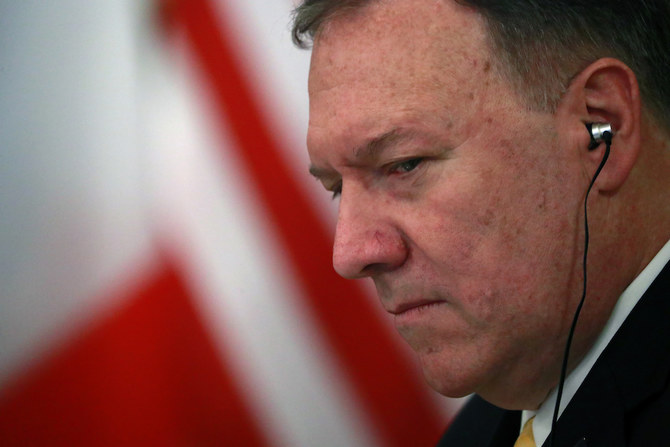
US Secretary of State Mike Pompeo declined to discuss the issue of a prisoner swap with Iran. (AFP)
Updated 26 September 2019
Follow

Pompeo has no comment on possibility of US-Iran prisoner swap

  • Rouhani said Tehran is open to talks about prisoner exchanges
  • The US and Iran are at odds over a host of issues

NEW YORK: US Secretary of State Mike Pompeo declined on Thursday to discuss the possibility of a US-Iranian prisoner swap after the United States deported an Iranian woman who pleaded guilty to exporting restricted US technology to Iran.
“So, I never talk about sensitive issues as you described there,” Pompeo told reporters in New York when asked about Negar Ghodskani, whose lawyer said she was deported on Tuesday, and whether he expected Iran to soon release a detained US doctoral student.
At a separate news conference in New York, Iranian President Hassan Rouhani said Tehran was open to talking about prisoner swaps but that the ball was in Washington’s court after Iran’s release of a Lebanese man with US permanent residency in June.
Pompeo and Rouhani were in New York for the annual United Nations General Assembly gathering of world leaders.
The United States and Iran are at odds over a host of issues, including the US withdrawal from the 2015 Iran nuclear deal, US accusations — denied by Tehran — that Iran attacked two Saudi oil facilities on Sept. 14 and Iran’s detention of US citizens on what the United States regards as spurious grounds.
According to the Justice Department, Ghodskani pleaded guilty to conspiring to buy export-controlled US technology, send it to Malaysia and then on to Iran. Federal court documents show that she was sentenced on Tuesday to 2-1/4 years time served.
Xiyue Wang, a US citizen and Princeton University graduate student, was conducting dissertation research in Iran in 2016 when he was detained and accused by Iran of “spying under the cover of research,” a claim his family and university deny.
He was subsequently convicted on espionage charges, and sentenced to 10 years in prison.
US officials typically do not discuss such cases in public. Brian Hook, the US State Department’s special representative for Iran, on Monday said that if Iran wanted to show good faith, it should release the US citizens it has detained, including the Princeton graduate student.
“We spent time this week, we spend time nearly every day working to release the Americans and others who are detained wrongfully inside of Iran. We will continue to do that,” Pompeo said.
Washington has demanded Iran release Americans it is holding including Wang, Iranian-American father and son Siamak and Baquer Namazi; Michael White, a Navy veteran imprisoned in 2018; and Robert Levinson, a former FBI agent missing since 2007.
Rouhani said Tehran is open to talks about prisoner exchanges, saying at his news conference, “We have always shown goodwill in the issue of prisoner swaps.”
Rouhani pointed to the release in June of a Lebanese citizen with US residency who was sentenced to 10 years in prison after being convicted of spying for the United States.
“After his release, Americans thanked us but failed to reciprocate. Therefore, the ball is in the American’s court now,” Rouhani said.
In June, Iran released Nizar Zakka, a Lebanese businessman with US permanent residency who had been in prison for four years, in a gesture meant as an opening for US-Iranian talks, according to three Western sources familiar with the issue.
Meanwhile, the Trump administration announced on Thursday it was restricting entry into the US for senior Iranian government officials and members of their families. 
“For years, Iranian officials and their family members have quietly taken advantage of America’s freedom and prosperity, including excellent educational, employment, entertainment, and cultural opportunities in the United States. Under this proclamation, designated senior regime officials and their families will no longer be allowed entry into the United States,” the State Department issued in a statement. 
The State Department cited Iran’s destabilizing activities in the Arabian Gulf region, their support for the Houthi militia in Yemen and other Shiite militias in Iraq, Lebanon and Syria
“No longer will elites reap the benefits of a free society while the Iranian people suffer under the regime’s corruption and mismanagement (and) the Government of Iran is the world’s leading state sponsor of terrorism,” which contributes to regional instability and humanitarian crises in these countries.
“America will no longer allow senior Iranian regime officials or their family members to continue to travel to the United States while their people suffer,” said Pompeo.

(With Reuters)


Trump says ‘hopefully’ no need for military action against Iran

Updated 58 min 28 sec ago
Follow

Trump says ‘hopefully’ no need for military action against Iran

  • US president said he is speaking with Iran and left open the possibility of avoiding a military operation
  • An Iranian military spokesman warned Tehran’s response to any US action would not be limited

PARIS: US President Donald Trump said on Thursday he hoped to avoid military action against Iran, which has threatened to strike American bases and aircraft carriers in response to any attack.
Trump said he is speaking with Iran and left open the possibility of avoiding a military operation after earlier warning time was “running out” for Tehran as the United States sends a large naval fleet to the region.
When asked if he would have talks with Iran, Trump told reporters: “I have had and I am planning on it.”
“We have a group headed out to a place called Iran, and hopefully we won’t have to use it,” the US president added, while speaking to media at the premiere of a documentary about his wife Melania.
As Brussels and Washington dialed up their rhetoric and Iran issued stark threats this week, UN chief Antonio Guterres has called for nuclear negotiations to “avoid a crisis that could have devastating consequences in the region.”
An Iranian military spokesman warned Tehran’s response to any US action would not be limited — as it was in June last year when American planes and missiles briefly joined Israel’s short air war against Iran — but would be a decisive response “delivered instantly.”
Brig. Gen. Mohammad Akraminia told state television US aircraft carriers have “serious vulnerabilities” and that numerous American bases in the Gulf region are “within the range of our medium-range missiles.”
“If such a miscalculation is made by the Americans, it will certainly not unfold the way Trump imagines — carrying out a quick operation and then, two hours later, tweeting that the operation is over,” he said.
An official in the Gulf, where states host US military sites, said that fears of a US strike on Iran are “very clear.”
“It would bring the region into chaos, it would hurt the economy not just in the region but in the US and cause oil and gas prices to skyrocket,” the official added.
‘Protests crushed in blood’
Qatar’s leader Sheikh Tamim bin Hamad Al-Thani and Iran’s President Masoud Pezeshkian held a call to discuss “efforts being made to de-escalate tensions and establish stability,” the Qatar News Agency (QNA) reported.
The European Union, meanwhile, piled on the pressure by designating the Islamic Revolutionary Guard Corps (IRGC) a “terrorist organization” over a deadly crackdown on recent mass protests.
“’Terrorist’ is indeed how you call a regime that crushes its own people’s protests in blood,” said EU chief Ursula von der Leyen, welcoming the “overdue” decision.
Though largely symbolic, the EU decision has already drawn a warning from Tehran.
Iran’s military slammed “the illogical, irresponsible and spite-driven action of the European Union,” alleging the bloc was acting out of “obedience” to Tehran’s arch-foes the United States and Israel.
Iranian officials have blamed the recent protest wave on the two countries, claiming their agents spurred “riots” and a “terrorist operation” that hijacked peaceful rallies sparked over economic grievances.
Rights groups have said thousands of people were killed during the protests by security forces, including the IRGC — the ideological arm of Tehran’s military.
In Tehran on Thursday, citizens expressed grim resignation.
“I think the war is inevitable and a change must happen. It can be for worse, or better. I am not sure,” said a 29-year-old waitress, speaking on condition of anonymity for fear of reprisals.
“I am not in favor of war. I just want something to happen that would result in something better.”
Another 29-year-old woman, an unemployed resident of an upscale neighborhood in northern Tehran, said: “I believe that life has highs and lows and we are now at the lowest point.”
Trump had threatened military action if protesters were killed in the anti-government demonstrations that erupted in late December and peaked on January 8 and 9.
But his more recent statements have turned to Iran’s nuclear program, which the West believes is aimed at making an atomic bomb.
On Wednesday, he said “time is running out” for Tehran to make a deal, warning the US naval strike group that arrived in Middle East waters on Monday was “ready, willing and able” to hit Iran.
Conflicting tolls
The US-based Human Rights Activists News Agency (HRANA) said it has confirmed 6,479 people were killed in the protests, as Internet restrictions imposed on January 8 continue to slow verification.
But rights groups warn the toll is likely far higher, with estimates in the tens of thousands.
Iranian authorities acknowledge that thousands were killed during the protests, giving a toll of more than 3,000 deaths, but say the majority were members of the security forces or bystanders killed by “rioters.”
Billboards and banners have gone up in the capital Tehran to bolster the authorities’ messages. One massive poster appears to show an American aircraft carrier being destroyed.