Seized British tanker Stena Impero still in Iran — Stena Bulk CEO

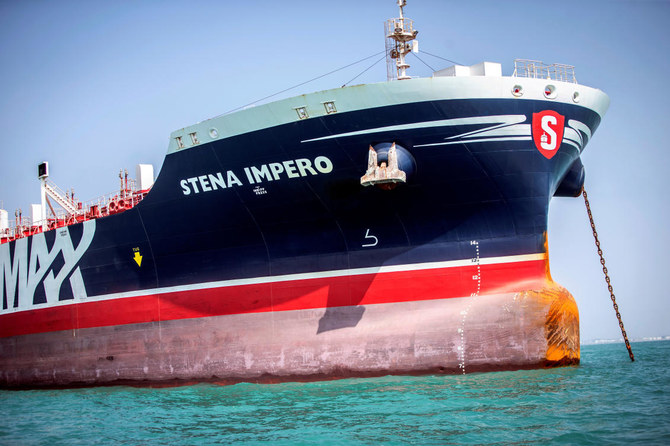
The seizure of the Stena Impero on July 19 ratcheted up tensions in the region. (West Asia News Agency via Reuters)
Updated 25 September 2019
Follow

Seized British tanker Stena Impero still in Iran — Stena Bulk CEO

  • The seizure of the Stena Impero on July 19 ratcheted up tensions in the region
  • Iranian envoy earlier said that the Swedish-owned vessel was free to leave after legal hurdles had been cleared

COPENHAGEN: The head of the Swedish shipping firm that owns the British-flagged oil tanker held by Iran since July said Tuesday the Stena Impero was still in Iranian waters, a day after Iran said the vessel was free to move.
Erik Hanell, CEO of Stena Bulk, told The Associated Press that “we know nothing as to why she is still there.”
On Monday, Iranian government spokesman Ali Rabiei told journalists that legal proceedings against the tanker had ended. The Stena Impero has been kept in the Iranian port of Bandar Abbas since July 19.
“Based on a friendly approach that allows forgiving mistakes, ground for freedom of the tanker has been paved and it can move,” Rabiei said.
Iran seized the tanker in the Strait of Hormuz, the narrow mouth of the Arabian Gulf through which 20% of the world’s oil passes. The raid saw commandos rappel down onto the vessel via helicopter carrying assault rifles, dramatic images later replayed on state television.
Earlier this month, Iran released seven of the ship’s crew members. Sixteen remain on board.
The seizure came after authorities in Gibraltar seized an Iranian tanker carrying $130 million in crude oil on suspicion of it breaking European Union sanctions on Syria.
Gibraltar later released the tanker, then called the Grace 1, after it said Iran promised the ship wouldn’t go to Syria. That ship, renamed the Adrian Darya 1, now sits off the Syrian coast, angering Britain. Iran hasn’t said who purchased its 2.1 million barrels of crude oil.
The ship seizures came after months of heightened tensions in the Arabian Gulf, sparked by President Donald Trump’s decision over a year ago to withdraw from Iran’s nuclear deal with world powers and impose crippling sanctions on its vital oil trade. Iran since has begun breaking terms of the deal.


UN rights chief Shocked by ‘unbearable’ Darfur atrocities

Updated 18 January 2026
Follow

UN rights chief Shocked by ‘unbearable’ Darfur atrocities

  • Mediation efforts have failed to produce a ceasefire, even after international outrage intensified last year with reports of mass killings, rape, and abductions during the RSF’s takeover of El-Fasher in Darfur

PORT SUDAN: Nearly three years of war have put the Sudanese people through “hell,” the UN’s rights chief said on Sunday, blasting the vast sums spent on advanced weaponry at the expense of humanitarian aid and the recruitment of child soldiers.
Since April 2023, Sudan has been gripped by a conflict between the army and the paramilitary Rapid Support Forces that has left tens of thousands of people dead and around 11 million displaced.
Speaking in Port Sudan during his first wartime visit, UN Human Rights commissioner Volker Turk said the population had endured “horror and hell,” calling it “despicable” that funds that “should be used to alleviate the suffering of the population” are instead spent on advanced weapons, particularly drones.
More than 21 million people are facing acute food insecurity, and two-thirds of Sudan’s population is in urgent need of humanitarian aid, according to the UN.
In addition to the world’s largest hunger and displacement crisis, Sudan is also facing “the increasing militarization of society by all parties to the conflict, including through the arming of civilians and recruitment and use of children,” Turk added.
He said he had heard testimony of “unbearable” atrocities from survivors of attacks in Darfur, and warned of similar crimes unfolding in the Kordofan region — the current epicenter of the fighting.
Testimony of these atrocities must be heard by “the commanders of this conflict and those who are arming, funding and profiting from this war,” he said.
Mediation efforts have failed to produce a ceasefire, even after international outrage intensified last year with reports of mass killings, rape, and abductions during the RSF’s takeover of El-Fasher in Darfur.
“We must ensure that the perpetrators of these horrific violations face justice regardless of the affiliation,” Turk said on Sunday, adding that repeated attacks on civilian infrastructure could constitute “war crimes.”
He called on both sides to “cease intolerable attacks against civilian objects that are indispensable to the civilian population, including markets, health facilities, schools and shelters.”
Turk again warned on Sunday that crimes similar to those seen in El-Fasher could recur in volatile Kordofan, where the RSF has advanced, besieging and attacking several key cities.
Hundreds of thousands face starvation across the region, where more than 65,000 people have been displaced since October, according to the latest UN figures.