

UK calls on Iran to immediately release ‘illegally seized’ tanker Stena Impero

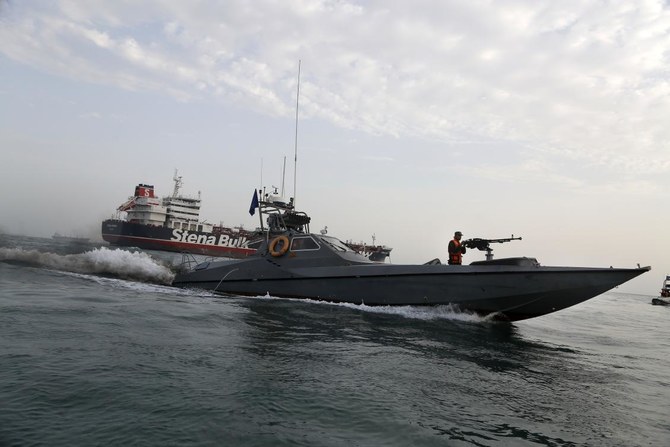
The Stena Impero was detained by Iran’s Revolutionary Guards in the Strait of Hormuz waterway for alleged marine violations on July 19, 2019. (Mizan News Agency via AP)
Updated 24 September 2019
Follow

UK calls on Iran to immediately release ‘illegally seized’ tanker Stena Impero

  • Stena Impero was detained two weeks after Britain detained an Iranian tanker off the territory of Gibraltar, which has since been released

LONDON: The UK Foreign Office said on Monday that the tanker Stena Impero and its crew were still being detained by Iran, while calling for the immediate release of the "illegally detaind" vessel.

The statement came after an Iranian government spokesman said all legal steps had been completed for the release of the detained British tanker Stena Impero but that he did not know the timing of the release, the semi-official news agency ILNA reported.

“The legal work and administrative procedures for the release of the English tanker have been completed but I have no information on the time of the release,” said government spokesman Ali Rabiei, according to ILNA.

The semi-official Fars news agency Fars quoted Rabiei as saying: “The legal work of the oil tanker is over ... and the oil tanker can move and the decisions indicate the end of the detention.” He did not elaborate.

The chief executive of the Swedish firm that owns the Stena Impero, the British-flagged tanker detained by Tehran on July 19, earlier said on Sunday he had been informed that the vessel may be released within a few hours.

The Stena Impero was detained by Iran’s Revolutionary Guards in the Strait of Hormuz waterway for alleged marine violations, two weeks after Britain detained an Iranian tanker off the territory of Gibraltar. That vessel was released in August.

Erik Hanell, chief executive of Stena Bulk, told the Swedish public broadcaster SVT: “We have received information now this morning that it seems like they will release the ship Stena Impero within a few hours. So, we understand that the political decision to release the ship has been taken.”

“We hope to be able to head out within a few hours, but we don’t want to anticipate events. We want to see that the ship sails out of Iranian territorial waters,” Hanell told SVT.

Hanell did not immediate respond to a request for comment.

On Sept. 4, Iran released seven of vessel’s 23 crew members. Swedish Foreign Minister Margot Wallstrom said at the time that Sweden had been in daily contact with Iran at a high political level since the vessel was seized.


UNICEF chief says GCC central to supporting operations across the region

Updated 7 sec ago
Follow

UNICEF chief says GCC central to supporting operations across the region

DUBAI: The Gulf Cooperation Council is playing a central role in combating acute crises affecting children and displaced people across the region, says UNICEF’s Gulf Area Office director, Lana Al-Wreikat.

Speaking to Arab News on the sidelines of the World Governments Summit on Tuesday, Wreikat said the GCC had become central to supporting refugees, hygiene and children’s health through funding and diplomatic support.

“Our work with the GCC countries when it comes to the humanitarian crisis goes beyond the refugee response,” Wreikat said.

“We are also dealing with displaced communities inside countries. We also deal with big issues and sectors like the water, sanitation, hygiene, promotion, nutrition, child protection, education. We have our core commitments for children and young people, and these translate across all these sectors. The GCC … has been a very generous donor for us.”

Wreikat revealed the UAE had just announced a $550 million donation for the UN’s 2026 global appeal, part of which goes to funding UNICEF’s operations.

She said Gulf countries had become crucial to supporting the organization diplomatically, especially in difficult situations with access difficulties.

“They also play a big role in terms of the humanitarian diplomacy and negotiations around access, where we really need to support maximum number of children,” she said.

“In terms of their priorities, what’s really high on the agenda is Gaza, Sudan, Yemen, and Syria.”