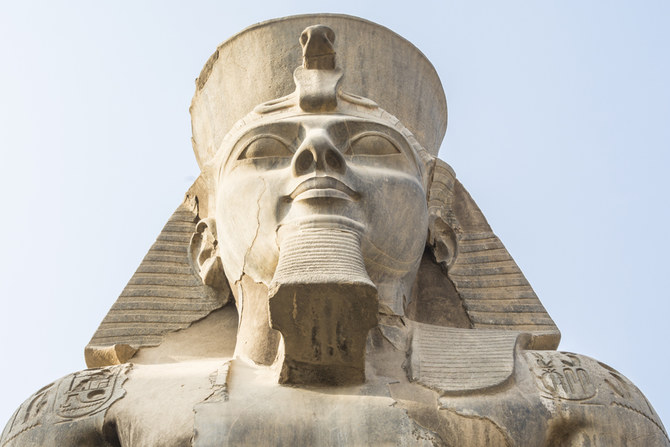
Restoration begins of more King Ramses II statues at Luxor Temple

Statue of Ramses II. (Shutterstock)
Updated 16 September 2019
Follow

Restoration begins of more King Ramses II statues at Luxor Temple

  • The remains and blocks of these statues were discovered between 1958 and 1961 during the excavations of the archaeologist Dr. Mohamed Abdel-Kader.

CAIRO: Egypt has begun a new international project in Luxor with the collection, restoration and reinstallation of two statues of King Ramses II.

The plan follows the restoration and assembly during the past three years of three statues of the ruler at Luxor Temple.

During his recent visit to Luxor, Egyptian Minister of Antiquities Khaled Al-Anani gave the green light for the restoration of two more statues of the pharaonic king at the western side of the temple.

Ahmed Arabi, managing director of the temple, said the statues belong to the 19th Dynasty and are made from red granite.

The remains and blocks of these statues were discovered between 1958 and 1961 during the excavations of the archaeologist Dr. Mohamed Abdel-Kader.

The statues, which fell apart years ago, have raised controversy after their restoration. This arises from the fact that one of the recently restored statues stands in the Osirian position, the “death position” of the ancient Egyptians, in which the statue’s feet are equal. That runs contrary to the tradition followed in all Egyptian temples, which is not to put the statues of kings in this position.

Director of the temple Ahmed Arabi said that his department had presented the idea of restoring the three statues. “We recently found pieces of the two other statues of Ramses II in the western facade of the temple. They will also be installed in the same place where they were found.” 

Arabi said that the statues will be renovated in cooperation with the Egyptian archaeological mission led by Dr. Mustafa Waziri, secretary-general of the Supreme Council of Antiquities, under the supervision of Ahmed Badr El-Din, of Luxor Temple, and the Chicago Institute of Oriental Archaeology headed by Dr. Ray Johnson. Work has already begun by studying the two statues, assembling their blocks, and documenting and photographing them. Each statue is seven meters high, again in the Osirian position.

Dr. Waziri confirmed that the two new statues have been placed next to the other statues in preparation for restoration, pointing out that there is writing on one of the pieces bearing the name Ramses II. The pieces include the upper half of a statue, two parts from the shoulders overlapping each other, the dress and the statues’ necks. It also has parts of the face.

King Ramses II is one of the most famous monarchs of ancient Egypt, ruling from 1279 to 1213 BC.



The difference between European and Gulf weddings — from a photographer’s point of view

Updated 21 January 2026
Follow

The difference between European and Gulf weddings — from a photographer’s point of view

DUBAI: From her early career in northeast France to working across the Gulf and Europe, wedding photographer Maddy Christina has observed many contrasts between such events in different parts of the world.

Her early years as a photographer were defined by variety; she worked across fashion, family portraits and weddings simultaneously before recognizing how wedding photography brings multiple genres together in a single day. 

Christina said weddings in the region required a shift in both perspective and technique. (Supplied)

“I actually fell into weddings by accident,” Christina told Arab News. “It blends every discipline at once — fashion for the couple session, sports for the reception, documentary work throughout the day, still life with details and jewelry.”

Christina’s connection to the Middle East began through Parisian clients who invited her to Dubai for a post-wedding session: “I instantly connected with the energy of the city,” she said.

Christina’s connection to the Middle East began through Parisian clients who invited her to Dubai for a post-wedding session. (Supplied)

A few years later, a wedding in Kuwait marked the start of her long-term relationship with the region.

Now working extensively across the Gulf Cooperation Council, Christina said weddings in the region required a shift in both perspective and technique.

For Christina, the most meaningful aspect extends beyond the wedding day itself. (Supplied)

“Working across the GCC has opened my mind in ways I didn’t expect,” she said, adding it felt like “resetting everything I thought I knew about weddings” — particularly compared to her experience in Europe.

She said there were clear distinctions between the two regions. “European weddings tend to be more demonstrative and expressive, while brides in the Gulf often place a deeper emphasis on tradition, family bonds and a sense of ceremony,” she said. “The emotional language is different, yet equally beautiful.”

From a technical standpoint, the contrast is just as pronounced: “In the south of France, I was used to shooting outdoors at sunset with couples already comfortable in front of the camera. Here, I often find myself in much smaller spaces, with no windows, artificial light and couples who may be more reserved.”

Christina is drawn to candid moments. (Supplied)

She added that adapting to these conditions pushed her to explore new ways of shaping light and expanded her creative approach.

While Christina is drawn to candid moments, like “guests laughing together, old friends reconnecting, a fleeting emotion passing across someone’s face,” posed pictures remain central to her work.

For Christina, the most meaningful aspect extends beyond the wedding day itself.

“It’s not the decor that makes a wedding unforgettable for me,” she said. “It’s the connection I build with the bride. That long-term bond is what feels truly magical.”