

Iran’s nuclear chief: EU has failed to fulfill 2015 deal commitments

1 / 2
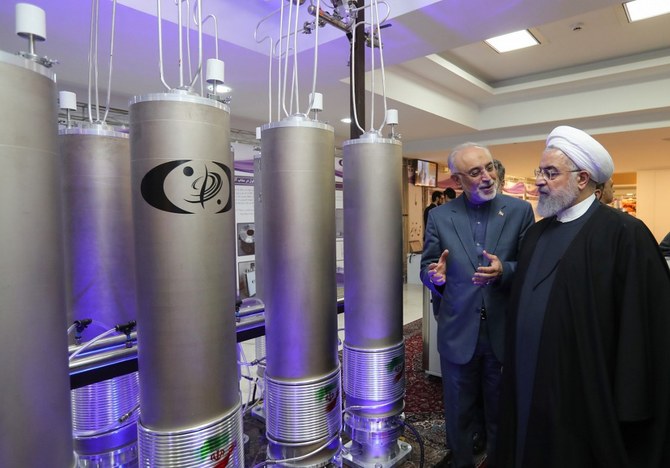
Iranian President Hassan Rouhani, right, listens to the head of Iran’s nuclear technology organization Ali Akbar Salehi during the ‘nuclear technology day’ in this April 9, 2019 photo. (Iranian Presidency / AFP)
2 / 2
A handout picture released by Iran's Atomic Energy Organization on September 7, 2019, shows spokesman for the organization Behrouz Kamalvandi speaking during a press conference in the capital Tehran. (File/AFP)
Updated 09 September 2019
Follow

Iran’s nuclear chief: EU has failed to fulfill 2015 deal commitments

  • Iranian state television aired Sunday video of Cornel Feruta in the capital, Tehran
  • Iran on Saturday announced it would begin using two types of advanced centrifuges

DUBAI: Iran’s nuclear chief said on Sunday the European parties to the 2015 nuclear deal have failed to fulfill their commitments under the pact, a day after Tehran announced further breaches of limits on its nuclear activity set by the pact.

The deal curbed Iran’s disputed nuclear program in exchange for relief from sanctions, but has unraveled since the United States withdrew last year and acted to strangle Iran’s oil trade to push it into wider security concessions.

France, Germany and Britain have tried to launch a barter trade mechanism with Iran protecting it from US sanctions but have struggled to get it off the ground, and Tehran on Wednesday set a 60-day deadline for effective European action.

“Unfortunately, the European parties have failed to fulfil their commitments ... The deal is not a one-way street and Iran will act accordingly as we have done so far by gradually downgrading our commitments,” said Ali Akbar Salehi, director of Iran’s nuclear energy agency.

“Iran will continue to reduce its nuclear commitments as long as the other parties fail to carry out their commitments,” Salehi said, speaking after meeting the acting head of the UN nuclear watchdog (IAEA), Cornel Feruta, in Tehran on Sunday.

Feruta, whose non-proliferation inspectors monitor Iran’s nuclear program, also planned to see Foreign Minister Mohammad Javad Zarif and other senior Iranian officials.

The IAEA’s 35-nation Board of Governors will discuss Iran at a quarterly meeting that begins on Monday.

Since May, Iran has begun to breach caps on its nuclear capacity set by the deal in retaliation for US pressure on Iran to negotiate restrictions on its ballistic missile program and support for proxy forces around the Middle East.

Iran says its retreat from terms of the deal is reversible if European signatories manage to restore its access to foreign trade promised under the nuclear deal but blocked by the re-imposition of US sanctions.

“The actions they have taken are negative but not definitive. They can come back (to full compliance) and the path of dialogue is still open,” French Foreign Minister Jean-Yves le Drian said on Sunday.

Upping the ante in its stand-off with Washington, Tehran said on Saturday it was now capable of raising uranium enrichment past the 20 percent level of fissile purity and had launched advanced centrifuge machines in further breaches of the deal.

IAEA inspectors reported in July that Iran had cranked up enrichment to 4.5 percent purity, above the 3.7 percent cap suitable for civilian energy generation set by the 2015 accord.

Under the deal, Iran is allowed limited research and development on advanced centrifuges, which accelerate the production of fissile material that could, if enriched to the 90 percent threshold, be used to develop a nuclear bomb.


Israeli police kill Bedouin man during raid in southern Israel, local official says

Updated 04 January 2026
Follow

Israeli police kill Bedouin man during raid in southern Israel, local official says

  • The shooting of 36-year-old Muhammed Hussein Tarabin threatened to worsen the already strained relations between the Israeli government and the country’s Bedouin minority

TEL AVIV: Israeli police shot and killed a Bedouin Arab man during an overnight raid in his village in southern Israel, according to media reports and a local official.
The shooting of 36-year-old Muhammed Hussein Tarabin threatened to worsen the already strained relations between the Israeli government and the country’s Bedouin minority.
Israeli police have been conducting a large-scale operation in the village of Tarabin for the past week in what they describe as a crackdown on local crime.
Talal Alkernawi, the mayor of the nearby town of Rahat, confirmed the man’s death.
Israeli police said they opened fire on a man who had “endangered” forces during an arrest raid.
The Israeli news site Haaretz cited relatives as saying Tarabin, whose family name shares the name of the village, was in his home.
In a video statement, Tarabin’s 11-year-old son, Hussein, said that men in uniform came to their house at night. He heard shots and saw his father’s body lying on the ground.
Israel’s far-right National Security Minister Itamar Ben-Gvir, who oversees the police force, expressed support for the police. “Anyone who endangers our police officers and fighters must be neutralized,” he posted on X.
Prime Minister Benjamin Netanyahu said Sunday that the country would do everything to prevent the Negev desert in southern Israel from becoming the “wild south”. He congratulated Ben-Gvir on leading the initiative and said he would visit the region in the coming days.
Israel’s more than 200,000 Bedouin are the poorest members of the country’s Arab minority, which also includes Christian and Muslim urban communities. Israel’s Arab population makes up roughly 20 percent of the country’s 10 million people. While they are citizens with the right to vote, they often suffer discrimination and tend to identify with Palestinians in the occupied West Bank and the Gaza Strip.
The Bedouin sector has grappled with crime and poverty, and about one-third of its members live in villages that the Israeli government considers illegal. Israel says it is trying to bring order to a lawless area, but Bedouin leaders accuse the government of neglect, trying to destroy their way of life or pushing to relocate them to less desirable areas.
Residents say police have made around two dozen arrests in the village of Tarabin over the past week. Nati Yefet, a spokesman for the regional council of unrecognized villages in the area, said most have been quickly released.
“They’re looking for people, crime-related things, but they didn’t find anything,” Yefet said. He accused Ben-Gvir of intensifying the raids in the run-up to elections expected later this year.
Marwan Abu Frieh, of the Arab rights group Adalah, said Israel has stepped up house demolitions in recent years, leaving thousands of residents without shelter and worsening the plight of communities often denied basic services.