

Tehran takes new step toward building a nuclear weapon

1 / 2
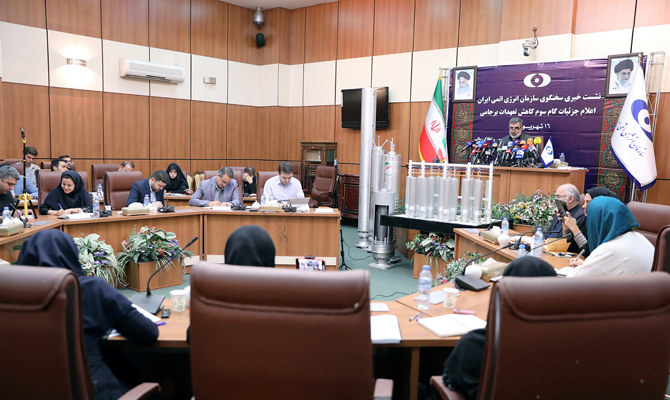
Behrouz Kamalvandi, spokesman for the Atomic Energy Organization of Iran speaks during news conference in Tehran on September 7, 2019. (West Asia News Agency via REUTERS)
2 / 2
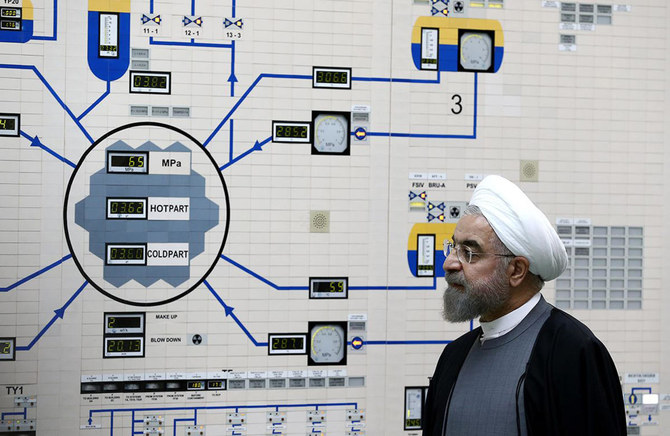
Iranian President Hassan Rouhani visits the control room of the Bushehr nuclear power plant in this January 13, 2015 photo. (Iranian Presidency/AFP)
Updated 08 September 2019
Follow

Tehran takes new step toward building a nuclear weapon

  • JCPOA breached again as Iran’s atomic chief boasts of high-powered uranium centrifuges
  • UN inspectors still will be able to access nuclear sites in the country

TEHRAN: Iran on Saturday activated at least 40 high-powered uranium centrifuges in the most serious breach so far of its commitments under the 2015 deal to curb its nuclear program.

Behrouz Kamalvandi of the Atomic Energy Organization of Iran the country had begun using an array of 20 IR-6 centrifuges and another of 20 IR-4 centrifuges. An IR-6 can produce enriched uranium 10 times as fast as an IR-1, and an IR-4 five times as fast.

The nuclear deal, the Joint Comprehensive Plan of Action (JCPOA), limited Iran to using only 5,060 first-generation IR-1 centrifuges to enrich uranium. By activating advanced centrifuges, Iran further cuts into the one year that experts estimate Tehran would need to have enough material to build a nuclear weapon.

“Iran is capable of increasing its enriched uranium stockpile as well as its enrichment levels, and that is not just limited to 20 percent,” Kamalvandi said in a news conference carried on live television. 

“We are capable inside the country to increase the enrichment much more beyond that,” he said. He spoke from a podium with advanced centrifuges standing next to him.

However, he stressed that Iran would allow UN inspectors to continue to monitor sites in the country. A top official from the UN’s International Atomic Energy Agency was expected to meet with Iranian officials in Tehran on Sunday.

Iran also plans to have two cascades, one with 164 advanced IR-2M centrifuges and another with 164 IR-5 centrifuges, running in two months, Kamalvandi said. A cascade is a group of centrifuges working together to more quickly enrich uranium.

Iran has already increased its enrichment up to 4.5 percent, above the 3.67 percent allowed under the deal, and it has gone beyond its 300kg limit for low-enriched uranium.

The staged breaches of the JCPOA are widely viewed as a form of nuclear blackmail, to pressure European signatories to the deal to find a way for Iran to avoid US sanctions.

“If Europeans want to make any decision, they should do it soon,” Kamalvandi said. “Our plan is that if the other parties act on their commitments, we, too, return to our commitments.”

The UN’s International Atomic Energy Agency said it was aware of Iran’s announcement and “agency inspectors are on the ground in Iran and they will report any relevant activities to IAEA headquarters in Vienna.”

The acting head of the IAEA, Cornel Feruta, is expected in Tehran on Sunday for talks with nuclear chiefs and Foreign Minister Mohammad Javad Zarif.

US Secretary of Defense Mark Esper in a joint press conference with his French counterpart, meanwhile said, “I am not surprised that Iran has announced a violation of the nuclear agreement again.”

“We seek to push Iran to respect the nuclear deal,” French defense minister Florence Parly said.

The US and European moves to strengthen security in the Gulf must be "complementary and well coordinated", she added.

France has ruled out joining a US-led coalition of countries protecting oil tankers and cargo ships from threats posed by Iran in the Strait of Hormuz, but has pushed for a European alternative.

Tensions between Iran and the US have risen in recent months that have seen mysterious attacks on oil tankers near the Strait of Hormuz, Iran shooting down a US military surveillance drone and other incidents across the wider Middle East.


Ceasefire with Kurdish-led force extended for another 15 days, Syrian army says

Updated 25 January 2026
Follow

Ceasefire with Kurdish-led force extended for another 15 days, Syrian army says

  • The defense ministry said the extension was in support of an operation by US forces to transfer accused Daesh militants to Iraq
  • The Kurdish-led Syrian Democratic Forces confirmed the ceasefire extension

RAQQA, Syria: Hours after the expiration of a four-day truce between the Syrian government and Kurdish-led fighters Saturday, Syria’s defense ministry announced the ceasefire had been extended by another 15 days.
The defense ministry said in a statement that the extension was in support of an operation by US forces to transfer accused Daesh militants who had been held in prisons in northeastern Syria to detention centers in Iraq.
The Kurdish-led Syrian Democratic Forces confirmed the ceasefire extension.
“Our forces affirm their commitment to the agreement and their dedication to respecting it, which contributes to de-escalation, the protection of civilians, and the creation of the necessary conditions for stability,” the group said in a statement.
Over the past three weeks, there have been intense clashes between government forces and the SDF, in which the SDF lost large parts of the area they once controlled.
Earlier in the day, the Kurdish-led force called on the international community to prevent any escalation.
The end of the truce came as government forces have been sending reinforcements to Syria’s northeast.
Syria’s interim government signed an agreement last March with the SDF for it to hand over territory and to eventually merge its fighters with government forces. In early January, a new round of talks failed to make progress over the merger, leading to renewed fighting between the two sides.
A new version of the accord was signed last weekend, and a four-day ceasefire was declared Tuesday. Part of the new deal is that SDF members will have to merge into the army and police forces as individuals.
The SDF said in a statement Saturday that military buildups and logistical movements by government forces have been observed, “clearly indicating an intent to escalate and push the region toward a new confrontation.” The SDF said it will continue to abide by the truce.
On Saturday, state TV said authorities on Saturday released 126 boys under the age of 18 who were held at the Al-Aqtan prison near the northern city of Raqqa that was taken by government forces Friday. The teenagers were taken to the city of Raqqa where they were handed over to their families, the TV station said.
The prison is also home to some of the 9,000 members of the Daesh group who are held in northeastern Syria. Most of them remain held in jails run by the SDF. Government forces have so far taken control of two prisons while the rest are still run by the SDF.
Earlier this week, the US military said that some 7,000 Daesh detainees will be transferred to detention centers in neighboring Iraq.
On Wednesday, the US military said that 150 prisoners have been taken to Iraq.