

Brent oil holds above $60 as lower inventories boost WTI

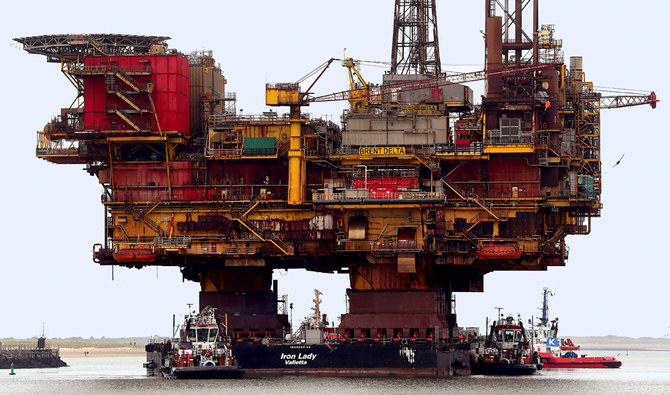
American crude stocks dropped last week by 10 million barrels amid concerns over global economic slowdown due to the US-China trade war. (AFP)
Updated 29 August 2019
Follow

Brent oil holds above $60 as lower inventories boost WTI

  • Concerns over a global slowdown in economic growth and its impact on oil demand are keeping prices in check

LONDON: Brent oil held above $60 a barrel on Thursday, withstanding pressure from concerns about economic growth, while a sharp fall in US inventories boosted West Texas Intermediate (WTI) crude futures.

International benchmark Brent crude was down 19 cents at $60.30 a barrel in early afternoon trade in London while WTI was up 32 cents at $56.10 a barrel.

“If the American Petroleum Institute (API) unexpectedly supplied bullets to oil bulls on Tuesday evening so that they could fire from all cylinders, the US government’s Energy Information Administration (EIA) flung the door of the ammunition depot wide open yesterday,” Tamas Varga of oil brokerage PVM said.

The EIA said on Wednesday that American crude stocks dropped last week by 10 million barrels, while gasoline and distillate stocks each fell by 2.1 million barrels.

On Tuesday, industry body API said US crude stocks had fallen by 11.1 million barrels last week.

US weekly crude production rose 200,000 barrels per day to a new record at 12.5 million bpd in the week to Aug. 23, the EIA said.

Concerns about a slowdown in economic growth due to the trade war raging between the US and China, the world’s biggest oil consumers, along with the potential hit to oil demand, are keeping prices in check.

“Trade tensions (are) hanging like a dark cloud threatening to rain over oil prices,” said Jeffrey Halley, senior market analyst at OANDA.

China’s commerce ministry said on Thursday that China and the US were discussing the next round of face-to-face trade talks scheduled for September, but hopes for progress hinged on whether Washington could create favorable conditions.

San Francisco Federal Reserve President Mary Daly said she is in a “watch and see” mode as she assesses the need for another US interest-rate cut for an economy that has “strong” momentum but faces headwinds from uncertainty and a global slowdown.

Concerns about the global economy have watered down the impact of oil production cuts that the Organization of the Petroleum Exporting Countries (OPEC), Russia and other producers have been exercising over the past two years.

“When they (OPEC and its allies) really managed to accelerate the price from late 2016 onwards they had a big tailwind of global growth acceleration, now they have this big negative headwind of global growth de-acceleration,” said Bjarne Schieldrop, chief commodities analyst at Nordic bank SEB.

Morgan Stanley has lowered its oil price forecasts for the rest of the year, citing a weaker economic outlook, faltering demand and higher shale oil output.


Saudi investment pipeline active as reforms advance, says Pakistan minister

Updated 08 February 2026
Follow

Saudi investment pipeline active as reforms advance, says Pakistan minister

ALULA: Pakistan’s Finance Minister Mohammed Aurangzeb described Saudi Arabia as a “longstanding partner” and emphasized the importance of sustainable, mutually beneficial cooperation, particularly in key economic sectors.

Speaking to Arab News on the sidelines of the AlUla Conference for Emerging Market Economies, Aurangzeb said the relationship between Pakistan and Saudi Arabia remains resilient despite global geopolitical tensions.

“The Kingdom has been a longstanding partner of Pakistan for the longest time, and we are very grateful for how we have been supported through thick and thin, through rough patches and, even now that we have achieved macroeconomic stability, I think we are now well positioned for growth.”

Aurangzeb said the partnership has facilitated investment across several sectors, including minerals and mining, information technology, agriculture, and tourism. He cited an active pipeline of Saudi investments, including Wafi’s entry into Pakistan’s downstream oil and gas sector.

“The Kingdom has been very public about their appetite for the country, and the sectors are minerals and mining, IT, agriculture, tourism; and there are already investments which have come in. For example, Wafi came in (in terms of downstream oil and gas stations). There’s a very active pipeline.”

He said private sector activity is driving growth in these areas, while government-to-government cooperation is focused mainly on infrastructure development.

Acknowledging longstanding investor concerns related to bureaucracy and delays, Aurangzeb said Pakistan has made progress over the past two years through structural reforms and fiscal discipline, alongside efforts to improve the business environment.

“The last two years we have worked very hard in terms of structural reforms, in terms of what I call getting the basic hygiene right, in terms of the fiscal situation, the current economic situation (…) in terms of all those areas of getting the basic hygiene in a good place.”

Aurangzeb highlighted mining and refining as key areas of engagement, including discussions around the Reko Diq project, while stressing that talks with Saudi investors extend beyond individual ventures.

“From my perspective, it’s not just about one mine, the discussions will continue with the Saudi investors on a number of these areas.”

He also pointed to growing cooperation in the IT sector, particularly in artificial intelligence, noting that several Pakistani tech firms are already in discussions with Saudi counterparts or have established offices in the Kingdom.

Referring to recent talks with Saudi Minister of Economy and Planning Faisal Alibrahim, Aurangzeb said Pakistan’s large freelance workforce presents opportunities for deeper collaboration, provided skills development keeps pace with demand.

“I was just with (Saudi) minister of economy and planning, and he was specifically referring to the Pakistani tech talent, and he is absolutely right. We have the third-largest freelancer population in the world, and what we need to do is to ensure that we upscale, rescale, upgrade them.”

Aurangzeb also cited opportunities to benefit from Saudi Arabia’s experience in the energy sector and noted continued cooperation in defense production.

Looking ahead, he said Pakistan aims to recalibrate its relationship with Saudi Arabia toward trade and investment rather than reliance on aid.

“Our prime minister has been very clear that we want to move this entire discussion as we go forward from aid and support to trade and investment.”