Indonesia to move capital from sinking Jakarta to Borneo

1 / 3
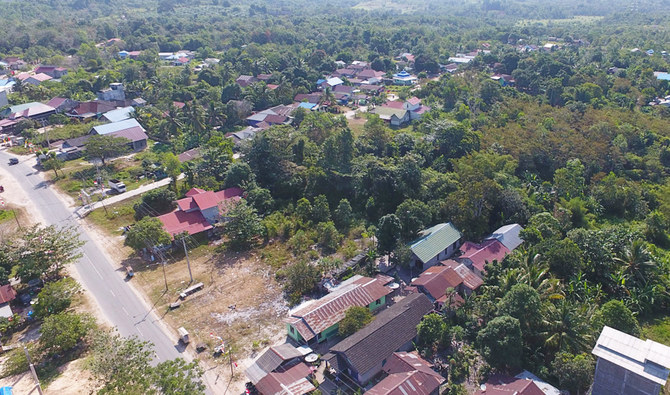
This aerial picture taken on August 16, 2019 by news outlet Tribun Kaltim shows a general view of Samboja, Kutai Kartanegara, one of two locations proposed by the government for Indonesia's new capital. (AFP)
2 / 3
This aerial picture taken on August 16, 2019 by news outlet Tribun Kaltim shows a general view of Samboja, Kutai Kartanegara, one of two locations proposed by the government for Indonesia's new capital. (AFP)
3 / 3
This aerial picture taken on July 31, 2019 by news outlet Tribun Kaltim shows a view of the area around Samboja, Kutai Kartanegara, one of two locations proposed by the government for Indonesia's new capital. (AFP)
Updated 27 August 2019
Follow

Indonesia to move capital from sinking Jakarta to Borneo

  • Infrastructure improvement has been Widodo’s signature policy and helped him win a second term in April elections

JAKARTA, Indonesia: Indonesia’s president says the country’s capital will move from overcrowded, sinking and polluted Jakarta to a site in sparsely populated East Kalimantan province on Borneo island, known for rainforests and orangutans.
President Joko Widodo said Monday intense studies over the past three years had resulted in the choice of the location on the eastern side of Borneo island.
The new capital city, which has not yet been named, will be in the middle of the vast archipelago nation and already has relatively complete infrastructure because it is near the cities of Balikpapan and Samarinda, Widodo said.
He said the burden has been become too heavy on Jakarta on Java island as the center of government, finance, business, trade and services as well as the location of the country’s largest airport and seaport.
Widodo said the decision was made not to move the capital elsewhere on Java because the country’s wealth and people are highly concentrated there and should be spread out.
Currently 54% of the country’s nearly 270 million people live on Java, the country’s most densely populated area.
“We couldn’t continue to allow the burden on Jakarta and Java island to increase in terms of population density,” Widodo said at a news conference in the presidential palace. “Economic disparities between Java and elsewhere would also increase.”
In an interview with The Associated Press last month, Widodo said he wants to separate the center of government from the country’s business and economic center in Jakarta.
Jakarta is an archetypical Asian mega-city with 10 million people, or 30 million including those in its greater metropolitan area. It is prone to earthquakes and flooding and is rapidly sinking due to uncontrolled extraction of ground water. The ground water and rivers are highly contaminated. Congestion is estimated to cost the economy $6.5 billion a year.
Mineral-rich East Kalimantan was once almost completely covered by rainforests, but illegal logging has removed many of its original growth. It is home to only 3.5 million people and is surrounded by Kutai National Park, known for orangutans and other primates and mammals.
Widodo said the relocation of the capital to a 180,000-hectare (444,780-acre) site will take up a decade and cost as much as 466 trillion rupiah ($32.5 billion), of which 19% will come from the state budget and the rest will be funded by cooperation between the government and business entities and by direct investment by state-run companies and the private sector.
He said the studies determined that the best site is between two districts, North Penajam Paser and Kutai Kertanegara, an area that has minimal risk of disasters such as floods, earthquakes, tsunamis, forest fires, volcanic eruptions or landslides in the seismically active nation.
Indonesia’s founding father and first president, Sukarno, once planned to relocate the capital to Palangkaraya in Central Kalimantan province.
Infrastructure improvement has been Widodo’s signature policy and helped him win a second term in April elections.
Decades of discussions about building a new capital on Borneo island moved forward in April when Widodo approved a general relocation plan. He appealed for support for the move in an annual national address on the eve of Indonesia’s independence day on Aug. 16.
He said Monday that his government is still drafting a law on the new capital which will need to be approved by Parliament.


Fourth pair of Filipino conjoined twins to undergo separation surgery in Riyadh

Updated 5 sec ago
Follow

Fourth pair of Filipino conjoined twins to undergo separation surgery in Riyadh

  • The Manuel twins and their parents met with the Saudi ambassador to Manila
  • Kingdom’s flagship program for conjoined twins has separated over 140 children 

MANILA: Conjoined twins Olivia and Gianna Manuel will travel to Riyadh for separation surgery, becoming the fourth pair of Filipino twins to be treated under the Saudi Conjoined Twins Program, the Kingdom’s Embassy in Manila said on Tuesday. 

The 20-month-old girls from the town of Talavera in the central Philippine province of Nueva Ecija were born in April 2024. They are joined from the chest to the abdomen, a condition known as omphalopagus. 

Saudi Ambassador Faisal Ibrahim Al-Ghamdi received them on Monday, “ahead of their departure to the Kingdom,” the embassy said in a statement. 

“The family of the twins conveyed their profound gratitude and appreciation to the Government of the Kingdom of Saudi Arabia for this generous gesture and the medical and humanitarian care extended to their daughters.”

Olivia and Gianna’s mother first learned about the Saudi Conjoined Twins Program last year when she was still in the hospital with the girls, closely monitored by doctors for three months after they were born. 

“From the time I gave birth to the twins, I already started searching about conjoined twins,” Ginalyn Manuel told Arab News.

In the beginning, she followed updates on Akhizah and Ayeesha Yusoph, the second pair of Filipino twins to be selected for separation surgery under the program. 

But at the time, she could not find anyone who was able to help connect her to the King Salman Humanitarian Aid and Relief Center, which runs the conjoined twins initiative. 

“Then in May, I saw the Misa twins. The mother posted that they were about to fly and she was thanking Saudi Arabia and the embassy,” Manuel said. 

Maurice Ann and Klea Misa are the third pair of conjoined twins from Lubang, a municipality on the Philippine island of Mindoro, who flew to Riyadh earlier this year in May for a separation surgery.

Through their social media posts, Manuel tried again to make online connections, eventually finding the right people to link her up with KSrelief. 

“Then in July, (KSrelief) sent us an email asking for the medical records of my twins, and that started the whole process,” she said. 

Conjoined twins are a rare phenomenon, estimated to occur once in every 50,000 to 60,000 births. 

Saudi Arabia is known as a pioneer in the field of separation surgery. KSrelief was established by King Salman in 2015 and is headed by Dr. Abdullah Al-Rabeeah, one of the world’s most renowned pediatric surgeons.

Since 1990, he and his team have separated more than 140 children from 27 countries who were born sharing internal organs with their twins.

The Misa twins, who are joined at the head, are currently being prepared for their surgery in Riyadh. 

The first pair of Filipino conjoined twins, Ann and Mae Manzo, were separated under the program in March 2004. They were joined at the abdomen, pelvis and perineum. 

They were followed by the Yusoph twins, who were joined at the lower chest and abdomen and shared one liver. Their successful separation surgery was conducted in September 2024.