

How Indonesians celebrate Independence Day

1 / 3
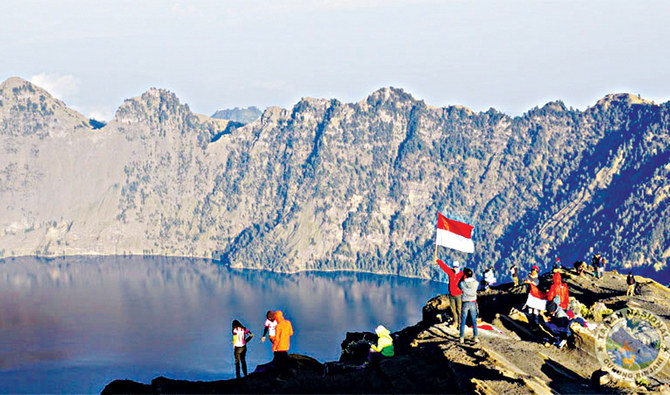
Climbers raised the national flag at the edge of Mount Rinjani’s Segara Anak crater. (Mount Rinjani National Park Agency)
2 / 3
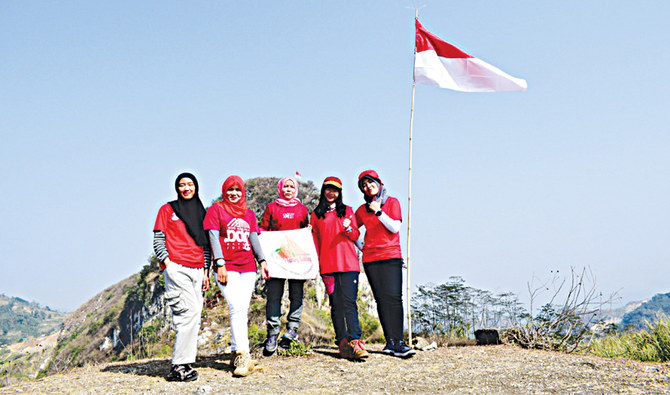
Bandung Mountain Climbers Community raised the national flag at the peak of one of the mountains in West Java. (Komunitas Pendaki Gunung Bandung)
3 / 3
Flag-raising at the peak of Mount Hawu, West Java. (Komunitas Pendaki Gunung Bandung)
Updated 17 August 2019
Follow

How Indonesians celebrate Independence Day

  • Thrill-seekers flock to the mountains to raise the flag on high
  • It’s a unique tradition a nation with 500 mountains, including active volcanoes

JAKARTA: Indonesians always find new ideas for celebrating the Aug. 17 Independence Day. While the most common celebration is a simple raising of the national flag, it has become a tradition for people to do it in extreme places, such as the top of a mountain.  In a vast archipelago that stretches 5,245 kilometers along the equator, Indonesian thrill-seekers who want to raise the flag on high are spoilt with options. With 500 mountains, of which 127 are active volcanoes and 22 are showing increased signs of activity.
Miena Muzdalifah, a mountain climber from Bandung, West Java, had her first high-altitude flag-raising moment in 2018 on Mount Hawu, a limestone mountain in Padalarang, west of Bandung. It was part of a simultaneous flag-hoisting ceremony in four compass directions that surround Bandung that her group, the Bandung Mountain Climbers Community, held last year.  
“There was a special sense of pride to be able to raise the red-and-white (flag) at a high altitude. We had to undergo a certain process to read the limestone cliff’s summit,” Miena told Arab News.  “It was a great feeling and it boosted my sense of nationalism and patriotism,” she added.  
Miena said the group plans to celebrate Indonesia’s 74th Independence Day by having a flag-hoisting ceremony at a 2,088-meter elevation on the Soleh Peak of Mount Jampang in Garut district, south of Bandung.


The high enthusiasm to celebrate Independence Day by climbing a mountain, especially the most popular ones and those located in national parks, has resulted in such an excess of climbers that park managements have to impose quotas. The limit fills up so quickly that climbers have to book online far ahead of their trip.
Mount Rinjani in Lombok Island, a 3,726-meter-high active volcano and the second-highest mountain in Indonesia, imposed a quota of 500 climbers per day. The restriction took effect after all four trails on the mountain were reopened for climbers on June 14. They had been closed following the 6.4-magnitude earthquake struck the island in July 2018.
“We’re not giving out more places for climbers, even though enthusiasm is high during the Independence Day holiday,” Sudiyono, head of Mount Rinjani National Park, told Arab News.
The mountain is also popular with foreign hikers, who have made up 80 percent of its climbers since the reopening, Sudiyono said.

NUMBERS

5,245km - The length of the Indonesian archipelago that straddles the equator.

500 - Mountains in Indonesia.

127 - Active volcanoes that dot the archipelago from Sumatra in the west to Papua in the east.

4,884m - The 7 highest summits in Indonesia that start from the 2,278-meter Mount Bukit Raya in Kalimantan to the 4,884-meter Mount Jayawijaya in Papua.

12 - The youngest age of an Indonesian climber to climb the seven summits.

2,088m - Height of one of this year’s Independence Day ceremonies.

Last year, rescuers had to evacuate 1,226 climbers, including 696 foreigners, who were stranded in various spots on the mountain, including its iconic crater lake, Segara Anak, due to landslides triggered by the powerful quake.
“It was always very crowded with climbers celebrating independence each year. After the earthquake, we have been improving our climbing procedures. We want to maintain manageable numbers for safety and for conservation purposes,” Sudiyono said.
Rahman Mukhlis, secretary-general of the Indonesia Mountain Guide Association, has had the chance to celebrate Independence Day on two of Indonesia’s seven highest summits, Mount Rinjani and Mount Latimojong, a 3,478-meter-high non-volcanic mountain in South Sulawesi.
“When we climb mountains, we get to know more about our country. We gain a better understanding of our sociocultural environment through interacting with the locals and seeing first-hand our country’s beautiful nature. We see a different view from above,” Rahman told Arab News.
Dody Permana, a long-time mountain climber, had his Independence Day moment years ago on Java’s highest mountain, Mount Semeru, which sits 3,676 meters above sea level in East Java province and is one of Indonesia’s seven highest summits.
“The Independence Day holiday is always a good opportunity to climb together with a group of friends. It feels heroic when have a flag-raising ceremony in an unusual place, such as the top of a mountain,” Dody said.
“Almost all the most popular ones would be overcrowded with climbers during the holiday, except some that have imposed a quota for climbers,” he added.
Mount Semeru used to host thousands of climbers for Independence Day celebrations. But since May, the Bromo Tengger Semeru National Park has imposed a quota of 600 climbers per day after months of closure following intense rainfall at the height of the rainy season in January.
Lanjar Sayekti, who works at the national park office, told Arab News that quotas for climbers in Semeru on the Independence Day weekend are full up.
“Mount climbing is a good way to gain a deeper feeling of nationalism and boost patriotism, especially on Independence Day,” Rahman said.

Decoder

Karst mountains

The karst mountains, made of limestone, can be worn away from the top or dissolved from a weak point inside the rock, featuring caves, underground streams and sinkholes. Steep rocky cliffs are visible where erosion has worn away the land above ground.


Mystery of CIA’s lost nuclear device haunts Himalayan villagers 60 years on

Updated 48 min 12 sec ago
Follow

Mystery of CIA’s lost nuclear device haunts Himalayan villagers 60 years on

  • Plutonium-fueled spy system was meant to monitor China’s nuclear activity after 1964 atomic tests
  • Porter who took part in Nanda Devi mission warned family of ‘danger buried in snow’

NEW DELHI: Porters who helped American intelligence officers carry a nuclear spy system up the precarious slopes of Nanda Devi, India’s second-highest peak, returned home with stories that sent shockwaves through nearby villages, leaving many in fear that still holds six decades later.

A CIA team, working with India’s Intelligence Bureau, planned to install the device in the remote part of the Himalayas to monitor China, but a blizzard forced them to abandon the system before reaching the summit.

When they returned, the device was gone.

The spy system contained a large quantity of highly radioactive plutonium-238 — roughly a third of the amount used in the atomic bomb dropped by the US on the Japanese city of Nagasaki in the closing stages of the Second World War.

“The workers and porters who went with the CIA team in 1965 would tell the story of the nuclear device, and the villagers have been living in fear ever since,” said Narendra Rana from the Lata village near Nanda Devi’s peak.

His father, Dhan Singh Rana, was one of the porters who carried the device during the CIA’s mission in 1965.

“He told me there was a danger buried in the snow,” Rana said. “The villagers fear that as long as the device is buried in the snow, they are safe, but if it bursts, it will contaminate the air and water, and no one will be safe after that.”

During the Sino-Indian tensions in the 1960s, India cooperated with the US in surveillance after China conducted its first nuclear tests in 1964. The Nanda Devi mission was part of this cooperation and was classified for years. It only came under public scrutiny in 1978, when the story was broken by Outsider magazine.

The article caused an uproar in India, with lawmakers demanding the location of the nuclear device be revealed and calling for political accountability. The same year, then Prime Minister Morarji Desai set up a committee to assess whether nuclear material in the area near Nanda Devi could pollute the Ganges River, which originates there.

The Ganges is one of the world’s most crucial freshwater sources, with about 655 million people in India, Nepal, and Bangladesh depending on it for their essential needs.

The committee, chaired by prominent scientists, submitted its report a few months later, dismissing any cause for concerns, and establishing that even in the worst-case scenario of the device’s rupture, the river’s water would not be contaminated.

But for the villagers, the fear that the shell containing radioactive plutonium could break apart never goes away, and peace may only come once it is found.

Many believe the device, trapped within the glacier’s shifting ice, may have moved downhill over time.

Rana’s father told him that the device felt hot when it was carried, and he believed it might have melted its way into the glacier, remaining buried deep inside.

An imposing mass of rock and ice, Nanda Devi at 7,816 m is the second-highest mountain in India after Kangchenjunga. 

When a glacier near the mountain burst in 2021, claiming over 200 lives, scientists explained that the disaster was due to global warming, but in nearby villages the incident was initially blamed on a nuclear explosion.

“They feared the device had burst. Those rescuing people were afraid they might die from radiation,” Rana said. “If any noise is heard, if any smoke appears in the sky, we start fearing a leak from the nuclear device.”

The latent fear surfaces whenever natural disasters strike or media coverage puts the missing device back in the spotlight. Most recently, a New York Times article on the CIA mission’s 60th anniversary reignited the unease.

“The apprehensions are genuine. After 1965, Americans came twice to search for the device. The villagers accompanied them, but it could not be found, which remains a concern for the local community,” said Atul Soti, an environmentalist in Joshimath, Uttarakhand, about 50 km from Nanda Devi.

“People are worried. They have repeatedly sought answers from the government, but no clear response has been provided so far. Periodically, the villagers voice their concerns, and they need a definitive government statement on this issue.”

Despite repeated queries whenever media attention arises, Indian officials have not released detailed updates since the Desai-appointed committee submitted its findings.

“The government should issue a white paper to address people’s concerns. The white paper will make it clear about the status of the device, and whether leakage from the device could pollute the Ganges River,” Soti told Arab News.

“The government should be clear. If the government is not reacting, then it further reinforces the fear.”