

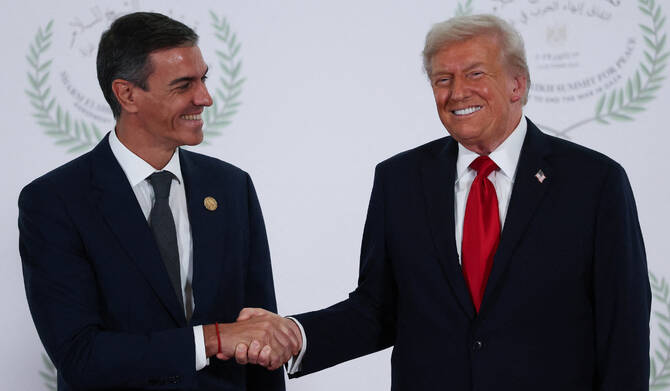

WASHINGTON/MADRID: US President Donald Trump threatened to impose a full US trade embargo on Spain on Tuesday after the European and NATO ally refused to let the US military use its bases for missions linked to strikes on Iran.
“Spain has been terrible,” Trump told reporters during a meeting with German Chancellor Friedrich Merz, adding that he had told Treasury Secretary Scott Bessent to “cut off all dealings” with Spain.
“We’re going to cut off all trade with Spain. We don’t want anything to do with Spain,” he added.
HIGHLIGHTS
• Spain refuses US military base use for Iran strikes
• Trump cites Supreme Court ruling to justify potential embargo
• Spain’s exports include olive oil, auto parts, steel, chemicals
The US relocated 15 aircraft, including refueling tankers, from the Rota and Moron military bases in southern Spain after the country’s Socialist leadership said it would not allow them to be used to attack Iran.
Trump again referenced Spain’s refusal to heed US calls for all NATO members to spend 5 percent of their GDP on defense, and added: “Spain has absolutely nothing that we need.”
“All business having to do with Spain, I have the right to stop it. Embargoes — do anything I want with it — and we may do that with Spain,” he said, again expressing his frustration with the Supreme Court’s ruling last month that his broadest global tariffs were illegal under a national emergencies law.
NO SEPARATE TREATMENT FOR SPAIN
Merz, speaking with reporters after the meeting, said he told Trump privately that Spain could not be excluded from a trade agreement reached between Brussels and Washington last year.
“I said that Spain is a member of the European Union and we negotiate about tariffs with the United States only together or not at all,” he said. “There is no way to treat Spain particularly badly.”
Trump publicly asked Bessent and US Trade Representative Jamieson Greer their opinions on cutting off Spanish trade.
“Well, sir, I think we’ll talk about it with you,” Greer said. “We know you can use it, and if you need to use it to assure national and economic security, we’ll do it.”
Bessent said the Supreme Court affirmed Trump’s embargo powers under the International Emergency Economic Powers Act, adding that the USTR and Commerce Department would begin investigations into how to penalize Spain under other trade laws.
HIGH BAR
Jennifer Hillman, a trade law professor at Georgetown University, said the Supreme Court did not address the president’s ability to impose a trade embargo under IEEPA. Trump could do so, but he would have to declare a national emergency over Spain as an “unusual and extraordinary” threat to the United States, she said, adding that such a move would go “well beyond” any previous emergency.
“It’s hard to see, however, how Spain denying us the use of air bases on its territory for us to launch an unprovoked attack on Iran poses ‘an unusual and extraordinary threat’ to our national security or foreign policy,” added Peter Shane, a New York University adjunct law professor.
SPAIN RESPONDS
The Spanish government responded in a statement that the US must be mindful of the autonomy of private businesses, international law and bilateral trade agreements between the US and the European Union.
Madrid said it had the necessary resources to contain the potential impact of a trade embargo and support affected sectors, but said it would continue to push for free trade and economic cooperation with its partners.
Spain is the world’s top exporter of olive oil and also sells auto parts, steel and chemicals to the United States, but is less vulnerable to Trump’s threats of economic punishment than other European nations.
The US had a trade surplus with Spain for the fourth year in a row in 2025, at $4.8 billion, according to US Census Bureau data, with US exports of $26.1 billion and imports of $21.3 billion. US exports of crude oil and liquefied natural gas to Spain have grown in recent years.
Merz said pressure was being brought to bear on Spain from within Europe on defense spending.
“We are trying to convince Spain to catch up with the 3 percent or 3.5 percent which we agreed on in NATO,” he said, adding later that Spain’s defense spending levels had nothing to do with the trade negotiations.
Spain’s Prime Minister Pedro Sanchez, one of a dwindling number of left-leaning voices in Europe, has risked Trump’s ire with a series of other policy moves, including refusing to let vessels transporting weapons to Israel dock in Spain.


