Islamabad administration invites beggars, trans people to join campaign to ban plastic

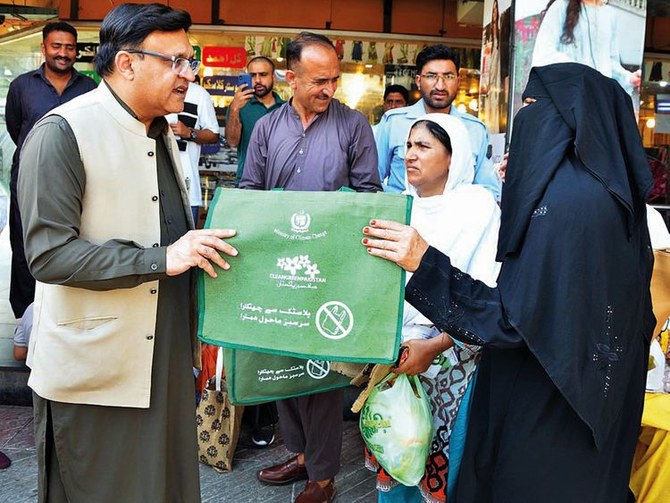
In this photo taken on 19th August, 2019, Hammad Shamimi, senior joint secretary, Climate Change, distributes fabric bags under Clean and Green Pakistan campaign in Islamabad. Image Credit: APP
Updated 23 August 2019
Follow

Islamabad administration invites beggars, trans people to join campaign to ban plastic

  • Deputy commissioner proposes that marginalized groups sell paper and fabric bags instead of begging on the streets
  • Local government banned the manufacture, sale and distribution of plastic carrier bags last week

ISLAMABAD: The deputy commissioner of Pakistan’s federal capital has invited beggars and transgender persons to sell paper and fabric bags instead of seeking alms around the city, thus helping the Ministry of Climate Change implement its decision to ban plastic bags.
The Islamabad local government banned the manufacture, sale, and distribution of plastic carrier bags last week, on the country’s independence day, as part of Prime Minister Imran Khan’s “Clean, Green Pakistan” campaign.
The new ban follows a three-month-long campaign to raise awareness about the environmental hazards of plastic bags, which can kill wildlife, block drainage systems, collect in waterways and cause other environmental and health problems.
“We have invited transgender people and beggars to sell paper bags – or any type of biodegradable shopping bags – in the city,” Muhammad Hamza Shafqaat, Islamabad’s deputy commissioner, told Arab News on Friday. “We will neither charge them rental or license fee nor impose a fine on them. They can also set up makeshift stalls after informing us at a location of their choice.”
Shafqaat is spearheading the awareness campaign against plastic bags in Islamabad and said involving beggars and transgender persons in the administration’s campaign against plastic would also help them earn a decent living.
“Our local administration’s new policy has widely been welcomed by the public,” the official said. “This is because our aim is also to help these marginalized segments and make them contribute toward a clean and green country.”
Pakistan is on its way to becoming the 128th country in the world that will end the use of non-biodegradable material made from various types of polymers that are harmful to the environment. It is ranked number seven on the index of climate change.
In an interview to Arab News just days before the ban came into effect, State Minister for Climate Change Zartaj Gul said: “We want Pakistan to be plastic-free because it is a burden on our environment.”
She also added that Pakistan wanted to demonstrate to the world that it was “contributing to green initiatives.”


Death toll in Pakistan shopping plaza fire rises to 67, officials say

Updated 22 January 2026
Follow

Death toll in Pakistan shopping plaza fire rises to 67, officials say

  • Rescue teams still searching for damaged Gul Plaza in Karachi where blaze erupted on Saturday, says police surgeon
  • Karachi has a long history of deadly fires, often linked to poor safety standards, weak regulatory enforcement

KARACHI: The death toll from a devastating fire at a shopping plaza in Pakistan’s southern port city of Karachi jumped to 67 on Thursday after police and a hospital official confirmed that the remains of dozens more people had been found.

Police surgeon Dr. Summaiya Syed said rescue teams were still searching the severely damaged Gul Plaza in the Karachi, where the blaze erupted on Saturday.

Most remains were discovered in fragments, making identification extremely difficult, but the deaths of 67 people have been confirmed, she said. Asad Raza, a senior police official in Karachi, also confirmed the death toll. Authorities previously had confirmed 34 deaths.

Family members of the missing have stayed near the destroyed plaza and hospital, even after providing their DNA for testing. Some have tried to enter the building forcibly, criticizing the rescue efforts as too slow.

“They are not conducting the search properly,” said Khair-un-Nisa, pointing toward the rescuers. She stood outside the building in tears, explaining that a relative who had left to go shopping has been missing since the blaze.

Another woman, Saadia Saeed, said her brother has been trapped inside the building since Saturday night, and she does not know what has happened to him.

“I am ready to go inside the plaza to look for him, but police are not allowing me,” she said.

There was no immediate comment from authorities about accusations they have been too slow.

Many relatives of the missing claim more lives could have been saved if the government had acted more swiftly. Authorities have deployed police around the plaza to prevent relatives from entering the unstable structure, while rescuers continue their careful search.

Investigators say the blaze erupted at a time when most shop owners were either closing for the day or had already left. Since then, the Sindh provincial government has said around 70 people were missing after the flames spread rapidly, fueled by goods such as cosmetics, clothing, and plastic items.

The cause of the fire remains under investigation, though police have indicated that a short circuit may have triggered the blaze.

Karachi has a long history of deadly fires, often linked to poor safety standards, weak regulatory enforcement, and illegal construction.

In November 2023, a shopping mall fire killed 10 people and injured 22. One of Pakistan’s deadliest industrial disasters occurred in 2012, when a garment factory fire killed at least 260 people.