

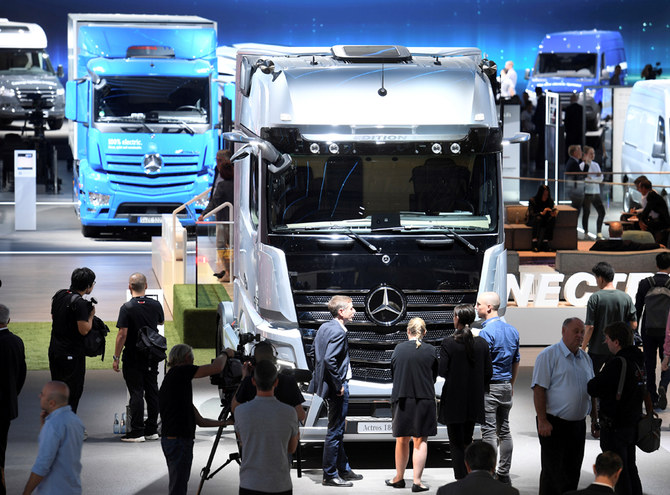
Daimler to make Mercedes-branded trucks in China

Beiqi Foton plans to greatly increase heavy truck production. (Reuters)
Updated 22 August 2019
Follow

Daimler to make Mercedes-branded trucks in China

  • The plan will deepen the alliance between Daimler and its Chinese truck JV partner, Beiqi Foton

SHANGHAI: German auto maker Daimler plans to build Mercedes Benz-branded heavy trucks in China by revamping truck plants owned by its local joint venture, according to a document seen by Reuters and two sources familiar with the matter.

The plan will deepen the alliance between Daimler and its Chinese truck JV partner, Beiqi Foton, and comes after the purchase of a 5 percent stake in Daimler last month by its Mercedes Benz passenger car partner, Beijing Automotive Group, Foton’s parent group.

“Localisation of Mercedes Benz-branded trucks had been planned years before, so it has nothing to do with BAIC Group's recent stake purchase in Daimler,” one source said.

In 2016, Daimler’s then head of its truck business told German media that it planned to make Mercedes Benz-branded Actros heavy trucks in China by the end of the decade. No details of the plan have since been reported or announced.

Under the plan, Beijing Foton Daimler Automotive will add Actros to its production lines which are mainly used to make Auman trucks, the joint venture’s sole truck brand, the sources said.

The JV plans to revamp its No.3 plant, which will have an annual capacity of 60,000 heavy trucks, and expand capacity at its No.2 plant to 100,000 units from 60,000 now, according to a document on the JV's website. The value of the investment was not known.

The No.3 plant will build both Actros and Auman trucks, said the sources, who declined to be identified because the plan had not been made public.

Daimler’s office in China did not immediately respond to phone calls seeking comment.


Egypt’s non-oil exports rise 17% as trade deficit narrows

Updated 28 January 2026
Follow

Egypt’s non-oil exports rise 17% as trade deficit narrows

RIYADH: Egyptian non-oil exports increased by over 17 percent year on year in 2025, reaching approximately $48.6 billion, new figures showed.

Latest foreign trade indicators released by the country’s Ministry of Investment and Foreign Trade revealed the trade deficit narrowed by 9 percent over the 12 months, reaching around $34.4 billion, according to a statement.

This supports Egypt’s ambition to enter the global top 50 in trade performance, boost exports to $145 billion a year, and narrow the trade deficit.

It also aligns with the country’s efforts to streamline procedures, maximize the benefits of trade agreements, and protect local industry in line with international agreements.

The newly released data said: “Egyptian gold exports also saw a substantial increase, reaching $7.6 billion in 2025 compared to $3.2 billion in 2024, an increase of $4.4 billion.”

It further indicated that the largest markets for Egyptian non-oil exports in 2025 included the UAE, Turkiye, and Saudi Arabia, as well as Italy and the US. 

The most important export sectors included building materials at $14.9 billion, chemicals and fertilizers at $9.4 billion, and food industries at $6.8 billion.

In October, Egypt’s credit rating was raised by S&P Global to “B” from “B-,” while Fitch reaffirmed its “B” rating, citing reform progress and macroeconomic stability.

S&P said at the time that the upgrade reflects reforms implemented over the past period by the country, including the liberalization of the foreign exchange regime, which boosted competitiveness and fueled a rebound in growth.

Prime Minister Mostafa Madbouly also said at that time that both rating agencies’ decisions signal confidence in the government’s reform agenda and its expected returns.

In September, Egypt’s Ministry of Planning, Economic Development and International Cooperation reported that the economy expanded 4.4 percent in fiscal year 2024/25, driven by a strong fourth quarter when gross domestic product growth hit a three-year high of 5 percent.

This reflects the impact of the more flexible exchange rate regime adopted since March 2024, which has helped stabilize the balance of payments and restore investor confidence.