

Emotions stir in Jerusalem as HBO’s ‘Our Boys’ hits local airwaves

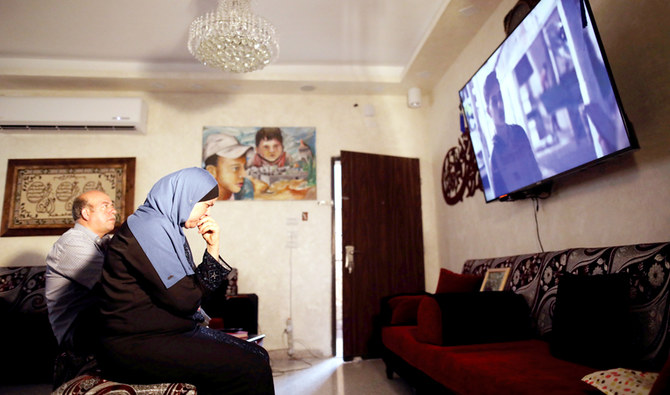
The mother of the murdered Mohammed Abu Khdeir watches the show. (Reuters)
Updated 20 August 2019
Follow

Emotions stir in Jerusalem as HBO’s ‘Our Boys’ hits local airwaves

  • The deaths of the four youths spiraled into a seven-week war between Israel and Hamas, which rules Gaza

JERUSALEM: A new HBO series on the killing of a Palestinian youth after three Israeli teens were murdered in a deadly summer five years ago is stirring up painful memories for bereaved families on both sides of the conflict.

“Our Boys,” which premiered in Israel and the US last week, centers on Mohammed Abu Khdeir, a 16-year-old Palestinian who was abducted near his East Jerusalem home and burned to death by three Israelis, two of them also teenagers, in July 2014.

“I wish I could reach into the screen and grab hold of my son,” Abu Khdeir’s mother, Suha, told Reuters, her voice breaking, soon after watching the first two episodes of the series, a co-production of HBO and Israel’s Keshet International and produced by Movie Plus.

“The show brought me right back to the pain, to the day he was kidnapped,” she said.

Prosecutors said Abu Khdeir’s convicted killers were avenging the kidnapping and murder of three Israeli teens — Naftali Frankel, Gilad Sha’er and Eyal Yifrach — in the occupied West Bank two weeks earlier by members of Hamas.

The deaths of the four youths spiraled into a seven-week war between Israel and Hamas, which rules the Gaza Strip.

HBO’s 10-episode dramatization dissects Israel’s internal investigation into the three ultra-Orthodox Jews eventually convicted of Abu Khdeir’s murder and the frantic initial days after his parents learned of his disappearance and death.

The Hebrew- and Arabic-language series was written, directed and produced by two Jewish Israelis and an Arab Israeli, who mix documentary footage with live production to delve into the micro details they say drive the conflict.

“We live in an extremely nuanced world where wars erupt because of tiny things,” co-director Joseph Cedar, 50, said in an interview alongside collaborators Hagai Levi and Tawfik Abu Wael. “We tried to peel back the layers of this hate crime,” he said.

But some bereaved Israeli families have said the show largely glosses over the murder of the three Israeli teens, who are referenced throughout the series but not included as characters.

Two Hamas suspects in the murders were killed in a 2014 shootout and in 2015 an Israeli court sentenced a third Hamas member to three life terms for the teens’ abduction and murder.

Levi said the creators felt they had portrayed the context of Abu Khdeir’s killing. “But the crime is the story,” he said.


UN rights chief Shocked by ‘unbearable’ Darfur atrocities

Updated 18 January 2026
Follow

UN rights chief Shocked by ‘unbearable’ Darfur atrocities

  • Mediation efforts have failed to produce a ceasefire, even after international outrage intensified last year with reports of mass killings, rape, and abductions during the RSF’s takeover of El-Fasher in Darfur

PORT SUDAN: Nearly three years of war have put the Sudanese people through “hell,” the UN’s rights chief said on Sunday, blasting the vast sums spent on advanced weaponry at the expense of humanitarian aid and the recruitment of child soldiers.
Since April 2023, Sudan has been gripped by a conflict between the army and the paramilitary Rapid Support Forces that has left tens of thousands of people dead and around 11 million displaced.
Speaking in Port Sudan during his first wartime visit, UN Human Rights commissioner Volker Turk said the population had endured “horror and hell,” calling it “despicable” that funds that “should be used to alleviate the suffering of the population” are instead spent on advanced weapons, particularly drones.
More than 21 million people are facing acute food insecurity, and two-thirds of Sudan’s population is in urgent need of humanitarian aid, according to the UN.
In addition to the world’s largest hunger and displacement crisis, Sudan is also facing “the increasing militarization of society by all parties to the conflict, including through the arming of civilians and recruitment and use of children,” Turk added.
He said he had heard testimony of “unbearable” atrocities from survivors of attacks in Darfur, and warned of similar crimes unfolding in the Kordofan region — the current epicenter of the fighting.
Testimony of these atrocities must be heard by “the commanders of this conflict and those who are arming, funding and profiting from this war,” he said.
Mediation efforts have failed to produce a ceasefire, even after international outrage intensified last year with reports of mass killings, rape, and abductions during the RSF’s takeover of El-Fasher in Darfur.
“We must ensure that the perpetrators of these horrific violations face justice regardless of the affiliation,” Turk said on Sunday, adding that repeated attacks on civilian infrastructure could constitute “war crimes.”
He called on both sides to “cease intolerable attacks against civilian objects that are indispensable to the civilian population, including markets, health facilities, schools and shelters.”
Turk again warned on Sunday that crimes similar to those seen in El-Fasher could recur in volatile Kordofan, where the RSF has advanced, besieging and attacking several key cities.
Hundreds of thousands face starvation across the region, where more than 65,000 people have been displaced since October, according to the latest UN figures.