

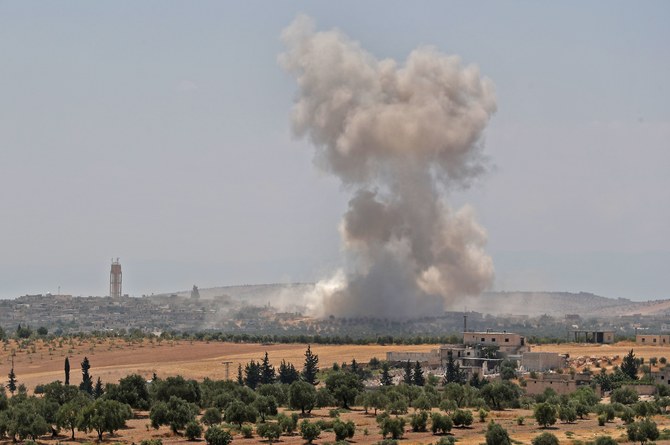

ANKARA: The Astana process to resolve the Syrian conflict was in danger of collapse on Monday after Assad regime warplanes struck a Turkish military convoy just north of Khan Sheikhun in Idlib province.
The strike was backed by Russia, a key participant in the Astana process with Turkey and Iran. “We support the efforts of the Syrian army,” Russian President Vladimir Putin said.
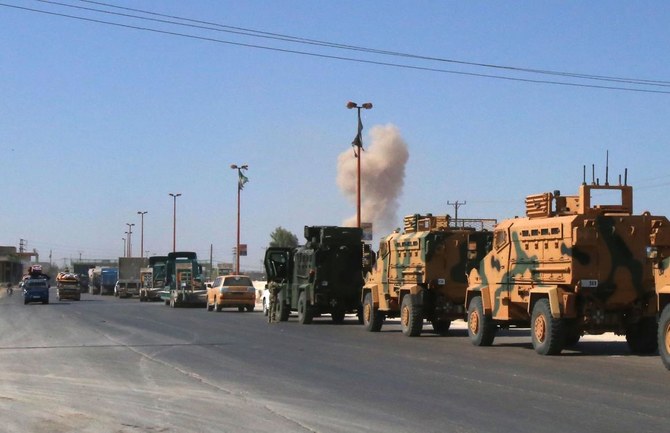
Turkish authorities said the convoy of about 50 armored personnel carriers and five tanks was on its way to reinforce one of its observation posts at Morek, south of Khan Sheikhun on the main M5 highway between Damascus and Aleppo.
But the Assad regime accused Ankara of supplying militants from Hayat Tahrir Al-Sham (HTS), who control most of Idlib. “Turkish vehicles loaded with munitions ... are heading toward Khan Sheikhun to help the terrorists,” the foreign ministry said.
Pro-regime forces have been battling HTS for the past three days for control of Khan Sheikhun, and the strategic highway. Regime troops took control ofpart of the road north of the city in a new advance on Monday, effectively blocking the Turkish convoy from continuing south.

A convoy of Turkish military vehicles passes through Maaret al-Numan in Syria's northern province of Idlib reportedly heading toward the town of Khan Sheikhun in the southern countryside of the province on August 19, 2019. (AFP)
Ankara condemned the airstrike, in which three people died. The attack was “in violation of the existing memorandums and agreements with the Russian Federation,” it said.
With the presidents of Turkey, Russia and Iran due to meet in Ankara next month in the next stage of the Astana process, Monday’s airstrike could not have come at a worse time, military analyst Navvar Saban told Arab News.
“Russians and Turks don’t have the luxury to destroy Astana. If it collapses, they will have to retreat from Idlib and it would be disaster internally and externally,” said Saban, of the Omran Center for Strategic Studies in Istanbul.

A convoy of Turkish military vehicles passes through Maaret al-Numan in Syria's northern province of Idlib reportedly heading toward the town of Khan Sheikhun in the southern countryside of the province on August 19, 2019. (AFP)
“Turkey’s aim is to stop regime forces from advancing, and to secure Turkish observation posts. But in case of a direct hit on the Turkish posts, there would be a counter-attack from the Turkish side.
“But Ankara should admit it is too late to secure the area. Regime forces have advanced greatly on the ground.”
Dr. Kerim Has, a Russia-Turkey relations analyst in Moscow, said a slow advance of Russia-backed Assad regime forces in Idlib was inevitable because talks so far had not eliminated the terror threat in Idlib. “On the contrary, HTS controls more territory than it did a year ago,” he said.
Has expects Russia to support a 15km-20 km demilitarized zone on the Turkish border, along with Assad-regime forces. “Also, the delivery of the first consignment of Russian-made S-400 missile systems to Turkey ties Ankara’s hands. It cannot effectively resist a regime offensive, or react to Moscow’s turning a blind eye to developments on the ground. Ankara may have to quit one of its observation posts in Idlib, which will come under regime fire soon.”


