

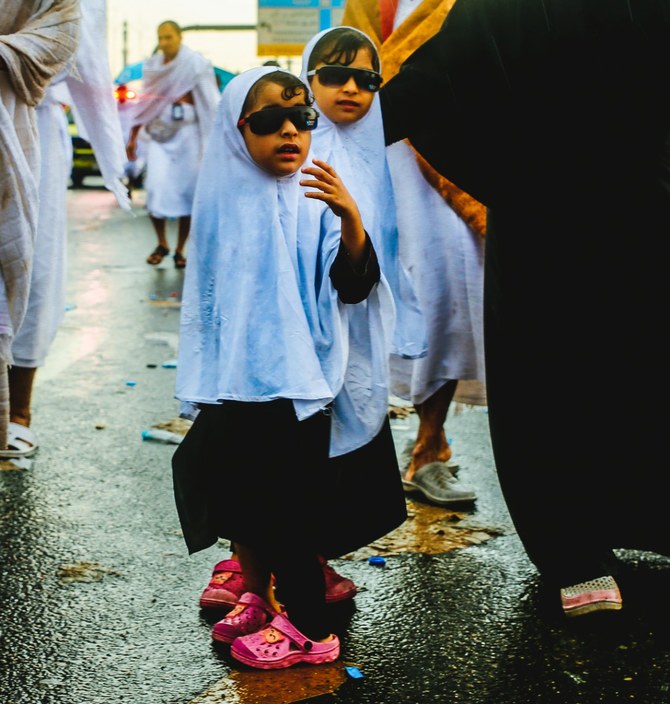
Meet the parents taking their children to Hajj

1 / 5
Many parents chose to take their children on Hajj with them. (AN photo/Essam Al-Ghalib)
2 / 5
Many parents chose to take their children on Hajj with them. (AN photo/Essam Al-Ghalib)
3 / 5
Many parents chose to take their children on Hajj with them. (AN photo/Essam Al-Ghalib)
4 / 5
Many parents chose to take their children on Hajj with them. (AN photo/Essam Al-Ghalib)
5 / 5
Many parents chose to take their children on Hajj with them. (AN photo/Essam Al-Ghalib)
Updated 11 August 2019
Follow

Meet the parents taking their children to Hajj

  • Pilgrims tell Arab News the benefits of taking their children with them on pilgrimage

ARAFAT, SAUDI ARABIA: Pilgrims who take their children to the holy sites mainly do so for two reasons: No one can look after them and the educational value.

Ayman Dafaalah, a Sudanese worshipper, is bringing his two young children along with his wife. He Arab News that brought his children because there were no relatives back home to take care of them. 

“We had no other choice. So, we decided to take them with us. Otherwise, we could not perform the rituals,” Dafaalah said.

He said that he and his wife are teaching their children the steps of Hajj.

“They have accompanied us on Umrah before, but this is their first time on Hajj. It is really hard to bring children, but it is sometimes even harder to leave them alone or with a relative,” he added.

Dafaalah said that they made sure that the elder son had learned his mobile number by heart. He said that he is always carrying his the younger son.

“Even if he got lost, I am sure that we could find him with the help of the security people who are everywhere here in Arafat,” he added.

Like Dafaalah, Egyptian pilgrim Rajab Ahmed Abdul-Ghani and his wife brought their 3-year-old son because they would have been worried if they left him behind.

“We cannot leave a child at this age, no matter how great the caretaker is. The child would emotionally suffer from our absence,” Abdul-Ghani said.

Iraqi pilgrim Muslim Rifaat Al-Jibari, who is bringing his 8-year-old daughter, said that the whole family are coming for Hajj so he could not leave her behind.

“We do have relatives but we thought it would be a good chance to take her with us, and teach her about the rituals. She will always remember this experience.”

Lina Abu Zinada, a supervisor at the Lost Children center, told Arab News that they had only one missing girl. They are trying their best to reunite her with her family.

“We only have only lost child here in Arafat. She is from Chad and was brought to us in Mina on Friday at 8 p.m. Since then, we have received no enquiry about her,” she said.


Over 4.8m captagon pills found hidden in Jeddah charcoal shipment

Updated 5 sec ago
Follow

Over 4.8m captagon pills found hidden in Jeddah charcoal shipment

  • Captagon is an addictive, amphetamine-type stimulant that is mass-produced in illicit factories

RIYADH: Saudi Arabia’s Zakat, Tax and Customs Authority foiled an attempt to smuggle more than 4.8 million captagon pills through Jeddah’s port, hidden inside a shipment of charcoal.

The authority’s spokesperson Hamoud Al-Harbi said that a shipment arrived at the port, which, after being assessed by customs authorities, was found to contain a large amount of the illicit drug, hidden inside charcoal bags, the Saudi Press Agency reported.

After the pills were seized, the authority coordinated with the General Directorate of Narcotics Control to ensure that the intended recipients were arrested.

Al-Harbi added that ZATCA is working to tighten customs control on Saudi imports and exports and stands ready to combat smuggling.

He called on members of the public to contribute to the fight against smuggling.

ZATCA may be contacted for security reports by phone from inside the Kingdom at 1910, outside the Kingdom at +9661910, or by email at [email protected].

The authority receives reports related to smuggling crimes and violations of the customs system in complete confidentiality and offers financial rewards to any reports that are accurate.

Captagon is an addictive, amphetamine-type stimulant that is mass-produced in illicit factories.

It is simple to produce compared to other narcotics, and drug smugglers have found a market for the substance in the Gulf states.

Syria under Bashar Assad was one of the largest producers of captagon in the region.

When his government was overthrown in December 2024, one of the first steps taken by the new President Ahmed Al-Sharaa was to crack down on the production of captagon in Syria.