

Syrian authorities thwart captagon smuggling to Jordan

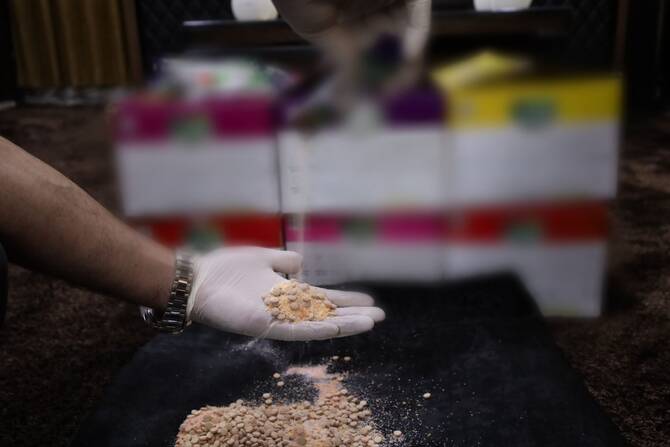
The Ministry of Interior Affairs announced that the shipment was intended for smuggling through the Nasib border crossing with Jordan. (SANA)
Short Url
Updated 03 November 2025
Follow

Syrian authorities thwart captagon smuggling to Jordan

  • The Daraa Anti-Narcotics Branch is intensifying monitoring and field operations along the border areas with Jordan
  • In another incident, anti-narcotics units in the Damascus countryside seized 323 blocks of hashish and approximately 35,000 captagon pills

LONDON: Syrian authorities thwarted a smuggling attempt on Monday involving a large quantity of captagon pills in the southern province of Daraa.

The Ministry of Interior Affairs announced that the psychostimulants were concealed within modified instant juice sachets for powdered drinks, intended for smuggling through the Nasib border crossing with Jordan.

The ministry confirmed that the Daraa Anti-Narcotics Branch is intensifying monitoring and field operations along the border with Jordan to safeguard national security and protect society from the dangers of illicit drugs.

In another incident, anti-narcotics units in the Damascus countryside seized 323 blocks of hashish and approximately 35,000 captagon pills, valued at thousands of US dollars, during an operation in Al-Zabadani.

Authorities in Syria continue to fight against drug trafficking, cooperating with neighboring countries such as Jordan, Turkiye, and Iraq to dismantle criminal networks.

The former regime of Bashar Assad has been accused of turning the country into a hub for the manufacture of the highly toxic captagon while sponsoring cartels to smuggle drugs to the Arab Gulf and other countries.


The art of war: fears for masterpieces on loan to Louvre Abu Dhabi

Updated 13 March 2026
Follow

The art of war: fears for masterpieces on loan to Louvre Abu Dhabi

  • UAE paid more than €1 billion to borrow priceless works, but experts in France want them back

PARIS: The Middle East war has raised fears for the safety of priceless masterpieces on loan from France to the Louvre Abu Dhabi, the museum’s only foreign branch.
The Abu Dhabi museum, which opened in 2017, has so far escaped damage from nearly 1,800 Iranian drone and missile strikes launched since the conflict erupted on Feb. 28.
However, concerns are mounting in France. “The works must be removed,” said Didier Selles, who helped broker the original agreement between France and the UAE.
French journal La Tribune de l’Art echoed that alarm. “The Louvre’s works in Abu Dhabi must be secured!” it said.
France’s culture ministry said French authorities were “in close and regular contact with the authorities of the UAE to ensure the protection of the works loaned by France.”
Under the agreement with the UAE, France agreed to provide expertise, lend works of art and organize exhibitions, in return for €1 billion, including €400 million for licensing the use of the Louvre name. The deal was extended in 2021 to 2047 for an additional €165 million.
Works on loan include paintings by Rembrandt and Chardin, Classical statues of Isis, Roman sarcophagi and Islamic masterpieces: such as the Pyxis of Al-Mughira.

A Louvre Abu Dhabi source said the museum was designed to protect collections from both security threats and natural disasters.