

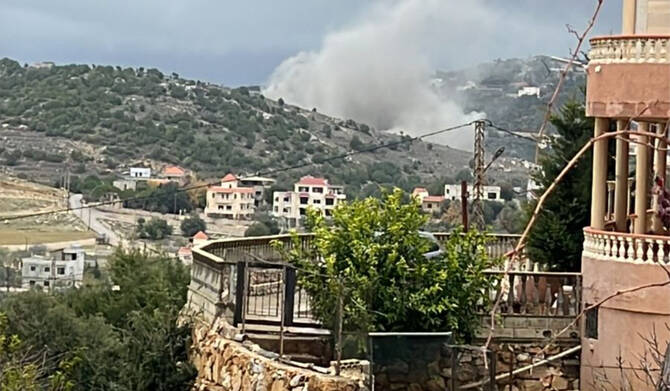


BEIRUT: Israeli warplanes on Friday carried out more than 20 raids across Lebanon, targeting sites in the south and Northern Bekaa.
Tel Aviv said the attacks were a response to an ongoing breach of the ceasefire agreement, and claimed “Hezbollah is rebuilding its military capabilities in violation of the agreements between Lebanon and Israel.”
The raids targeted the valleys between Houmin in Nabatieh and Deir Al-Zahrani north of the Litani River, in addition to Al-Aaishiyah, Al-Zagharin, Iklim Al-Tuffah, Kfarkila, Ain Qana, the Sajd Heights and Al-Rayhan. In addition, the Israeli army targeted the town of Al-Baissariyeh in Saida.
Repeated airstrikes shook the eastern mountain range without prior warnings, targeting the upper parts of the Brital highlands in the Baalbek district of Northern Bekaa, and the Al-Jbour area in Western Bekaa.
Israeli army spokesperson Avichay Adraee accused Iran-backed Hezbollah of attempting to rebuild its military capabilities, claiming the Israeli army attacked the group’s “targets and raided a manufacturing site, weapon depots and missile-launching pads used by Hezbollah.”
In a post on social media, Adraee vowed that “the Israeli army will continue to work on removing any threat.”
As part of Israel’s campaign — albeit at a reduced pace — an Israeli force penetrated the border village of Yaroun and destroyed a building in the Al-Bayader neighborhood before withdrawing, according to a Lebanese military source.
An Israeli raid on Thursday targeted a car on the road between Zaita and Bnaafoul, resulting in one fatality.
The latest incidents came as the Lebanese Army Command announced on Thursday the completion of the first phase of a plan to restrict weapons to state hands south of the Litani River. A plan to restrict weapons north of the river is set to be prepared and submitted to the Cabinet next month, as the military moves to contain weapons and prevent their smuggling, transfer, or use.
Iranian foreign minister
Amid the Israeli strikes, Iranian Foreign Minister Abbas Araghchi, who is currently in Beirut, has held a series of meetings with Lebanese officials.
Araghchi affirmed that Iran “supports Lebanon’s independence, unity and sovereignty,” and added that “defending the country is the Lebanese government’s responsibility.”
He said: “Iran supports Hezbollah as a resistance group, but it does not interfere at all in its affairs, and any decision related to Lebanon is left to the party itself.”
He described his visit to Lebanon as part of “strengthening and developing relationships between both countries.”
Araghchi — who is visiting Beirut amid mass protests at home over government spending during a cost-of-living crisis — met Lebanese Foreign Minister Youssef Rajji, who had declined to receive him on a previous visit.
He told him that “his country seeks to build a relationship with Lebanon based on amicability and mutual respect, within the framework of the two governments, with all their institutions and components.”
He said that “a joint confrontation of challenges and risks requires continued dialogue and consultation despite differences in approaches to certain files,” stressing that “the unity of Lebanon’s sects under the authority of the Lebanese government would protect Lebanon and achieve its stability.”
According to his media office, Rajji reaffirmed that “defending Lebanon is the (sole) responsibility of the Lebanese state.”
He added: “When the state possesses its strategic decision-making power, holds the decision of war and peace, and confines weapons to its own hands, it can then request assistance from countries, including Iran.”
Rajji also emphasized that “building a state capable of defending its land and its people cannot happen while there is an armed organization outside its authority.”
He addressed Araghchi by asking whether Tehran “would accept the presence of an illegal armed organization on its own territory.”
Rajji called on Iran to engage in talks with Lebanon to find “a new approach to the issue of Hezbollah’s weapons, drawing on Iran’s relationship with the party, so that these weapons do not become a pretext for weakening Lebanon.”
He pointed out that “the Shiite community is not being targeted, and the only sustainable guarantee for it, and for the other communities, is unity, and being under the authority of the state and the rule of law.”
He added: “Experience has shown that weapons have not been able to defend the Shiite community, or Lebanon and all its components.”
Rajji urged his Iranian counterpart to “put a stop to the statements and stances of some Iranian officials, which are considered a blatant interference in Lebanese affairs.”
The European Council
The Israeli actions coincided with the arrival in Beirut of a delegation from the European Council headed by its President Antonio Costa, along with European Commission President Ursula von der Leyen, who was accompanied by an EU delegation.
In remarks made while meeting Lebanese officials, Costa welcomed “the Lebanese army’s announcement that it has completed the first phase of the plan to disarm Hezbollah south of the Litani River.”
During his meeting with Lebanese President Joseph Aoun, Costa reaffirmed “the commitment to Lebanon’s sovereignty and territorial integrity,” stressing that “there is no room for armed militias that undermine stability.”


