Gazans struggle to protect antiquities from neglect, looting

1 / 5
Palestinian heritage pieces and ancient artifacts are piled inside Al-Aqqad private museum in town of Khan Younis, Southern Gaza Strip. (AP)
2 / 5
Gaza was a major trade route between Egypt and the Levant for thousands of years. (AP)
3 / 5
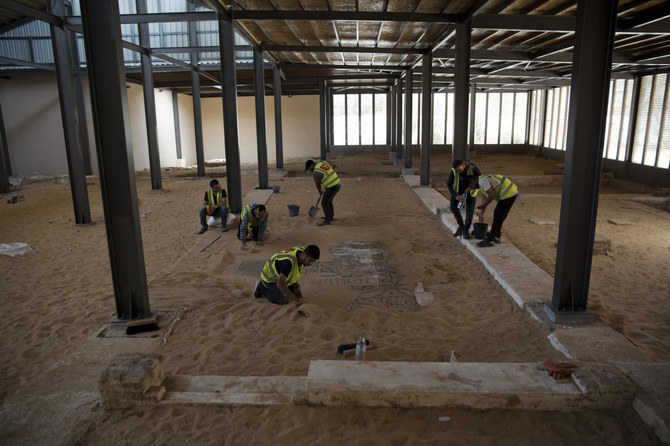
Palestinians are working on a 4th century AD St. Hilarion monastery archaeological site in central Gaza Strip. (AP)
4 / 5
Decades of uprisings, war and political turmoil have inflicted a heavy toll on Gaza’s rich archaeological heritage, exposing it to looting and destruction. (AP)
5 / 5
Neglect by Hamas authorities and a blockade imposed by Israel and Egypt have hindered efforts to preserve and protect antiquities, leaving much of the work to private collectors. (AP)
Updated 07 August 2019
Follow

Gazans struggle to protect antiquities from neglect, looting

  • Uprisings, war and political turmoil have inflicted a heavy toll on Gaza heritage, exposing it to looting and destruction
  • The militant group Hamas seized Gaza in 2007 from forces loyal to the Western-backed Palestinian Authority

KHAN YOUNIS, Gaza Strip: Walid Al-Aqqad’s Gaza home would be the envy of many an antiquities collector.
Pieces of Corinthian columns greet visitors in the backyard. Inside, hundreds of ancient pots and other artifacts hang on the walls or are arranged helter-skelter on shelves.
They are remnants of five millennia of Gaza’s history, from the Bronze Age to the Islamic caliphates and on down to the years of Ottoman and British rule in the 20th century.
A sliver of land on the Mediterranean, Gaza was a major trade route between Egypt and the Levant going back to ancient times. But decades of uprisings, war and political turmoil have inflicted a heavy toll on its rich archaeological heritage, exposing it to looting and destruction.
The militant group Hamas seized Gaza in 2007 from forces loyal to the Western-backed Palestinian Authority. In response, Egypt and Israel imposed a blockade on Gaza that has left the territory isolated and increasingly impoverished. The Palestinians say the closures have also hindered excavations and restricted experts’ access to new discoveries.
Hamas has done little to protect Gaza’s antiquities and in some cases actively destroys them. In 2017, Hamas authorities leveled large parts of Tel Es-Sakan, the remains of a 4,500-year-old Bronze Age city, to make way for construction projects.
Ayman Hassouna, professor of history and archaeology at Gaza’s Islamic University, blames Israel, the Palestinian Authority and Hamas equally for not protecting the territory’s cultural heritage. He says Israel confiscated artifacts from archaeological digs in the decades it occupied Gaza and did little to prevent antiquities trafficking. Palestinian authorities governing Gaza since 1995 have “attacked many archaeological sites — either intentionally or not,” he said.
He also blamed a lack of awareness among Gazans of the importance of preserving antiquities and leaving ancient sites undisturbed.
“When they find something, they would hide it or build over it,” he said.
Antiquities plundering and trafficking also remains a problem, said Heyam Al-Bitar, an archaeologist with Gaza’s ministry of tourism and antiquities. She said the ministry only learned earlier this year that dozens of ancient Greek silver coins were smuggled out of Gaza in 2016.
“It’s difficult to track down the trafficking because everything happens in the dark,” she said.
Al-Aqqad is one of few trying to save antiquities in Gaza. He began his collection in 1975, buying from collectors or searching the beach and new construction sites. Now his house in the southern city of Khan Younis is an archaeological, heritage and cultural museum, welcoming school trips and history students.
“This museum was established by personal efforts and at the expense of my children’s bread... to protect the pieces,” Al-Aqqad said.
His is one of five legally registered private collections in the Strip, containing 10,000 artifacts and objects of historical value, according to the ministry.
The ministry keeps an inventory of all private collections to prevent artifacts from being sold or smuggled out, said Al-Bitar. Owners have received training from the ministry and the Islamic University on how to preserve artifacts and restore clay objects when they fracture, she added.
The underfunded ministry opened a public museum in 2010 at Al-Basha Palace, a fort built by Gaza’s Mamluk rulers in the mid-13th century. It has 350 to 400 pieces held in sparsely-filled display cases. The museum occasionally showcases pieces from the private collections, but does not have space for all of them.
“The ministry has plans to build a large national museum for all these archaeological pieces, but the political economic situation and the siege on Gaza are preventing this,” she said.
Restorers are struggling to save two of Gaza’s endangered heritage sites: a 5th century Byzantine Church in Jabaliya, discovered in 1996, and a 4th-century monastery just south of Gaza City. Since the Jabaliya church’s discovery, it has suffered from neglect and was damaged in fighting between Israel and Palestinian militants.
Last year, French NGO Première Urgence Internationale launched an ambitious 26-month project to preserve the two sites with a £1,755,000 grant by the British Council. As part of the project, protective roofs now cover the ruins and layers of sand protect ornate mosaic floors from further destruction.


Japan’s traditional kimonos are being repurposed in creative and sustainable ways

Updated 20 February 2026
Follow

Japan’s traditional kimonos are being repurposed in creative and sustainable ways

  • A genuine silk kimono, which literally means ‘worn thing,’ lasts a hundred years or more
  • In a Japanese family, it’s handed down over generations like heirloom jewelry, artworks and military medals

TOKYO: The kimono, that elaborate, delicate wrap-around garment worn by geisha and samurai from centuries back, is getting a vibrant remake, appreciated these days for a virtue that’s more relevant than ever: sustainability.
A genuine silk kimono, which literally means “worn thing,” lasts a hundred years or more. In a Japanese family, it’s handed down over generations like heirloom jewelry, artworks and military medals.
It never goes out of style.
The design of the kimono and accompanying “obi” sash has remained basically the same since the 17th century Edo period depicted in Akira Kurosawa samurai movies.
But today, some people are taking a different creative approach, refashioning the traditional kimono, and also taking apart and resewing them as jackets, dresses and pants.
“I noticed that a lot of beautiful kimono is just sleeping in people’s closets. That’s such a waste,” said Mari Kubo, who heads a kimono-remake business called K’Forward, pronounced “K dash forward.”
Hers is among a recent surge in such services, which also turn old kimono into tote bags and dolls.
The most popular among Kubo’s products are “tomesode,” a type of formal kimono that is black with colorful, embroidered flowers, birds or foliage at the bottom.
She also creates matching sets, or what she calls “set-ups.” A tomesode is turned into a jacket with its long, flowing sleeves intact, and its intricate patterns placed at the center in the back. She then takes a kimono with a matching pattern to create a skirt or pants to go with the top. Sometimes, an obi is used at the collar to add a pop of color.
Kubo said many of her customers are young people who want to enjoy a kimono without the fuss.
A remade kimono at K’Forward can cost as much as 160,000 yen ($1,000) for a “furisode,” a colorful kimono with long sleeves meant for young unmarried women, while a black tomesode goes for about 25,000 yen ($160).
Reuse and recycle
What Tomoko Ohkata loves most about the products she designs using old kimonos is that she doesn’t have to live with a guilty conscience, and instead feels she is helping solve an ecological problem.
“I feel the answer was right there, being handed down from our ancestors,” she said.
Recycling venues in Japan get thousands of old kimonos a day as people find them stashed away in closets by parents and grandparents. These days, Japanese generally wear kimonos just for special occasions like weddings. Many women prefer to wear a Western-style white wedding dress rather than the kimono, or they wear both.
Many of Ohkata’s clientele are people who have found a kimono at home and want to give it new life. They care about the story behind the kimono, she added.
Her small store in downtown Tokyo displays various dolls, including a figure of an emperor paired with his wife, who are traditionally brought out for display in Japanese homes for the Girls’ Day festival every March 3. Her dolls, however, are exquisitely dressed in recycled kimonos, tailored in tiny sizes to fit the dolls. They sell for 245,000 yen ($1,600) a pair.
The art of putting on a kimono
The original old-style kimono is also getting rediscovered.
“Unlike the dress, you can arrange it,” says Nao Shimizu, who heads a school in Japan’s ancient capital of Kyoto that teaches people how to wear a kimono and how to carry oneself while wearing it.
“In half a year, you can learn how to do it all by yourself,” she said, briskly demonstrating several ways to tie the obi to express different moods, from playful to understated.
Besides its durability, said Shimizu, that versatility also makes the kimono sustainable.
Younger Japanese are taking a more relaxed view, wearing a kimono with boots, for instance, she laughed. Traditionally, kimono is worn with sandals called “zori.”
Although it requires some skill to put on a kimono in the traditional way, one can take lessons from teachers like Shimizu, like learning a musical instrument. Professional help is also available at beauty parlors, hotels and some shops.
Most Japanese might wear a kimono just a few times in their lives. But wearing one is a memorable experience.
Sumie Kaneko, a singer who plays the traditional Japanese instruments koto and shamisen, often performs wearing flashy dresses made of recycled kimonos. The idea of sustainability is deeply rooted in Japanese culture, she says, noting that the ivory and animal hide used in her musical instruments are now hard to obtain.
She calls it “the recycling of life.”
“The performer breathes new life into them,” says the New York-based Kaneko.
“In the same way, a past moment — and those patterns and colors that were once loved — can come back to life.”