

Fakeero adds Benazir Bhutto to his pool of star-studded statues

1 / 8
2 / 8
An undated photo of the sculpture of Pakistan’s former prime minister Benazir Bhutto. The statue is expected to take its final shape by the end of the next month, Fakeero told Arab News on July 29, 2019. (Photo courtesy: Fakeero Khemoon)
3 / 8
An undated picture of a sculpture created by Fakeero Khemoom. (Photo courtesy: Fakeero Khemoon)
4 / 8
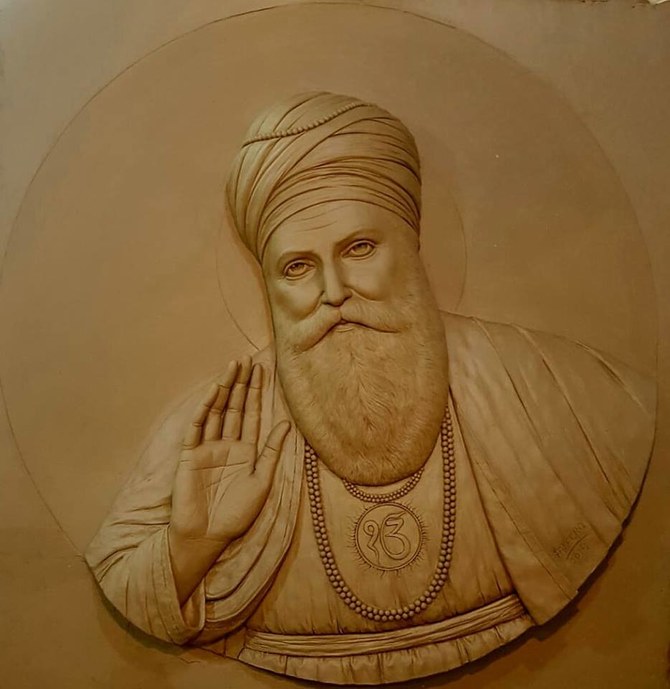
An undated picture of a portrait of Guru Nanak made by Fakeero Khemoom. (Photo courtesy: Fakeero Khemoon)
5 / 8
An undated picture of a portrait of Ernesto "Che" Guevara made by Fakeero Khemoom. (Photo courtesy: Fakeero Khemoon)
6 / 8
An undated picture of a sculpture of Hanuman by Fakeero Khemoom. (Photo courtesy: Fakeero Khemoon)
7 / 8
An undated picture of a portrait of Karl Marx made by Fakeero Khemoom. (Photo courtesy: Fakeero Khemoon)
8 / 8
An undated picture of a portrait of Buddha made by Fakeero Khemoom. (Photo courtesy: Fakeero Khemoon)
Short Url
Updated 27 April 2021
Follow

Fakeero adds Benazir Bhutto to his pool of star-studded statues

  • Fakeero has used his craft bring Martin Luther King Jr., Che Guevara, Karl Marx, Guru Nanak and other prominent personalities to life
  • The 40-year-old sculptor never went to an art school for formal education, but his work has been exhibited at various art galleries

KARACHI: Fakeero Khemoom, who belongs to a family of Hindu sculptors, took the art of his ancestors to another level in the 1990s by creating statues, busts and portraits of global personalities who he thought had left a deep imprint on human history.
By the time his clay statue of Benazir Bhutto, the first woman prime minister of the Muslim world, became popular on social media platforms, his magical hands had already created sculptures of people like Martin Luther King, Jr., John F. Kennedy, Ernesto Che Guevara, Abraham Lincoln, Guru Nanak, Vladimir Lenin, Karl Marx, Muhammad Ali Jinnah and Abdul Sattar Edhi.
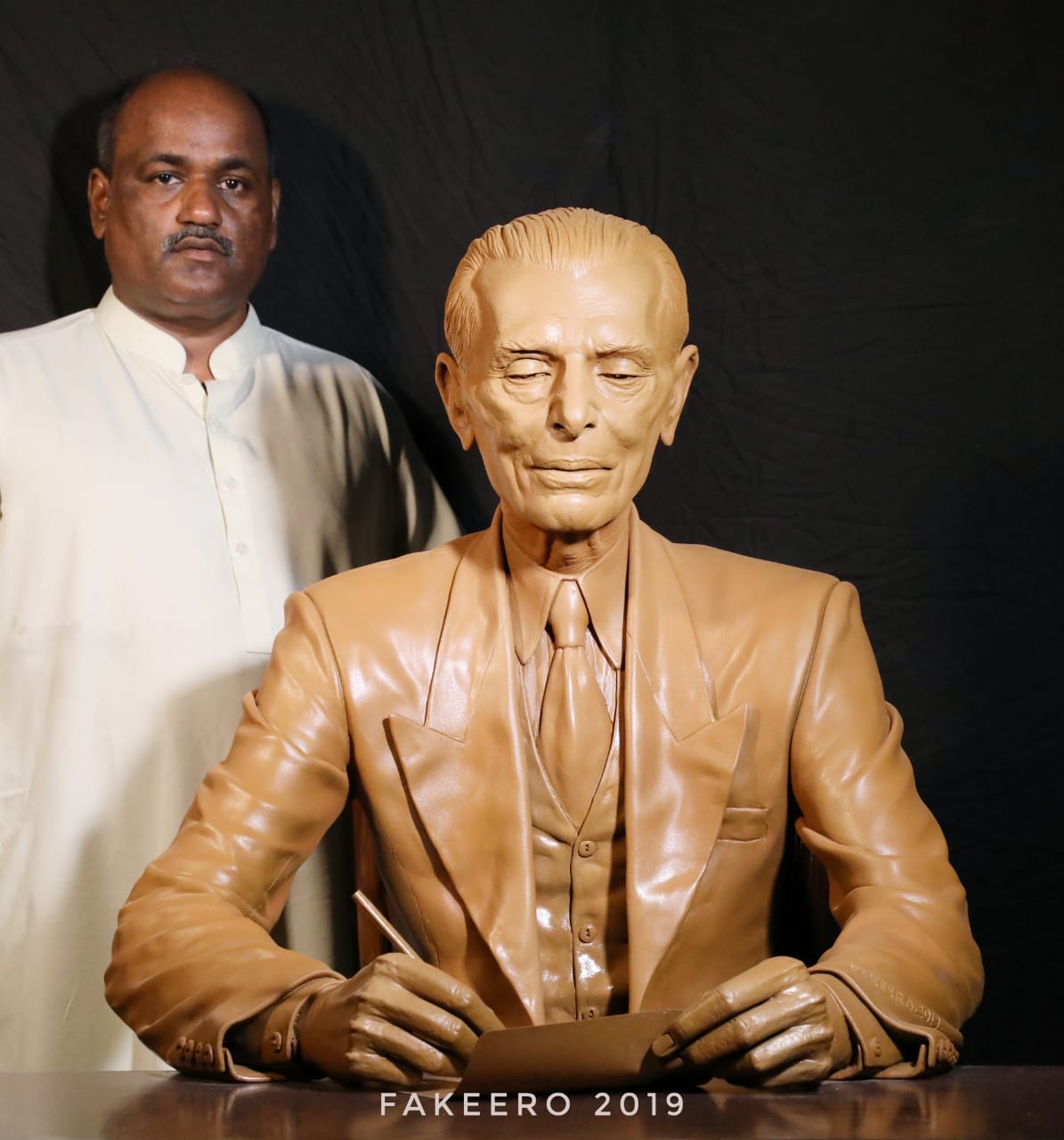


Fakeero Khemoom can be seen standing with the sculpture of Pakistan’s founder, Muhammad Ali Jinnah, in this undated photo. (Photo courtesy: Fakeero Khemoon)

“Benazir Bhutto was a great woman,” Khemoom, more popularly known as Fakeera Fakeero, said while talking to Arab News on phone from his hometown of Tando Allahyar in Pakistan’s southern Sindh province. “She became a role model for women across the world. So it was for my own happiness that I decided to build her statue.”
“I started working on [sculpture] in the middle of the last month [of June],” he continued. “It will take another month to get its final shape.”
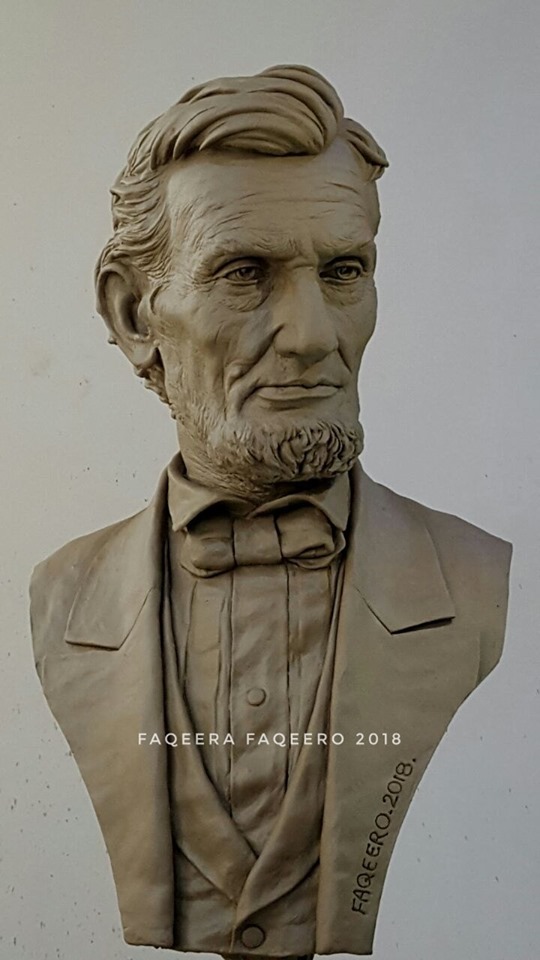


An undated picture of a portrait of Abraham Lincoln made by Fakeero Khemoom. (Photo courtesy: Fakeero Khemoon)

40-year-old Fakeero has got his skill from family elders. His grandfather, Bhekharam, made statues of Hindu gods and adorned temples before Pakistan’s independence. “It was our family art during the days of united India,” he said, adding: “I was only ten years old when I started working with my grandfather and father who were both masters at this.”
After getting his primary and intermediate education from his hometown, Fakeero decided to concentrate on his work in 1996 and gave it a new direction.
“I decided to take this art beyond religion frontiers and started making statues of famous personalities,” he said. “Art has no religion and resonates with everyone. It’s about humanity.”
Although he continues to make statues of Hindu gods with similar religious zeal as his elders, Fakeero says that Pakistan and humanity come ahead of everything else for him. It is for the same reason that he has been making sculptures of important global personalities.
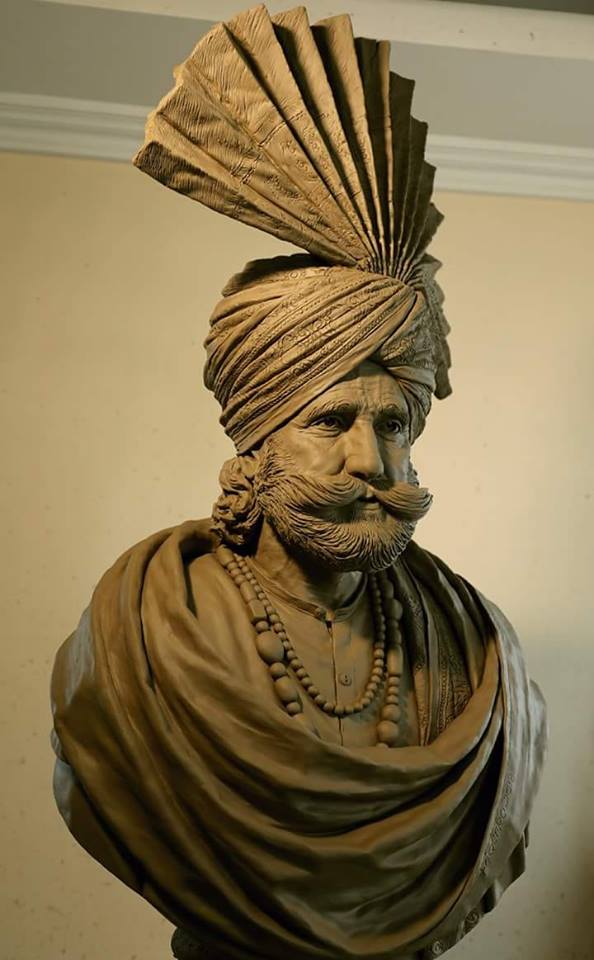


An undated picture of a sculpture of Allan Fakeer made by Fakeero Khemoom in the 1990s. (Photo courtesy: Fakeero Khemoon)

His first such creation was Allan Fakir, a Pakistani folk singer from Sindh, in the 1990s. “Since then I have created over 350 sculptures and portraits,” he said.
Fakeero has exhibited his work at several art galleries around the world. He uses materials like clay, wood, plaster of Paris, fiberglass, stone and plasticine to bring his artistic creations to life. He also holds the credit of introducing new varieties of sculptures in the country which, he says, blend Indian and European art. “To this day, I am the only one in the field who has gone for such fusion,” he said.
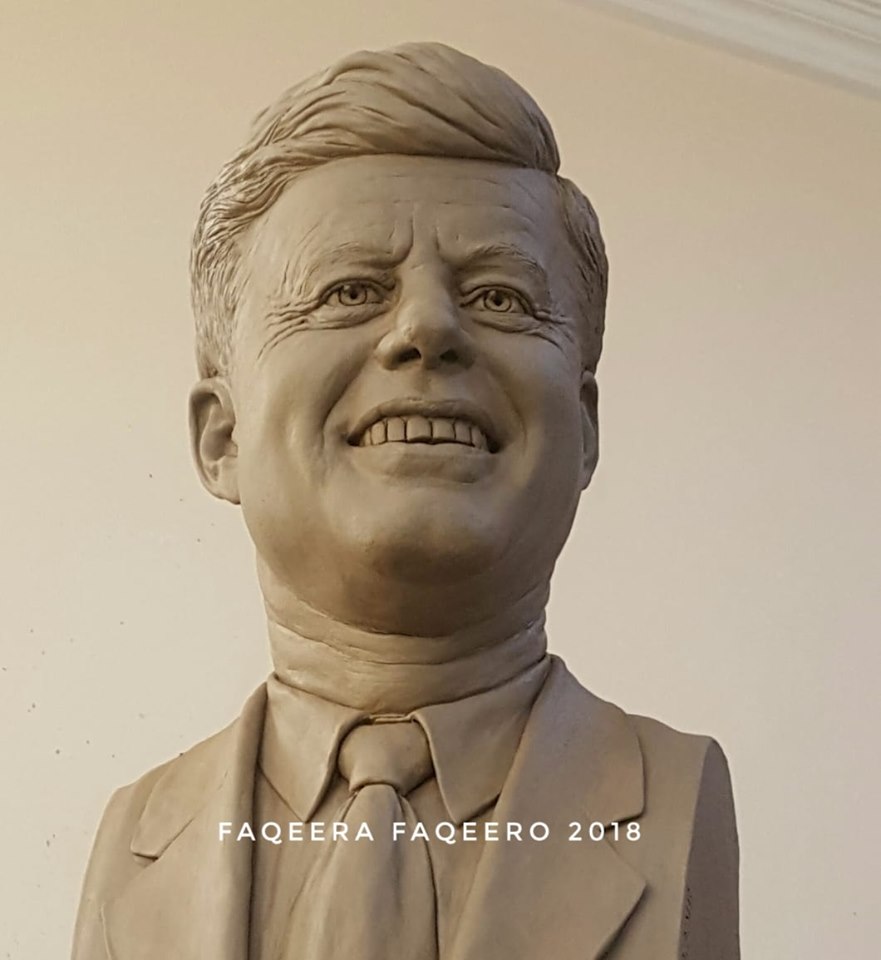


An undated picture of a sculpture of John F. Kennedy made by Fakeero Khemoom. (Photo courtesy: Fakeero Khemoon)

Fakeero could not get formal education as an artist, but he does not have any regrets.
“Many people ask me where I was trained as an artist. When I tell them that I didn’t go to an art school, they get surprised,” he smiled.
Fakeero has, nevertheless, been invited to various education institutes, such as the National College of Arts, to share his knowledge of the craft with students. While he enjoys such interactions and goes out of his way to mentor others, he constantly chalks out his own work plans as well.
“After completing Benazir Bhutto’s sculpture, I’ll make [Dr. Muhammad] Iqbal’s statue who envisioned this country,” he said.


Pakistan launches final nationwide polio drive for 2025 amid rise in global cases

Updated 11 sec ago
Follow

Pakistan launches final nationwide polio drive for 2025 amid rise in global cases

  • Global polio tracking data shows Pakistan accounted for 30 of the world’s 39 cases in 2025, with remainder in Afghanistan
  • Health authorities urge parents to cooperate with vaccination teams and ensure all children under five receive polio drops

ISLAMABAD: Pakistan will launch its final nationwide polio vaccination campaign for 2025 from tomorrow, aiming to immunize more than 45 million children under the age of five, health authorities said on Sunday, as the country remains at the center of global efforts to eradicate the disease.

Global polio tracking data shows that 30 of the 39 confirmed wild poliovirus type 1 (WPV1) cases worldwide 2025 were reported in Pakistan, with the remainder in neighboring Afghanistan.

Pakistan recorded 74 polio cases in 2024, a sharp increase from six cases in 2023 and just one case in 2021, highlighting the volatility of eradication efforts in a country where misinformation, vaccine hesitancy and security issues have repeatedly disrupted progress.

“The final national polio campaign of 2025 will formally begin across the country from tomorrow,” Pakistan’s National Emergency Operations Center (NEOC) said in a statement.

“During the campaign, polio drops will be administered to more than 45 million children nationwide,” it said, adding that the seven-day drive would run from Dec. 15 to Dec. 21.

The NEOC said more than 400,000 male and female polio workers would take part in the campaign, with vaccination targets including over 23 million children in Punjab, 10.6 million in Sindh, 7.2 million in Khyber Pakhtunkhwa, 2.6 million in Balochistan and smaller numbers in Islamabad, Gilgit-Baltistan and Azad Jammu and Kashmir.

“Protecting children from polio is a shared national responsibility,” the NEOC said. “Parents must fully cooperate with polio workers to secure the future of the nation.”

It urged families to ensure that all children under five years of age receive the required two drops of the vaccine during the campaign.

Pakistan has drastically reduced polio prevalence since the 1990s, when annual cases exceeded 20,000.

By 2018, the number had fallen to eight. But health authorities warn that without consistent access to children — particularly in high-risk and underserved regions — eradication will remain out of reach.

Violence has also hampered the program. Polio teams and their security escorts have frequently come under attack from militants in parts of northwestern Khyber Pakhtunkhwa and southwestern Balochistan.

Officials say continued security threats, along with natural disasters such as recent flooding, remain major obstacles to reaching every child.