

Ennahda’s Ghannouchi to stand for national elections in Tunisia

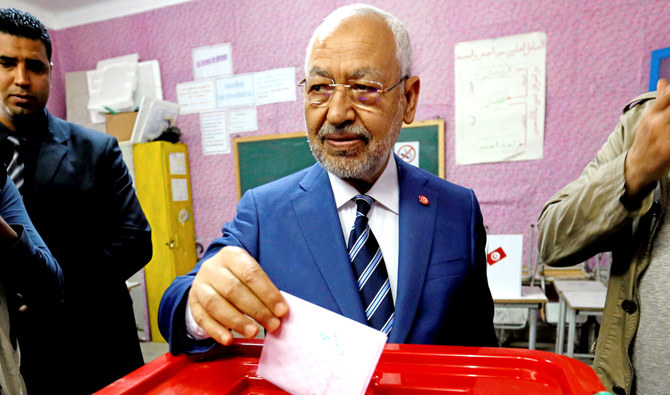
Tunisian leader Rached Ghannouchi will stand in the next parliamentary elections, which is expected to be held in October. (Reuters/File)
Updated 21 July 2019
Follow

Ennahda’s Ghannouchi to stand for national elections in Tunisia

  • The 78-year-old veteran remains a dominant figure in Tunisian politics
  • Ghannouchi’s candidacy for a parliamentary seat reinforces expectations

TUNIS: Rached Ghannouchi, the influential leader of Tunisia’s moderate Ennahda Party, will stand in the next parliamentary elections in October, a move widely seen as an attempt to seek a leadership position in the country.

Exiled in London for about two decades during the time of former President Zine El-Abidine Ben Ali, Ghannouchi has been a major force since Tunisia’s 2011 revolution, but he has never run for any official position. 

The 78-year-old remains a dominant figure who critics say effectively controls the country in tandem with the secular-minded President Beji Caid Essebsi, 92, often dubbed the “two sheikhs” in reference to their age. 

“The decision to present Ghannouchi at the top of the party’s electoral list in Tunis1, is to have leaders of parties play a more important role at this crucial stage in the history of the democratic transition in Tunisia,” Ennahda Party official Imed Khmiri told Reuters. 

Ghannouchi’s candidacy for a parliamentary seat reinforces expectations that he is seeking to play a bigger role, possibly as prime minister or speaker of Parliament, if his party wins the election. 

Parliamentary elections are expected to be held on Oct. 6 with a presidential vote following on Nov. 17. They will be the third set of polls in which Tunisians can vote freely following the 2011 revolution. 

The parliamentary race is expected to be fought closely by the Ennahda Party, the secular Tahya Tounes Party of Prime Minister Youssef Chahed, the Nidaa Tounes Party led by Hafedh Caid Essebsi, the president’s son, and the Courant Democrate party. 

Tunisia has been hailed as the only democratic success of the Arab Spring uprisings, with a new constitution, free elections and a coalition government with secular and moderate leaders in a region otherwise struggling with upheaval. 

But political progress has not been matched by economic advances. Unemployment stands at about 15 percent, up from 12 percent in 2010, due to weak growth and low investment.


Sudanese nomads trapped as war fuels banditry and ethnic splits

Updated 4 sec ago
Follow

Sudanese nomads trapped as war fuels banditry and ethnic splits

  • War disrupts nomads’ traditional routes and livelihoods
  • Nomads face threats from bandits as well as ethnic tensions
NEAR AL-OBEID: Gubara Al-Basheer and his family used ​to traverse Sudan’s desert with their camels and livestock, moving freely between markets, water sources, and green pastures. But since war erupted in 2023, he and other Arab nomads have been stuck in the desert outside the central Sudanese city of Al-Obeid, threatened by marauding bandits and ethnic tensions. The war between the Sudanese army and the paramilitary Rapid Support Forces (RSF) has left nearly 14 million people displaced, triggered rounds of ethnic bloodshed, and spread famine ‌and disease. It ‌has also upset the delicate balance of ‌land ⁠ownership ​and livestock routes ‌that had maintained the nomads’ livelihoods and wider relations in the area, local researcher Ibrahim Jumaa said. Al-Obeid is one of Sudan’s largest cities and capital of North Kordofan state, which has seen the war’s heaviest fighting in recent months. Those who spoke to Reuters from North Kordofan said they found themselves trapped as ethnic hatred, linked to the war and fueled largely online, spreads.
“We used to be ⁠able to move as we wanted. Now there is no choice and no side accepts you,” ‌al-Basheer said. “In the past there were a ‍lot of markets where we ‍could buy and sell. No one hated anyone or rejected anyone. Now ‍it’s dangerous,” he said.
RISK OF ROBBERY
As well as the encroaching war, the nomads — who Jumaa said number in the millions across Sudan — face a threat from bandits who steal livestock.
“There are so many problems now. We can’t go anywhere and if we ​try we get robbed,” said Hamid Mohamed, another shepherd confined to the outskirts of Al-Obeid. The RSF emerged from Arab militias known ⁠as the Janjaweed, which were accused of genocide in Darfur in the early 2000s. The US and rights groups have accused the RSF of committing genocide against non-Arabs in West Darfur during the current conflict, in an extension of long-running violence stemming from disputes over land. The RSF has denied responsibility for ethnically charged killings and has said those responsible for abuses will be held to account. Throughout the war the force has formed linkages with other Arab tribes, at times giving them free rein to loot and kidnap.
But some Arab tribes, and many tribesmen, have not joined the fight.
“We require a national program to counter ‌hate speech, to impose the rule of law, and to promote social reconciliation, as the war has torn the social fabric,” said Jumaa.
