

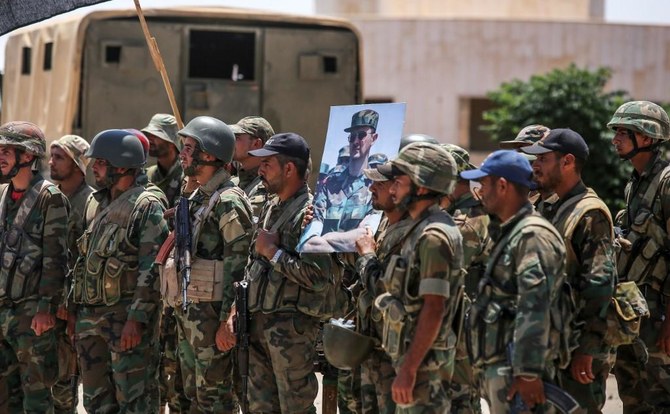

AMMAN: Russia has sent special forces in recent days to fight alongside Syrian army troops in northwestern Syria where they have been struggling for more than two months to seize the last opposition bastion, senior opposition commanders said.
Moscow, a staunch ally of Syria’s Bashar Assad, denied on Thursday that it had sent special forces to Idlib, maintaining that Russia has no ground troops in Syria.
The opposition commanders said Russian officers and troops had been behind front lines directing the operation in northern Hama and adjoining Idlib province since it began in April, using snipers and firing anti-tank missiles.
They said this was the first time Russian ground forces had joined in the battle to seize the strategic Humaymat hilltops which fell into opposition hands last week.
“These special Russian forces are now present on the battlefield. The Russians are intervening directly now,” said Capt. Naji Mustafa, spokesman for the Turkey-backed National Liberation Front (NLF) coalition of opposition factions.
“When (Syrian President Bashar) Assad’s forces failed to advance, Russia then intervened directly ... after bombing the area with more than 200 sorties,” Mustafa said.
Russia’s Defense Ministry said these were false allegations, calling them “another fake,” and repeated its official position that “There have not been and there are not now any Russian ground forces in Syria.”
“In line with the Russian-Turkish agreements of 2017 only Russian military police observations posts are located around the perimeter of the Idlib de-escalation zone which along with Turkish colleagues are monitoring the cease-fire regime,” the ministry said in a statement.
Idlib campaign crisis
More than two months of Russian-backed operations in and around Idlib province have yielded little or nothing for Russia and Assad — a rare case of a military campaign that has not gone in Russia’s favor since it intervened in the Syrian conflict in 2015.
Jamil Al-Saleh, the head of the Jaish al Izza opposition group, said Moscow’s deployment of undisclosed numbers of ground forces came only after elite Syrian troops known as the Tiger Forces and allied militias were unable to make “any significant territorial gains.”
“The Syrian army found itself in a crisis and were forced to ask for Russian troops on the battlefield,” Saleh said, adding he believed that Moscow miscalculated the strength and motivation of the opposition fighters fighting in their last remaining bastion.
“In light of the size of artillery and aerial bombing, the Russians and the regime had expected to seize large areas,” Saleh said.
Opposition fighters in northwestern Syria contacted by Reuters said supplies of weapons including guided anti-tank missiles by Turkey had not only made it a costly battle for the Russians and their allies but repelled ground assaults.
The Russian-led assault in opposition held northwestern Syria not only left dozens of villages and towns in ruins but according to the UN forced over 300,000 civilians to flee to the safety of areas closer to the Turkish border.
Another opposition official said Iranian-backed Shiite forces that had so far refrained from joining the Russian-led assault were now also entering the battlefield.
“The Iranians have brought reinforcements and are now fighting on several fronts,” said Mohammad Rashid, a spokesperson for Jaish Al-Nasr, a Turkey-backed opposition group fighting the Syrian army.


