Explosion in south Syria kills six soldiers: monitor

More than 370,000 were killed in the Syrian civil war, since it broke out in 2011. (File/AFP)
Updated 17 July 2019
Follow

Explosion in south Syria kills six soldiers: monitor

  • The attack also wounded 15 persons
  • Nobody has claimed the attack yet

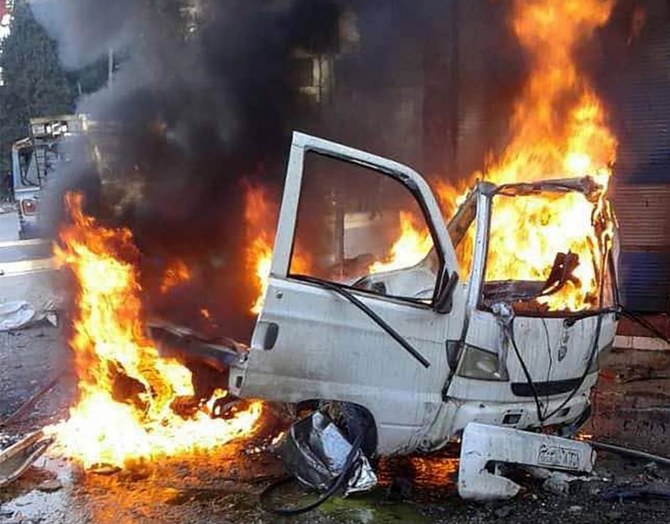
BEIRUT: A blast killed six soldiers in southern Syria Wednesday in a rare such deadly attack in the defeated cradle of the eight-year uprising, a war monitor said.
“The explosive device was aimed at a convoy transporting members of the Fourth Division” in the southern province of Daraa, the Syrian Observatory for Human Rights said.
Fifteen others were also wounded in the attack near Yadud village, some seven kilometers outside the provincial capital of Daraa city, the Britain-based monitor said.
It was not immediately clear who was behind the blast, but loyalists in the province face explosions and gunfire on a near daily basis, although they are usually not deadly, it said.
“Previous rebel fighters who call themselves the Popular Resistance usually carry out these types of attacks against the regime,” Observatory chief Rami Abdel Rahman said.
State news agency SANA said “terrorists targeted a military vehicle on the Yaduda road,” reporting an undefined number of “dead and wounded.”
Russia-backed government forces last summer retook the province, following a deadly bombardment campaign and surrender deals that saw part of the population board buses to an opposition holdout region in the northwest.
Government institutions have since returned, but army forces have not deployed in all of the province.
And local anger has grown after hundreds were detained despite the so-called “reconciliation deals,” and many others forcibly conscripted into President Bashar Assad’s army.
In March, dozens of people took part in a hasty protest against a statue of the late father of the president being reinstated eight years after protesters demolished it.
The civil war has killed more than 370,000 people since it started with anti-government protests in Damascus and Daraa in March 2011, before their brutal repression triggered conflict.


Baghdad traders protest new customs tariffs

Iraqi traders protest against the imposition of customs duties on imported goods in Baghdad, Iraq, Sunday, Feb. 8, 2026. (AP)
Updated 4 sec ago
Follow

Baghdad traders protest new customs tariffs

  • The demonstrators gathered outside the General Customs Directorate on Sunday, chanting slogans against corruption and rejecting the new fees

BAGHDAD: Hundreds of traders and owners of customs clearance companies protested in central Baghdad on Sunday, demanding that Iraq’s government reverse recently imposed customs tariffs they say have sharply increased their costs and disrupted trade.
The new tariffs that took effect on Jan. 1 were imposed to reduce the country’s debt and reliance on oil revenues, as oil prices have fallen.
Iraq faces a debt of more than 90 trillion Iraqi dinars ($69 billion) — and a state budget that remains reliant on oil for about 90 percent of revenues, despite attempts to diversify.
But traders say the new tariffs — in some cases as high as 30 percent — have placed an unfair burden on them. Opponents have filed a lawsuit aiming to reduce the decision, which Iraq’s Federal Supreme Court is set to rule on Wednesday.
The demonstrators gathered outside the General Customs Directorate on Sunday, chanting slogans against corruption and rejecting the new fees.
“We used to pay about 3 million dinars per container, but now in some cases they ask for up to 14 million,” said Haider Al-Safi, a transport and customs clearance company owner. 
“Even infant milk fees rose from about 495,000 dinars to nearly 3 million.”
He said that the new tariffs have caused a backlog of goods at the Umm Qasr port in southern Iraq and added that electric vehicles, previously exempt from customs duties, are now subject to a 15 percent fee.
“The main victim is the citizen with limited income, and government employee whose salary barely covers his daily living, those who have to pay rent, and have children with school expenses — they all will be affected by the market,” said Mohammed Samir, a wholesale trader from Baghdad.
Protesters also accused influential groups of facilitating the release of goods in exchange for lower unofficial payments, calling it widespread corruption. 
Many traders, they said, are now considering routing their imports through the Kurdistan region, where fees are lower.
The protests coincided with a nationwide strike by shop owners, who closed markets and stores in several parts of Baghdad to oppose the tariff increase. 
In major commercial districts, shops remained shut and hung up banners reading “Customs fees are killing citizens.”