MAAR SHUREEN, Syria: Regime air strikes on Tuesday killed 11 civilians in opposition-held northwest Syria, the target of months of bombardment by the government and its ally Russia, a war monitor said.
Three children were among 10 civilians killed in the village of Maar Shureen in the south of Idlib province, said the Syrian Observatory for Human Rights.
An AFP photographer said the strike hit near a mosque in the center of the village, destroying vegetable stalls and shops.
Another man was killed in regime air strikes on the northern countryside of nearby Hama province, according to the Britain-based Observatory, which relies on a network of sources inside Syria.
Russian and Syrian regime aircraft have ramped up strikes on Idlib since late April, killing more than 600 civilians, while 52 others have died from rebel fire, according to the monitor.
Government forces have also been locked in battle with extremists and allied rebels on the edges of the bastion, which is held by Syria’s former Al-Qaeda affiliate Hayat Tahrir Al-Sham, including the north of Hama province.
The group in January took full administrative control of the Idlib region, home to three million people, although other extremist groups and rebel factions are also present.
Idlib and its surrounding areas are supposed to be protected from a massive regime offensive by a September 2018 deal between Russia and rebel backer Turkey.
A buffer zone planned under that accord was never fully implemented, and the region has seen an uptick in violence.
Syria’s war has killed a total of more than 370,000 people and displaced millions since it started in 2011 with a brutal crackdown on anti-government protests.


Regime air raids kill 11 civilians in northwest Syria: monitor
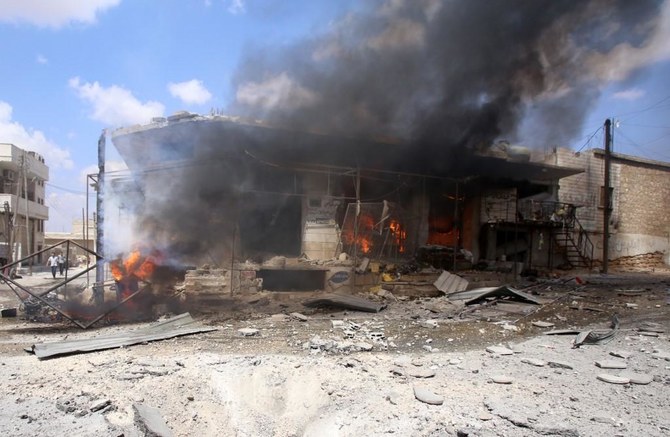
Regime air raids kill 11 civilians in northwest Syria: monitor
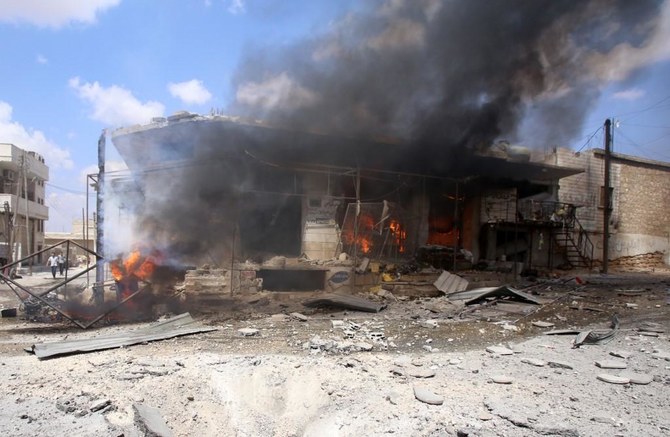
- Three children are among the dead in the airstrikes
- Syrian and Russian bombing of northwest Syria killed more than 600 civilians


Baghdad traders protest new customs tariffs
- The demonstrators gathered outside the General Customs Directorate on Sunday, chanting slogans against corruption and rejecting the new fees
BAGHDAD: Hundreds of traders and owners of customs clearance companies protested in central Baghdad on Sunday, demanding that Iraq’s government reverse recently imposed customs tariffs they say have sharply increased their costs and disrupted trade.
The new tariffs that took effect on Jan. 1 were imposed to reduce the country’s debt and reliance on oil revenues, as oil prices have fallen.
Iraq faces a debt of more than 90 trillion Iraqi dinars ($69 billion) — and a state budget that remains reliant on oil for about 90 percent of revenues, despite attempts to diversify.
But traders say the new tariffs — in some cases as high as 30 percent — have placed an unfair burden on them. Opponents have filed a lawsuit aiming to reduce the decision, which Iraq’s Federal Supreme Court is set to rule on Wednesday.
The demonstrators gathered outside the General Customs Directorate on Sunday, chanting slogans against corruption and rejecting the new fees.
“We used to pay about 3 million dinars per container, but now in some cases they ask for up to 14 million,” said Haider Al-Safi, a transport and customs clearance company owner.
“Even infant milk fees rose from about 495,000 dinars to nearly 3 million.”
He said that the new tariffs have caused a backlog of goods at the Umm Qasr port in southern Iraq and added that electric vehicles, previously exempt from customs duties, are now subject to a 15 percent fee.
“The main victim is the citizen with limited income, and government employee whose salary barely covers his daily living, those who have to pay rent, and have children with school expenses — they all will be affected by the market,” said Mohammed Samir, a wholesale trader from Baghdad.
Protesters also accused influential groups of facilitating the release of goods in exchange for lower unofficial payments, calling it widespread corruption.
Many traders, they said, are now considering routing their imports through the Kurdistan region, where fees are lower.
The protests coincided with a nationwide strike by shop owners, who closed markets and stores in several parts of Baghdad to oppose the tariff increase.
In major commercial districts, shops remained shut and hung up banners reading “Customs fees are killing citizens.”


