

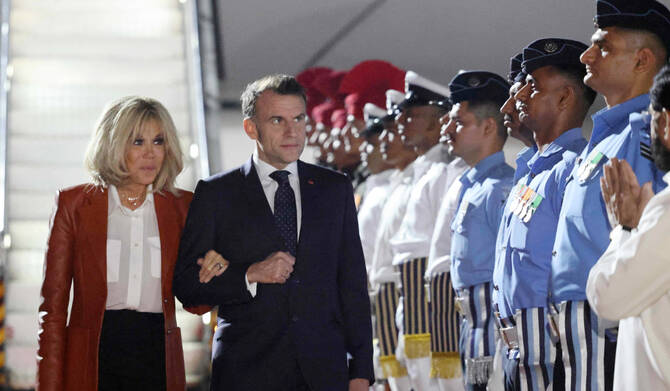

MUMBAI, India: French President Emmanuel Macron begins a three-day visit to India on Tuesday, with talks focused on artificial intelligence cooperation and a potential multibillion dollar Dassault Rafale fighter jet deal.
France is seeking to expand its military partnership with New Delhi, with discussions expected on a potential contract for 114 additional French fighter jets.
Macron and his wife Brigitte arrived around midnight on Monday in Mumbai, India’s financial capital, for his fourth visit to India since taking office in 2017.
He is scheduled to meet Prime Minister Narendra Modi later on Tuesday.
Macron will then travel to New Delhi for an artificial intelligence summit on Wednesday and Thursday.
The visit follows New Delhi’s confirmation last week that it intends to place a major order for Rafale jets, as well as the signing of a landmark free trade agreement between India and the European Union in January.
- ‘Contract of the century’ -
New Delhi has sought over the past decade to reduce its dependence on Russia, its traditional main supplier of military equipment, turning to other countries while also pushing for more domestic production.
An Indian defense ministry statement last week said the proposed purchase of Rafale jets had been cleared — with “the majority” of them to be manufactured in India.
The statement did not specify the exact number of jets New Delhi would purchase, but a New Delhi defense ministry source said that 114 was likely.
Christophe Jaffrelot, an India specialist at Sciences Po Center for International Studies in Paris, described the potential EUR30 billion ($35 billion) deal for 114 Rafales as the “contract of the century” and a potential “crowning achievement” for bilateral ties.
If finalized, the jets would add to the 36 Rafales India purchased for its air force in 2016 and 26 it has ordered for its navy.
Negotiations over the additional aircraft still need to be concluded with manufacturer Dassault Aviation, but the French presidency has voiced optimism that what it calls a “historic” agreement could be reached.
- ‘Good chemistry’ -
Modi and Macron will also inaugurate on Tuesday India’s first helicopter final assembly line via videoconference from Mumbai, a joint venture between India’s Tata Group and Airbus.
The facility in Vemagal, in the southern state of Karnataka near the tech hub of Bengaluru, will manufacture the Airbus H125, the company’s best-selling single-engine helicopter.
France has emerged as one of India’s most important defense and economic partners in the last decade.
“Through this visit, we seek to further strengthen cooperation” with India, and to “diversify” France’s economic and trade partnerships, Macron’s office said.
India, the world’s most populous country with 1.4 billion people, is on track to become the fourth-largest economy globally.
This week’s talks are also expected to address global economic uncertainty triggered by tariff policies under US President Donald Trump, as well as China’s influence in the region.
Modi’s office said discussions would focus on “cementing the strategic partnership and further diversifying it into new and emerging areas.”
Bilateral trade between France and India, driven largely by defense and aerospace — India’s commercial fleet includes a substantial number of Airbus aircraft — stands at around EUR15 billion ($18 billion) annually.
French foreign direct investment in India totals nearly EUR13 billion ($15 billion).
The two leaders will also be keen to nurture close personal ties.
“There is apparently a good chemistry, a good personal rapport,” Jaffrelot said.
One sensitive issue remains Ukraine: India has not condemned Russia’s 2022 invasion and has continued buying oil from Moscow.
US President Donald Trump has said India had committed to halting the purchases, though that has not been formally confirmed by New Delhi.
“If the Indians stop buying Russian oil, they won’t be blamed for abstaining at the UN,” Jaffrelot added.


